
 Iffa Jayyana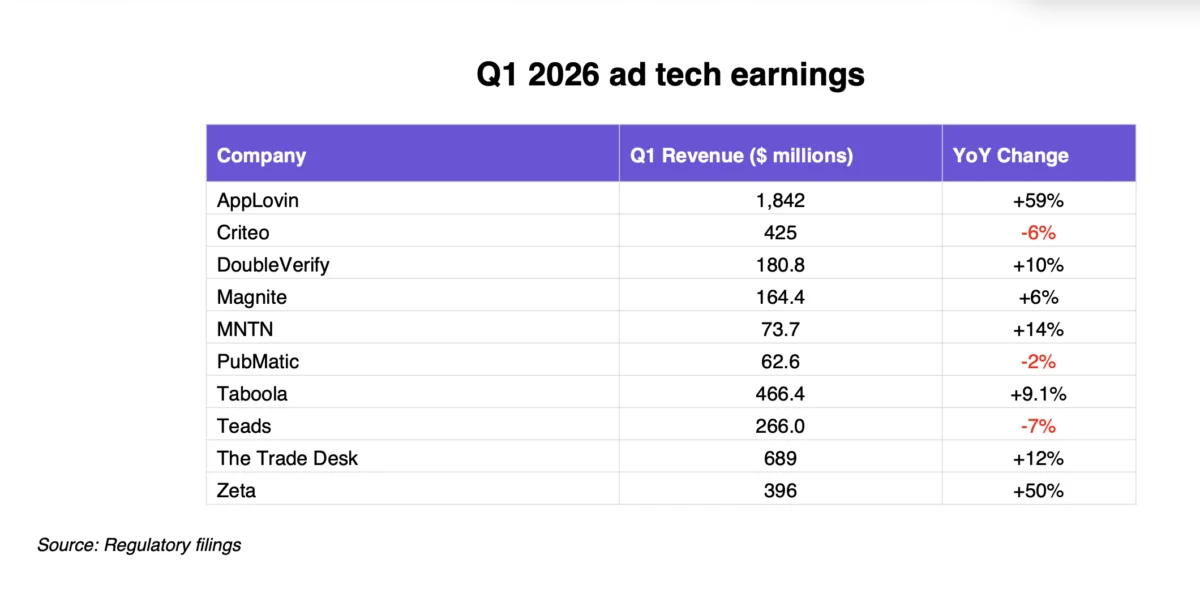
By Ronan Shields | May 7, 2026
The Trade Desk (TTD), the titan of the demand-side platform (DSP) landscape, has reported robust first-quarter 2026 revenues of $689 million. While the figures suggest that the company remains in a period of sustained growth, the underlying narrative is far more complex. The company is currently balancing a high-profile executive departure, deepening friction with traditional advertising holding companies, and a strategic ideological crusade against the "cheap reach" promises of walled gardens.
As the industry digests a flurry of Q1 earnings reports from across the programmatic ecosystem, The Trade Desk’s performance serves as a bellwether for the health of digital advertising. Yet, the confluence of internal turnover and external market pressure suggests that the company’s "changing of the guard" is happening at a pivotal, perhaps volatile, juncture.
Main Facts: A Strong Quarter Amidst Internal Turbulence
The Trade Desk’s financial health appears resilient. Posting $689 million in revenue for Q1 2026, the company continues to benefit from its dominant position in Connected TV (CTV), retail media, and data-driven programmatic buying. The company’s outlook remains optimistic, with a guidance of "at least $750 million" for Q2.
However, the financial narrative was interrupted by a significant personnel shift. Just hours before the market disclosure, it was confirmed that Chief Strategy Officer (CSO) Samantha Jacobson—a cornerstone of the company’s strategic partnerships for the past five years—would be departing for OpenAI. While Jacobson will retain a seat on The Trade Desk’s board of directors, her exit follows a recent wave of departures among senior leadership, including the company’s CMO. CEO Jeff Green has framed these exits as a natural "changing of the guard," but industry observers are watching closely to see how the loss of such a key architect of the company’s partnership ecosystem will impact future strategic direction.
Chronology: A Week of Market Disclosure
The week surrounding May 7, 2026, was a microcosm of the current state of ad-tech. As leading publicly traded entities released their Q1 results, the data painted a picture of an industry attempting to navigate macroeconomic headwinds while pivoting toward more sophisticated, data-rich advertising models.
- Pre-Market Announcement: The Trade Desk confirms the departure of CSO Samantha Jacobson to OpenAI.
- Earnings Call (May 7): CEO Jeff Green unveils Q1 revenue of $689 million.
- Competitive Context: The announcement arrives alongside reports from supply-side peers like PubMatic, who reported $62.6 million in revenue, highlighting the disparate scales of the players within the programmatic supply chain.
- Strategic Pivot: The company highlights its recent integrations with major retail and media players—including Dollar General, LinkedIn, Netflix, and PacVue—and the scaling of its "Koa" platform’s agentic planning tools.
Supporting Data: The JBP Strategy and Customer Retention
At the heart of The Trade Desk’s growth strategy are Joint Business Plans (JBPs). These direct-to-brand agreements have become a lightning rod for controversy. According to Jeff Green, the company saw a 40% year-over-year growth in new JBP spend during the quarter, with 45 new signings recorded in March alone—the company’s most successful month to date.
The company maintains a high customer retention rate of over 95%. This metric is frequently cited by leadership as evidence that, despite reported "spats" with major holding companies, the core value proposition of the platform remains intact. For the brands themselves, the JBP offers a direct pipeline to the DSP, bypassing some of the traditional friction associated with agency-led programmatic trading.
Official Responses: Tensions and "Overblown" Narratives
During the earnings call, Jeff Green addressed the elephant in the room: the cooling relationship between The Trade Desk and some of the world’s largest media-buying holding groups. Reports have suggested that the push for direct brand relationships has unsettled the agency ecosystem, leading to friction in contractual negotiations.
Green was dismissive of the media coverage surrounding these tensions. When pressed by analysts, he maintained that the dialogue with major partners, such as Publicis, remains constructive. "We continue to have great dialogue with Publicis about the next chapter of our partnership. Our negotiations are ongoing; it’s probably not prudent for me to say more about it in this forum," Green noted.

Regarding the Q2 revenue forecast—which some analysts labeled a "revenue deceleration"—the company cited macroeconomic fluctuations rather than internal conflicts as the primary driver for conservative guidance. "Macroeconomic environments are creating unique challenges for the market overall," the leadership team emphasized, distancing the revenue outlook from the political maneuvering with agencies.
Implications: The War on "Cheap Reach"
Perhaps the most aggressive stance taken by Jeff Green during the Q1 earnings presentation was his critique of the "walled garden" approach to advertising—specifically targeting Amazon. Green argued that the industry’s obsession with "cheap reach" is a fundamental error that compromises long-term growth for short-term cost savings.
Quality Over Cost
Green’s argument is built on a simple premise: quality advertising inventory is not cheap. By positioning The Trade Desk as the "quality" alternative to the low-cost inventory often touted by e-commerce giants, Green is attempting to reframe the conversation for CMOs.
"The best CMOs in the world are focused on the question: ‘How do I grow?’ Not, ‘How do I cut costs?’" Green stated. "They know that quality and cheap tend to have very little overlap. Chasing cheap reach is one of the biggest landmines a CMO or digital marketer can pursue."
Case Study: The Pharma Bake-Off
To illustrate this, Green cited a recent competitive battle for a major pharmaceutical advertiser. According to Green, the client had been "lured by seemingly low rates" offered by Amazon’s DSP. The shift in spend, however, did not yield the desired results, leading the client to return to The Trade Desk. The company not only won the business back but secured a 2026 JBP that increases the client’s spend on their platform by 114% year-over-year.
This anecdote serves a dual purpose: it validates the efficacy of The Trade Desk’s platform while casting doubt on the long-term viability of competitors who rely on aggressive, low-cost pricing models.
Future Outlook: A Changing Landscape
As The Trade Desk looks toward the second half of 2026, the company stands at a crossroads. The transition of leadership—marked by the loss of Samantha Jacobson—will test the company’s depth of talent. Simultaneously, the success of their "direct-to-brand" strategy will dictate how much further they can push their boundaries with holding companies.
The industry is watching to see if the "changing of the guard" will result in a shift in strategy, or if the departure of high-level executives is simply the byproduct of a company reaching a new level of scale. As AI-driven tools like the Koa platform become more integrated into the daily workflow of media buyers, The Trade Desk’s ability to remain the preferred partner for brands—while navigating the sensitivities of the agencies that manage them—will be the defining story of the year.
For now, the numbers are strong, the rhetoric is defiant, and the battle for the future of digital advertising is clearly centered on the question of whether quality can continue to command a premium in a world obsessed with efficiency. The Trade Desk is betting that it can, provided they can keep their internal house in order while facing down the giants of the walled garden.


 Azzam Bilal Chamdy
 Sagoh
Sagoh





