

Introduction: A Dialogue with the Concrete
In the heart of Manhattan, PPOW Gallery has unveiled an exhibition that serves as both a retrospective of a legendary career and a vibrant, living installation. Orchid Rain on the Underground, the third solo exhibition by the seminal artist Chris “Daze” Ellis, is a sprawling exploration of the grit, glamour, and transformative energy that defined New York City in the late 20th century. Running through April 25, 2026, the exhibition presents a multifaceted look at the evolution of graffiti as a fine art form, seamlessly weaving together the spontaneity of spray paint with the meticulous discipline of studio practice.
For Daze, whose career began in the subterranean arteries of the NYC subway system during the 1970s, this show is not merely an exercise in nostalgia. It is an active reclamation of the city’s creative spirit. By juxtaposing new series of paintings, multimedia installations, and a sprawling site-specific mural, Daze argues that the “bygone era” of his youth remains a foundational pillar for the contemporary urban experience.
The Chronology of a Creative Force: From Subway Cars to Studio Walls
To understand the significance of Orchid Rain on the Underground, one must look back to the formative years of Chris Ellis. Born in Brooklyn in 1962, Daze emerged at a pivotal moment in American art history. While attending the prestigious High School of Art and Design in the mid-1970s, he found himself surrounded by the burgeoning graffiti movement. Influenced by legends such as Blade, Lee Quiñones, and PHASE 2, Daze began to view the city’s subway system not just as public transport, but as the world’s most expansive, democratic canvas.
The Midnight Transformation
By the late 1970s, Daze had established himself as a fixture in the underground scene. However, his ambitions quickly outgrew the transient nature of train cars. As the 1980s dawned, Daze made a conscious transition from the exterior world of tagging to the controlled, deliberate environment of the studio. This period saw him frequenting the “nerve centers” of downtown Manhattan—the Lit Lounge, Danceteria, and the Mudd Club. These spaces were more than just nightclubs; they were hothouses of interdisciplinary experimentation where painters, musicians, poets, and performers collided.
This period serves as the bedrock of Daze’s artistic identity. He absorbed the raw, unfiltered energy of the nightlife scene and translated it into a sophisticated visual language. Today, nearly five decades later, that transition is complete; Daze has successfully navigated the shift from an outlaw graffiti writer to a blue-chip gallery artist without sacrificing the soul of his beginnings.
Supporting Data: The Synthesis of Styles
The technical mastery on display in Orchid Rain on the Underground reveals an artist who is as much a scholar of art history as he is a pioneer of street culture. Daze’s practice is defined by a unique synthesis of conflicting influences.
The Ashcan Realists Meets Lyrical Abstraction
One of the most striking aspects of the exhibition is Daze’s deep respect for early 20th-century urban realists. He cites the Ashcan School’s John Sloan and the WPA-era painter Reginald Marsh as primary influences. Like them, Daze treats the streets, tunnels, and stations of New York as sacred, vital sites of human drama.
Yet, this grounded realism is balanced by a fierce commitment to abstract expressionism. His canvases often feature sweeping, gestural strokes of acrylic paint—reminiscent of the lyrical abstraction practiced by Joan Mitchell and Willem de Kooning. By layering these ethereal, abstract backgrounds with precise, detailed renderings of architectural elements like subway tunnels and train interiors, Daze creates a tension between the physical city and the emotional impression it leaves behind.
The Gem Spa Narrative
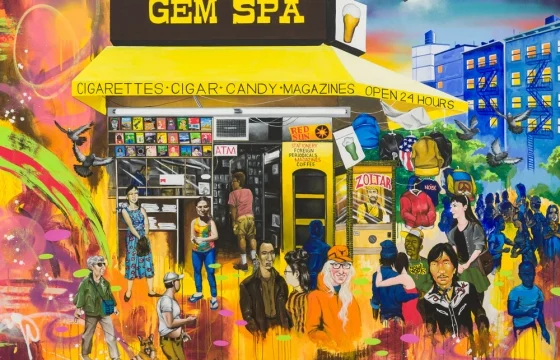
The centerpiece of the exhibition, Gem Spa In the 80s (2025), is a masterpiece of cultural documentation. The painting depicts the legendary St. Mark’s Place newspaper stand and candy store, a site once described by Allen Ginsberg as the “nerve center” of the city. In Daze’s rendering, the stand is not just a commercial space but a crossroads of history. Careful observers will notice figures from the artist’s own inner circle emerging from the crowd, including the late, great artist Martin Wong and the influential critic and curator Carlo McCormick. It is a work that functions as both a historical record and a personal memorial.
Multimedia Installations: The Immersive Experience
Perhaps the most ambitious component of the exhibition is its move away from two-dimensional art into the realm of total immersion. Daze has transformed a portion of the gallery into a multi-sensory environment that replicates the atmosphere of his formative years.
A Sensory Time Machine
Upon walking through the site-specific mural—which brings the ephemeral energy of outdoor graffiti into the sterile, white-walled gallery—viewers are funneled into a final room. This space is a composite scene of a 1980s New York club. Featuring authentic salvaged subway car seats, a pulsing light-up dance floor, and a curated soundscape of house, disco, and early hip-hop, the installation is a poignant homage to the freedom that once defined the NYC nightlife scene.
The inclusion of these artifacts serves a specific purpose: it highlights the symbiotic relationship between Daze’s visual art and the musical landscape of the city. For Daze, the creative inspiration he found in these venues was the fuel that sustained his studio practice. By recreating this environment, he allows a new generation to step into the world that fostered his artistic growth, bridging the gap between historical memory and contemporary experience.
Implications: The Enduring Legacy of Urban Resilience
Orchid Rain on the Underground is a powerful statement on the persistence of beauty in the face of decay. Throughout the exhibition, a recurring motif—technicolor flowers blooming amidst heaps of urban rubble—serves as a metaphor for the city itself.
Hope Amidst Inequality
Daze’s juxtaposition of delicate tropical flora and robust, local upstate New York wildflowers with images of urban destruction creates a complex narrative. It suggests that even in a city marked by rapid gentrification, socio-economic inequality, and the loss of historical landmarks, there remains a persistent capacity for beauty and renewal.
The exhibition does not mourn the city that was, nor does it ignore the city that is. Instead, it posits that the “creative spirit” of New York—the very thing that defined the 1970s and 80s—is a regenerative resource. By revitalizing the foundational energy of the graffiti movement and applying it to his current, more mature practice, Daze affirms that the influence of those early street artists is still pulsing through the streets of New York today.
Conclusion: The Cultural Heartbeat
As the exhibition title suggests, there is an "orchid rain"—a sense of fragile, exotic beauty falling over the gritty "underground" of the city. Daze’s work acts as a bridge, connecting the raw, illicit thrill of his early career with the contemplative, intellectual rigor of his current status as a veteran artist.
PPOW’s presentation of Orchid Rain on the Underground is more than an art show; it is an act of cultural preservation. It reminds us that the people, places, and movements that comprise New York’s cultural heartbeat are never truly gone as long as they are remembered, analyzed, and reimagined. Through this exhibition, Chris “Daze” Ellis proves that he is not just a chronicler of New York history, but an architect of its future. Whether through a spray-painted mural or a detailed study of a lost storefront, Daze continues to find the extraordinary in the everyday, ensuring that the legacy of his generation remains relevant, resonant, and remarkably alive.










No comments yet. Be the first to join the conversation!