

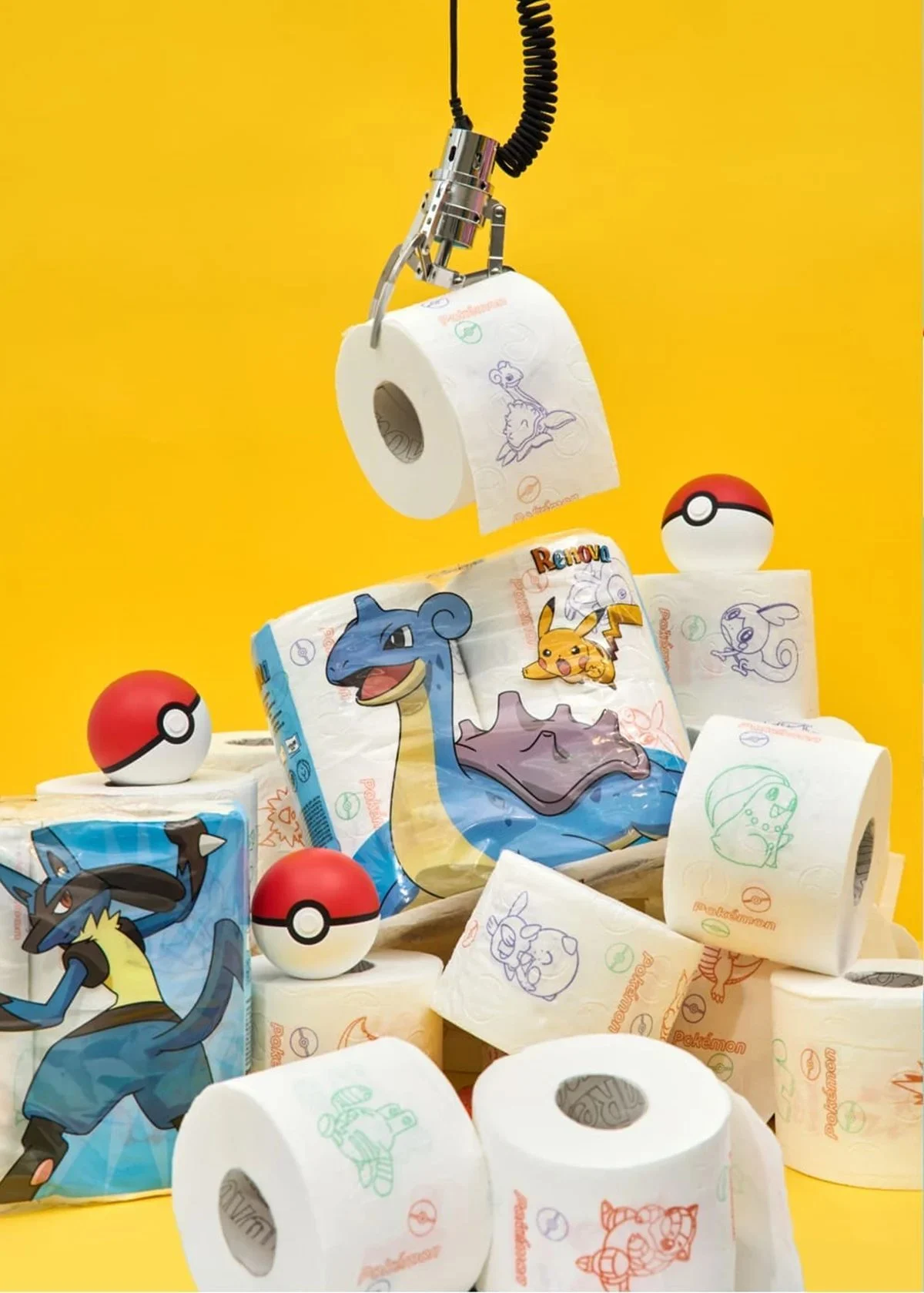
Whether you are a lifelong devotee of the Pokémon franchise or someone who has grown weary of seeing the electric mouse plastered on everything from breakfast cereals to luxury jewelry, a new development from South Korea is bound to pique your interest. The tissue brand Renova has officially launched a Pokémon-themed line of bathroom products, turning everyday hygiene into a collectible experience. With 79 unique character designs spanning multiple generations of the franchise, this collaboration represents perhaps the most intimate—and arguably the most bizarre—merchandise pivot in the history of the world’s highest-grossing media IP.
The Core of the Collaboration: Bringing Pokémon into the Bathroom
The launch, which debuted via a South Korean crowdfunding platform, features more than just standard rolls of toilet paper. The expansive collection includes pocket tissues, decorative tissue boxes, and paper napkins, all adorned with iconic creatures from the Kanto region and beyond.
For the dedicated collector, this is a "must-have" novelty item. For the casual observer, it is a head-scratching addition to a market already saturated with Pokémon goods. However, the design choice is deliberate: by placing characters like Pikachu, Charmander, Chikorita, and the legendary Rayquaza onto everyday household consumables, Renova is banking on the "fanatic" factor. Fans are not just buying toilet paper; they are participating in a scavenger hunt of sorts, hoping to secure their favorite pocket monsters in a format that, until now, seemed entirely off-limits for brand licensing.
A Brief Chronology of Pokémon’s Commercial Expansion
To understand how we arrived at Pokémon toilet paper, one must look at the trajectory of The Pokémon Company’s licensing strategy over the past three decades.
The Early Years (1996–2005)
Initially, the focus was squarely on the core pillars of the franchise: video games, the trading card game (TCG), and the anime series. Merchandising during this era was largely restricted to action figures, plushies, and school supplies. The goal was to build a cultural identity, focusing on the "Gotta Catch ‘Em All" ethos.
The Lifestyle Integration (2006–2015)
As the original generation of players matured into adulthood, the licensing strategy shifted. Pokémon began appearing on high-end apparel, limited-edition sneakers, and home decor. This was the transition phase where the brand began to occupy the living room and the closet, rather than just the toy box.
The Ubiquity Era (2016–Present)
Following the explosive global success of Pokémon GO, the brand entered a state of absolute saturation. We saw the rise of Pokémon-themed fine jewelry, high-end wedding rings, and gourmet mineral water. The partnership with Renova represents the current peak of this phase: the brand is no longer just a hobby or a fashion statement; it is a fundamental part of the household infrastructure.

Supporting Data: The Economic Engine of the Pocket Monster Empire
The sheer scale of the Pokémon brand is difficult to comprehend. Recent data confirms that Pokémon remains the highest-grossing media franchise in human history. Over the last 30 years, the IP has generated over $15 billion in cumulative revenue, a figure that dwarfs legendary intellectual properties like Mickey Mouse, Winnie the Pooh, and the Harry Potter series.
To put the financial dominance of Pokémon into perspective, it has out-earned the Star Wars franchise by over $60 billion in total lifetime revenue. While Disney often relies on the strength of its cinematic universe and theme park dominance, The Pokémon Company’s strategy is rooted in "Micro-Licensing"—the practice of allowing their imagery to be used on thousands of diverse products simultaneously. By placing their characters on low-cost, high-turnover items like toilet paper, they ensure that the brand remains visible in every room of the consumer’s home, 365 days a year.
Official Responses and Market Availability
Currently, the Renova Pokémon collection is exclusive to the South Korean market. The launch, facilitated through a local crowdfunding site, was met with immediate, high-volume interest from collectors.
While there has been no official word from The Pokémon Company regarding a wider rollout to European or North American markets, the "gray market" has already begun to react. Savvy resellers have listed these items on platforms like eBay, with starting bids reaching as high as $100 for a limited set. This price gouging highlights the extreme demand for "regional exclusives" within the Pokémon community, where completionism drives fans to pay astronomical prices for items that, under normal circumstances, would cost a few dollars.
In response to the absurdity of the product, consumer analysts suggest that this is a classic case of "brand elasticity." When a brand becomes as culturally ingrained as Pokémon, the rules of conventional marketing no longer apply. A company can effectively slap a Pikachu face on a brick of coal or a roll of toilet paper, and the strength of the brand loyalty will ensure that it sells.
The Implications: Is There a Ceiling to Brand Licensing?
The arrival of Pokémon toilet paper raises a legitimate question: where does it stop? If the most valuable IP in the world can successfully market hygiene products, what is next?
The "Star Wars" Comparison
The article’s earlier jab at Disney—suggesting that if Lucasfilm produced Star Wars toilet paper, they might finally close the $60 billion gap with Pokémon—is, of course, a joke, but it highlights a deeper reality. Disney is often protective of its brand image, maintaining a "prestige" aura around Star Wars and Marvel. The Pokémon Company, conversely, has embraced the "anything goes" approach. By allowing their characters to be associated with every facet of human existence, they have successfully lowered the barrier to entry for new generations of fans.

Cultural Normalization
The primary implication of this move is the total normalization of the brand. When a child grows up seeing Pokémon on their bedroom walls, their clothes, their school supplies, and now their bathroom tissue, the franchise becomes a permanent fixture of their subconscious. It is no longer "just a game"; it is an environment.
The Risk of Over-Saturation
However, there is a risk. Critics argue that aggressive licensing can lead to "brand fatigue." If the market is flooded with low-quality or nonsensical items, the perceived value of the core product—the games and the cards—could potentially diminish. Yet, for 30 years, Pokémon has defied this logic. Every time analysts predict a bubble burst, the franchise reinvents itself with a new generation of creatures and a new category of consumer goods.
Conclusion: A Wiping Success?
Whether you view the Renova collaboration as a stroke of marketing genius or a sign of the late-stage commodification of childhood nostalgia, it is undeniably a testament to the power of the Pokémon brand. As it stands, the world is not just playing Pokémon; it is living with it.
If you are a fan who absolutely must have the full set of 79 character-themed rolls, you may want to keep a close eye on import sites or prepare to pay a premium on the secondary market. For the rest of the world, this serves as a fascinating reminder that in the battle for global market dominance, even the most mundane household products can become a battlefield for a multi-billion dollar empire.
One thing is certain: as Pokémon moves toward its next decade of dominance, the line between "collectible merchandise" and "essential household item" will continue to blur. And if the history of this franchise is any indicator, we are likely only at the beginning of the "anything goes" era of Pokémon branding. Whether you are ready for it or not, the world is becoming a Pokémon world, one sheet at a time.










No comments yet. Be the first to join the conversation!