

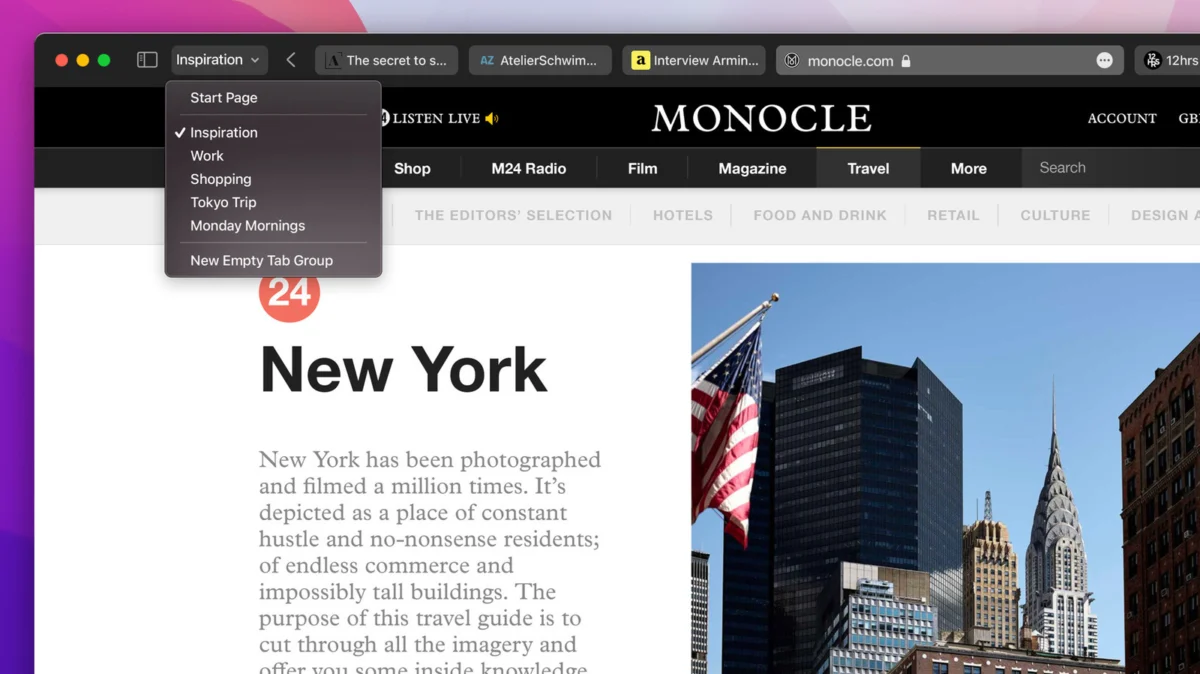
For the modern digital professional, the web browser has become a surrogate brain. It is where we research, work, communicate, and occasionally lose ourselves in an endless stream of open tabs. For those who habitually keep hundreds of Safari tabs active—a digital hoard that slows down devices and fractures focus—Apple is reportedly preparing a solution. According to reports from Bloomberg’s Mark Gurman, the Cupertino-based tech giant is developing a feature internally titled "Organize Tabs," slated for a grand debut in the upcoming iOS 27, iPadOS 27, and macOS 27 software suites.
While Apple has long been criticized for its measured, sometimes sluggish, approach to integrating generative artificial intelligence into its ecosystem, this development signals a strategic pivot toward proactive utility. By automating the categorization of browser clutter, Apple aims to refine the Safari experience, bringing it into parity with competitors while maintaining its hallmark emphasis on privacy and user agency.
The Core Innovation: What We Know About "Organize Tabs"
At its simplest, the "Organize Tabs" feature is designed to perform the tedious work of digital housekeeping that most users perpetually defer. Instead of manually dragging tabs into groups or bookmarking pages to close them, Safari will utilize on-device intelligence to analyze the content and context of open web pages. It will then categorize them into logical buckets—such as "Work," "Shopping," "Research," or "Travel"—effectively turning a chaotic, horizontal list of hundreds of icons into a clean, hierarchical structure.
What is perhaps most intriguing about the reports is the branding strategy. While the underlying technology is undoubtedly a product of machine learning and generative modeling, Gurman notes that Apple does not intend to market this as part of its "Apple Intelligence" suite. This decision likely stems from a desire to position the feature as a fundamental utility rather than a "gimmick" or a flashy AI play. By decoupling the feature from the marketing hype surrounding its premium AI services, Apple may be attempting to emphasize that this is a core improvement to the browser’s functionality rather than a third-party integrated service.
Users will reportedly retain granular control. The feature is expected to be togglable, allowing those who prefer a manual workflow to bypass automation entirely. This aligns with Apple’s longstanding philosophy of providing sophisticated tools without forcing an automated workflow upon users who value manual precision.
A Chronology of Browser Evolution
To understand the significance of this update, one must look at the history of tab management in the Safari ecosystem.
The Pre-Group Era (2003–2021)
For nearly two decades, Safari’s approach to tab management was strictly linear. Tabs were simply individual windows in a stack. As the web became more complex and users began relying on the browser as their primary workspace, the "hundred-tab problem" emerged as a major point of user frustration, leading to significant memory strain on MacBooks and iPads.
The Introduction of Tab Groups (2021)
In 2021, with the launch of Safari 15, Apple introduced "Tab Groups." This was a significant leap forward, allowing users to save and organize sets of tabs into folders that synced across iCloud. While this solved the storage problem, it required significant manual input. Users had to create the group, name it, and move the tabs themselves. It was an organizational tool, but not an intelligent one.
The Rise of the AI Competitors (2024–2025)
In January 2024, Google fundamentally changed the expectations for browser management by introducing "Organize Similar Tabs" in Chrome. Leveraging generative AI, Chrome offered to automatically group tabs based on topic, providing a "one-click" cleanup solution. This put immense pressure on Apple. For years, Apple had been viewed as a laggard in the AI race, often relying on small, behind-the-scenes machine learning improvements rather than the flashy LLM-powered interfaces favored by Google, Microsoft, and OpenAI.
The WWDC 2026 Horizon
We are currently awaiting the official unveiling of these changes at the Worldwide Developers Conference (WWDC) 2026, scheduled for June 8. Industry insiders expect the announcement to serve as a cornerstone of the broader iOS 27 presentation, showcasing how Apple intends to integrate smarter, context-aware features into its core applications.
Supporting Data: The Case for Browser Optimization
The necessity for such a feature is backed by data regarding memory consumption and user productivity. Modern web pages are heavier than ever; a single tab can consume hundreds of megabytes of RAM. When a user has 200 tabs open, the browser essentially becomes the largest consumer of system resources, often leading to reduced battery life and sluggish system performance.
Studies on "digital hoarding"—a psychological phenomenon where users feel compelled to keep browser tabs open for fear of losing information—show that excessive tabs are a leading cause of cognitive load. By providing an automated way to organize these tabs, Apple is not just optimizing system performance; they are theoretically reducing the "background anxiety" associated with digital clutter.
Furthermore, browser telemetry data from the last three years suggests that the majority of users who adopt "Tab Groups" do so within the first week of a new macOS update, but usage drops off significantly after one month because the manual maintenance of these groups becomes burdensome. An automated, AI-driven solution addresses this "maintenance fatigue," likely increasing the long-term adoption rate of organization features by a significant margin.
Official Responses and Industry Perspectives
While Apple has maintained its characteristic silence regarding unannounced products, industry analysts have been vocal about the implications of the move.
"Apple is playing a long game," says tech analyst Sarah Jenkins. "They aren’t interested in being the first to announce an AI tool. They are interested in being the company that makes the tool usable for the average person. By not labeling this as ‘Apple Intelligence,’ they are stripping away the buzzword and focusing on the utility. It’s a very Apple way of acknowledging that AI is now just a component of software, not a product in itself."
Competitors, particularly Google and Microsoft, have been pushing the narrative that the browser is the "new operating system." By embedding Gemini and Copilot directly into Chrome and Edge, these companies have turned browsers into personal assistants. Apple’s move to "Organize Tabs" represents a defensive fortification; they are ensuring that Safari remains the most efficient, battery-friendly, and streamlined choice for their user base, preventing a mass exodus of power users to Chrome or Arc—browsers that have already successfully marketed themselves on the promise of better tab management.
Implications for the Future of Safari
The introduction of "Organize Tabs" is a precursor to a larger shift in how Apple treats the web. If the feature proves successful, we can expect to see similar AI-driven management tools arrive for other aspects of the OS, such as file management in Finder or message threads in Mail.
1. Privacy-First AI
The primary challenge for Apple will be demonstrating that this organization happens locally. Unlike Google, which processes much of its tab-clustering data in the cloud, Apple is expected to leverage its Neural Engine to keep this categorization on-device. This is a key selling point for their enterprise and privacy-conscious users.
2. The End of the "Manual Era"
The success of this feature would mark the end of the "manual era" of digital organization. If users can trust their browser to sort their thoughts, the next logical step is AI that suggests which tabs to close based on inactivity or relevance. We are moving toward a browser that is not just a viewer for the web, but a curator.
3. Impact on Web Development
Developers will also need to take note. If Safari begins grouping tabs based on content, sites that provide clear metadata, clean structures, and descriptive titles will be more easily sorted and surfaced by the AI. This could potentially lead to a new form of "browser-optimization" (BO), where web developers structure their sites to be more "digestible" by these new, intelligent browser agents.
Conclusion: A Measured Step Forward
As we approach WWDC 2026, the tech world’s eyes are on Cupertino. The "Organize Tabs" feature for Safari might seem like a minor quality-of-life update, but it is representative of a much larger transition. Apple is successfully transitioning from an era of manual, user-defined interfaces to one of "anticipatory computing."
By automating the mundane, Apple hopes to free its users to focus on what matters: the content itself, rather than the vessel containing it. Whether or not this feature will be enough to quell the criticism regarding Apple’s AI speed remains to be seen, but for the millions of users currently staring at a row of 100 tiny, indistinguishable favicons, it is a welcome, necessary, and long-overdue evolution. As the browser continues to function as our primary gateway to the digital world, the ability to keep that gateway tidy is not just a luxury—it is a requirement for productivity in the modern age.










No comments yet. Be the first to join the conversation!