

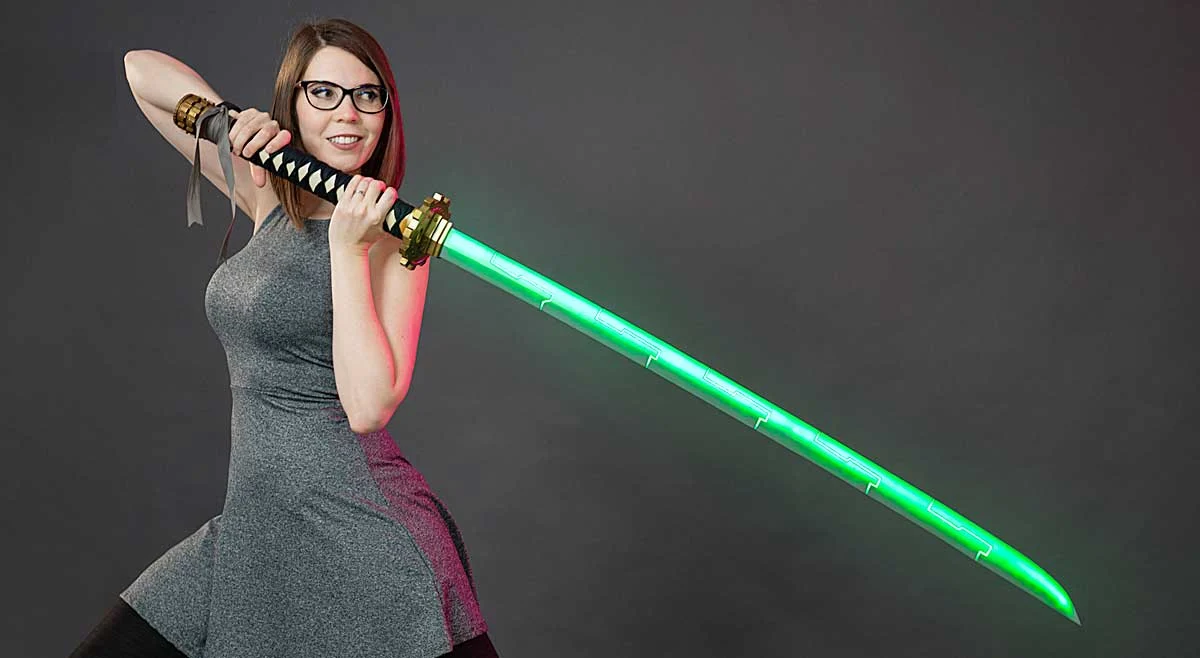
In the ever-evolving world of cosplay, the line between digital fantasy and physical reality is becoming increasingly blurred. Nowhere is this more evident than in the recent collaborative project between legendary cosplay duo Kamui Cosplay and Electronic Arts (EA). Tasked with recreating one of the most iconic weapons from the high-octane action title Wild Hearts, the duo has successfully engineered a fully functional, light-up, and sound-emitting Karakuri Katana, setting a new benchmark for prop fabrication in the gaming community.
Main Facts: A Convergence of Gaming and Engineering
The project, which spanned approximately one week of intensive development, saw Kamui Cosplay—comprising Svetlana and Benni—take on the challenge of bringing the "Karakuri Katana" to life. The weapon, characterized in Wild Hearts by its intricate shifting mechanics and vibrant light-emitting properties, served as the perfect candidate for a high-fidelity prop build.
Unlike traditional foam-based props, which prioritize weight and ease of handling, this project necessitated a sophisticated blend of 3D modeling, electronics integration, and specialized material science. The finished prop features an integrated LED array that mimics the in-game weapon’s "special attack" animation, complemented by a bespoke sound system that reacts to the wielder’s movements. By utilizing ABS plastic, the team achieved a balance between structural integrity and the translucency required for the blade’s signature glow.
Chronology: From Digital Concept to Physical Manifestation
The journey from a rendered asset to a tangible prop followed a rigorous development pipeline that highlights the technical proficiency required for modern cosplay fabrication.
Phase 1: Conceptualization and Modeling (Days 1–2)
The process began in Blender, where Benni meticulously reconstructed the Karakuri Katana from the ground up. Because the sword in Wild Hearts features moving parts and complex geometries, the digital model had to be engineered with printability in mind. This required "slicing" the model into segments that could be assembled without compromising the structural tension of the blade.
Phase 2: Fabrication and Material Selection (Days 3–4)
For the physical build, the team utilized a Creality CR-M4 3D printer. The choice of white ABS plastic was strategic; the material’s natural translucency allows light to diffuse evenly through the blade, creating a soft, ethereal glow rather than harsh, point-source light. The team focused on printing "thin-wall" segments to maximize the impact of the internal LEDs while keeping the total weight of the prop manageable for long periods of convention wear.
Phase 3: Electronics and Assembly (Days 5–7)
The final stages involved integrating the hardware. Heavily inspired by the open-source light saber tutorials provided by Adafruit, the duo implemented a system that manages both the power delivery to the LEDs and the triggered audio cues. This phase proved to be the most labor-intensive, requiring precise soldering and cable management to ensure that no wires were visible through the translucent blade casing.
Supporting Data: The Technical Foundation
The success of this project is rooted in the team’s willingness to leverage existing open-source hardware documentation while innovating on the design front.

- Design Software: Blender was the primary tool for 3D modeling. The duo has documented their workflows extensively in their 3D Printing and Modeling guide, which serves as a cornerstone for their professional operations.
- Hardware Stack: The project utilized a custom electronics setup based on the Adafruit Featherwing ecosystem. This allows for modularity, meaning the sword’s light patterns and sound effects can be updated via software rather than hardware modification.
- Printing Metrics: By using the Creality CR-M4, the team was able to print large-format sections, reducing the number of glue joints required and resulting in a cleaner, more robust final product. The use of white ABS is a technical recommendation for anyone attempting to build light-diffusing props, as it eliminates the need for expensive high-end resin casting for beginners.
Official Responses and Collaborative Synergy
The collaboration between EA and Kamui Cosplay represents a growing trend in the gaming industry: the "Creator-Publisher Partnership." By commissioning high-profile cosplayers to bring in-game items to life, publishers like EA are not only promoting their titles but are also validating the cosplay community as a legitimate extension of their marketing and design efforts.
"Electronic Arts asked us to bring our favorite weapon from their new game to life," the duo noted in their official project retrospective. "It was an amazing opportunity to finally bring this blade to life." The collaboration underscores the trust gaming giants are placing in independent creators to represent their intellectual property with a level of detail that standard marketing materials often lack.
Implications for the Future of Prop Making
The completion of the Karakuri Katana has significant implications for the future of the hobby. First, it demonstrates the democratization of complex fabrication. Through their shop, Kamui Cosplay has made the print files for the LED Katana available to the public. This means that an amateur maker with a mid-range 3D printer and access to basic electronics can now produce a prop that matches the quality of industry-standard work.
Furthermore, this project signals a shift in the "standard" of cosplay excellence. As 3D printing becomes more accessible, the barrier to entry for high-end props has lowered, while the expectation for "functional" props—those that light up, move, or interact with the environment—has risen. The community is no longer satisfied with static statues; there is an increasing demand for "interactive gear."
Finally, the reliance on resources like Adafruit’s tutorials highlights the collaborative nature of the maker movement. No longer does a prop maker need to be an electrical engineer to integrate complex lighting systems. By aggregating knowledge from the DIY electronics community and applying it to the artistic medium of cosplay, creators like Kamui are creating a roadmap for the next generation of makers.
Conclusion: A Blueprint for Aspiring Makers
The Karakuri Katana project is more than just a promotional stunt for Wild Hearts; it is a masterclass in modern prop construction. It highlights the importance of iterative design, the necessity of choosing the right materials for the desired effect, and the power of sharing knowledge within a community.
For those inspired by this build, the path is clear: start with the software, understand the fundamentals of light diffusion, and don’t be afraid to lean on the expertise of others. As Kamui Cosplay has proven, the bridge between a digital file on a hard drive and a glowing, functional weapon in your hand is shorter than ever—provided you have the right tools and the curiosity to learn how to use them. Whether you are a veteran cosplayer or a newcomer to 3D printing, the blueprint provided by this project offers a definitive look at what is possible when technical skill meets creative passion.









No comments yet. Be the first to join the conversation!