


Las Vegas, NV – May 11, 2026 – In the vibrant tapestry of Magic: The Gathering‘s Universes Beyond series, few crossovers have captivated players and fans as profoundly as the Final Fantasy set, released in June 2025. Among its most iconic cards, "Yuna, Hope of Spira," stands as a beacon of both mechanical prowess and profound thematic resonance. Yet, an exclusive interview with Gavin Verhey, Principal Game Designer at Wizards of the Coast and the design lead for the Final Fantasy set, has unveiled a surprising truth: this beloved mythic rare card, a cornerstone for many players, very nearly remained a mere rare.
Verhey, speaking at MagicCon: Las Vegas 2026, peeled back the curtain on the iterative design process that elevated Yuna from an intriguing rare to one of the set’s most sought-after mythic rares. This pivotal decision not only rectified a perceived imbalance in representation for Final Fantasy X within the set but also underscored Wizards of the Coast’s commitment to both thematic integrity and player sentiment. Yuna’s journey from a common rarity slot to the pinnacle of collectibility is a testament to the dynamic nature of game design and the surprising influence of internal feedback mechanisms.
The Genesis of a Legend: From Rare to Mythic
An Unexpected Origin Story
The Final Fantasy Universes Beyond crossover, launched in June 2025, quickly became a sensation, drawing in both veteran Magic: The Gathering players and legions of Final Fantasy enthusiasts. For many, the set’s standout cards were those that perfectly encapsulated the essence of their digital counterparts. Among these, "Yuna, Hope of Spira" from Final Fantasy X emerged as an immediate favorite. Her powerful abilities, deeply rooted in the lore of Spira, made her an indispensable piece in various strategies, particularly in "Naya enchantress" or "summoner" decks that leveraged green, white, and red mana.
As a dedicated player, this reporter can attest to Yuna’s impact. My preferred deck on Magic Arena, a Naya enchantress build, revolves entirely around her synergy with other summoners like "Rydia, Summoner of Mist" and "Terra, Magical Adept." The sheer joy of assembling a board state with powerful enchantment creatures, consistently buffed and resurrected by Yuna, is unparalleled. This personal attachment to the card makes the revelation of its initial design even more astonishing.
In Magic: The Gathering, rarity plays a crucial role beyond just collectibility. Common cards are abundant and form the backbone of limited formats; uncommons introduce more complex interactions; rares offer significant power and unique effects; and mythic rares represent the absolute pinnacle of design, often featuring iconic characters, game-warping abilities, or extremely unique mechanics. Mythic rares are printed at a significantly lower frequency than rares, making them highly desirable and often more expensive. For a card like Yuna, embodying one of Final Fantasy‘s most beloved protagonists, to be initially slated for a lower rarity speaks volumes about the early stages of design.
The Crucible of "The Mythic Wall"
The decision to promote Yuna to mythic rare was not arbitrary; it was the direct result of a unique internal feedback process at Wizards of the Coast known as "The Mythic Wall." Gavin Verhey described this process in detail during our interview at MagicCon: Las Vegas 2026, highlighting its organic yet profoundly impactful nature.
"We came to the saga creature idea pretty fast and pretty early," Verhey explained, setting the stage for the set’s core mechanics. "Once we came to that, it meant all of our saga creatures were also going to be enchantments, so obviously the summoners had to care about enchantments in one way or another – and different summoners had to do that in different ways." This foundational design decision laid the groundwork for Yuna’s abilities, ensuring she interacted meaningfully with the set’s central themes.
However, Yuna’s initial rarity assignment was "rare for a really long time," Verhey confirmed. The turning point came through "The Mythic Wall." This innovative feedback system involves printing out all the proposed mythic rare cards from an upcoming set on large sheets of paper. These sheets are then displayed prominently on a wall in one of the most frequently trafficked hallways within the Wizards of the Coast building. Employees, regardless of their department or direct involvement in game design, are encouraged to leave Post-It notes with comments, suggestions, or observations as they pass by – perhaps on their way to lunch or a meeting.

"We just leave Post-It notes there, so people can leave comments as they walk by while walking to lunch or something like that," Verhey elaborated. This informal yet highly effective method allows for a diverse range of perspectives to influence design decisions, capturing insights from marketing, art, brand management, and even casual players within the company, rather than just the core design team. It’s a testament to a corporate culture that values broad internal engagement and recognizes that fresh eyes can often spot critical omissions or opportunities.
It was through this "Mythic Wall" process that a crucial observation emerged: despite Final Fantasy X being one of the most popular and critically acclaimed titles in the entire Final Fantasy series, it conspicuously lacked a single mythic rare card within the upcoming set. This realization, shared via a simple Post-It note, prompted a re-evaluation of the set’s rarity distribution and thematic representation.
"One particular note that stuck out on the Mythic Wall was simple: despite FF10 being one of the most popular titles in the series, it didn’t have a single mythic rare," Verhey recalled. This feedback was invaluable. The design team, upon taking a second look at the batch of rares, quickly identified Yuna as the obvious candidate for promotion. Her popularity, the significance of Final Fantasy X‘s narrative, and the compelling design of her card made her an ideal fit for the elevated status. This swift decision, driven by collective internal intelligence, ensured that a beloved game received its due representation at the highest rarity tier.
Weaving Worlds: Final Fantasy X’s Heart in Magic
Beyond Card Text: A Thematic Masterpiece
Yuna, Hope of Spira, is more than just a powerful card; she is a meticulously crafted homage to Final Fantasy X. Her abilities in Magic: The Gathering are deeply intertwined with the game’s narrative and central themes, transforming her card into a playable piece of lore. As a 3/3 legendary creature for three mana (one green, one white, and one generic), she provides immediate value and long-term strategic depth.
Her static abilities grant all your enchantment creatures – which notably include the set’s "saga creatures" that represent summons – trample, lifelink, and ward 2. Trample allows oversized creatures to deal excess damage to the opponent even if blocked, lifelink ensures that damage dealt also replenishes your life total, and ward 2 makes them harder to target by spells or abilities unless an opponent pays an additional two mana. These abilities collectively empower a creature-heavy enchantment strategy, making your board resilient and capable of closing out games.
However, Yuna’s most iconic ability, and the one that resonates most deeply with Final Fantasy X‘s somber narrative, triggers at the start of your end step: she returns an enchantment card from your graveyard to the battlefield with a finality counter. This "finality counter" ensures that if the creature with it dies again, it is exiled instead of returning to the graveyard, preventing endless recursion loops.
Verhey specifically highlighted this aspect: "For Yuna in particular, it kind of made sense for her to bring someone back from the graveyard, and we were working on trying to make some cool cards for Standard that would be really fun for a green-white reanimator deck with summons like Bahamut or Titan." The connection here is profound. In Final Fantasy X, the Aeons, powerful entities summoned by Yuna, are not merely magical beasts; they are the spiritual manifestations of fayth – human souls who sacrificed themselves and were sealed into statues. This system of summoning is inextricably linked to death, sacrifice, and the spiritual realm. Yuna’s ability to "reanimate" enchantments from the graveyard perfectly mirrors her role as a summoner who brings forth beings intrinsically tied to the departed. The finality counter can even be seen as a subtle nod to the ephemeral nature of the Aeons, who, despite their power, are ultimately bound by the cycle of Spira.
The Summoner Archetype: Rydia, Terra, and Yuna
The Final Fantasy Universes Beyond set innovatively adapted the concept of summons into Magic: The Gathering through "saga creatures." These unique permanents begin as enchantments that, over the course of three to five turns, tell a story through a series of abilities, culminating in a powerful final effect before they transform into creatures. This mechanic beautifully captures the essence of summons in the Final Fantasy games: they appear, perform a powerful move, and then depart, leaving their mark on the battlefield. As both saga enchantments and creatures, they provide versatile threats that interact with a wide array of card types.

The design team ensured that different summoners from across the Final Fantasy multiverse interacted with these mechanics in distinct ways, reflecting their unique lore.
-
Rydia, Summoner of Mist (from Final Fantasy IV): Rydia’s abilities specifically target "sagas." In FFIV, "Mist" is a magical energy associated with summons, mystical monsters called from another plane. Her card, "Rydia, Summoner of Mist," appropriately focuses on enhancing and interacting with these specific "saga" enchantment creatures, reflecting her deep connection to the elemental forces that govern her summons.
-
Terra, Magical Adept (from Final Fantasy VI): Terra’s card, "Terra, Magical Adept," showcases her unique heritage as half-Esper. Espers are FFVI‘s term for a race of powerful magical beings from another plane. Terra’s dual nature allows her to literally transform into an Esper herself and copy a summon already on the board. Her Magic card design reflects this transformative power, making her a versatile tool for replicating powerful summon effects.
-
Yuna, Hope of Spira (from Final Fantasy X): While Rydia focuses on sagas and Terra on copying, Yuna’s scope is broader, affecting "enchantment creatures." This broader brushstroke reflects FFX‘s unique take on summoning, where the concept is not just about magical beings but about a deeper, more spiritual connection to sacrifice and the afterlife. Her ability to bring back any enchantment from the graveyard, not just saga creatures, makes her incredibly versatile and potent, allowing for diverse deck-building strategies that leverage various enchantment types. This design choice elevates her beyond a mere summoner of specific entities, making her a "Hope of Spira" who can revive any fallen ally or powerful enchantment effect.
The synergy between these three summoners is what led this reporter to construct the Naya (red-green-white) deck that has dominated my Magic Arena play for months. Yuna’s ability to resurrect enchantments provides a constant threat, while Rydia and Terra offer powerful on-board effects and replication, creating a dynamic and resilient strategy that embodies the spirit of Final Fantasy‘s iconic summoners.
The Universes Beyond Phenomenon
Bridging Franchises: A New Frontier for Magic
"Universes Beyond" represents a groundbreaking initiative by Wizards of the Coast to integrate popular intellectual properties from outside the traditional Magic: The Gathering multiverse into the game. This ambitious venture has seen characters and settings from franchises like The Lord of the Rings, Warhammer 40,000, Doctor Who, and, most recently, Final Fantasy, appear as playable cards. The goal is to attract new players who are fans of these external IPs, while also offering existing Magic players fresh and exciting gameplay experiences.
The Final Fantasy crossover was particularly anticipated, given the series’ legendary status in video game history and its deep lore, which often features intricate magic systems and iconic monsters that translate seamlessly into Magic‘s fantasy setting. The challenge for the design team was to adapt these beloved characters and mechanics in a way that felt authentic to both Final Fantasy and Magic, balancing flavor with mechanical integrity. The creation of "saga creatures" as the representation of summons is a prime example of this successful adaptation, providing a fresh take on a classic Magic enchantment type while perfectly capturing the ephemeral yet impactful nature of Final Fantasy summons.
Impact on Gameplay and Community
Yuna’s elevation to mythic rare had significant implications for both gameplay and the Magic community. As a mythic, her presence in booster packs is rarer, making her a more sought-after card for collectors and competitive players alike. Her power level, particularly in Commander (a popular multiplayer format) and potentially in Standard or Explorer/Pioneer on Magic Arena, made her a format-defining card.
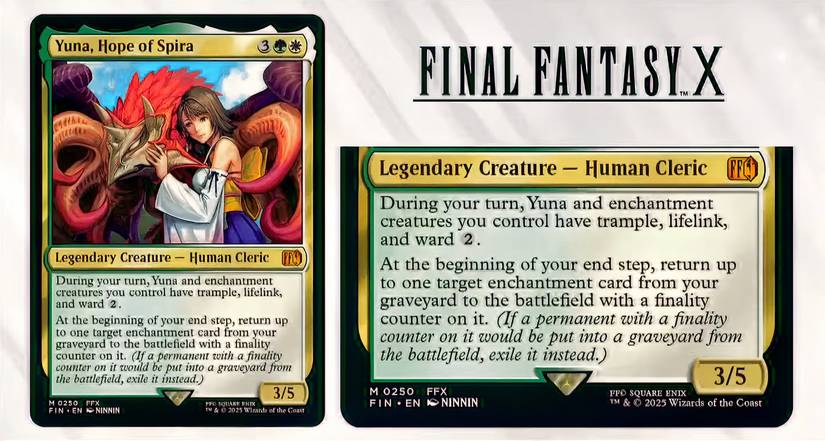
In Commander, Yuna, Hope of Spira, quickly became a popular choice for green-white (Selesnya) or Naya (green-white-red) enchantment-focused decks. Her ability to grant trample, lifelink, and ward to an entire board of enchantment creatures, coupled with her recursion engine, provides both offensive power and defensive resilience. The ability to continuously bring back powerful enchantments or saga creatures from the graveyard creates a persistent value engine that can overwhelm opponents.
The community’s reception to the Final Fantasy set, and Yuna specifically, was overwhelmingly positive. Players appreciated the faithful adaptation of the source material, the innovative mechanics, and the sheer power level of many of the cards. Yuna, in particular, became a symbol of how Universes Beyond could successfully merge beloved IPs with Magic‘s intricate gameplay, delivering cards that were not only powerful but also deeply resonant with their origins. Her story, now revealed, only adds another layer of appreciation for the thought and care that goes into creating these cross-franchise masterpieces.
Lessons from Spira: Design Philosophy and Future Horizons
The Power of Iteration and Feedback
The narrative of Yuna’s journey from rare to mythic is a powerful illustration of Wizards of the Coast’s iterative design philosophy. It highlights that game development is rarely a linear process but rather a continuous cycle of creation, testing, feedback, and refinement. "The Mythic Wall" stands as a prime example of an effective, low-barrier feedback mechanism that can catch crucial oversights and lead to significant improvements.
Gavin Verhey’s account underscores the importance of valuing diverse perspectives within a design team and beyond. A simple Post-It note from a non-designer, observing a thematic imbalance, led to a re-evaluation that ultimately enhanced the product. This kind of organic, cross-departmental feedback fosters a culture of collective ownership and quality assurance, ensuring that the final product is as polished and resonant as possible. It demonstrates that sometimes, the most profound insights come from unexpected places.
Setting a Precedent for Crossover Design
Yuna’s story also sets an important precedent for future Universes Beyond sets. It emphasizes that while mechanical design is paramount, the emotional and thematic connection to the source material is equally vital. Players want to see their favorite characters not just represented, but represented accurately and powerfully. The initial oversight regarding Final Fantasy X‘s lack of mythics, and its subsequent correction, shows a responsiveness to the brand’s legacy and fan expectations.
This balancing act – between creating mechanically sound Magic cards and faithfully representing another beloved IP – is the core challenge and triumph of Universes Beyond. Yuna’s mythic status ensures that one of Final Fantasy‘s most iconic characters from one of its most popular installments receives the attention and power level she deserves, making her not just a strong card, but a true centerpiece of the set. This commitment to both power and flavor will undoubtedly continue to guide the development of future crossovers, ensuring that Universes Beyond remains a vibrant and exciting frontier for Magic: The Gathering.
In hindsight, Yuna almost not being a mythic rare feels almost absurd. Final Fantasy X transformed summons from mere flashy spell effects into the emotional backbone of an entire RPG, intertwining them with themes of life, death, and sacrifice. Magic: The Gathering‘s adaptation of Yuna, especially with her graveyard recursion abilities, beautifully reflects that. Her card doesn’t just enable summons; it turns the graveyard itself into part of the summoning ritual, a resonance that strengthens the thematic integrity of both the card and the entire set.
As Magic: The Gathering continues to expand its horizons through Universes Beyond, the story of Yuna, Hope of Spira, will remain a testament to the magic of collaborative design, the power of player feedback, and the enduring appeal of weaving beloved narratives into new forms. Her journey to mythic rare isn’t just about a card; it’s about the deep respect for the source material and the dedication to crafting an unforgettable player experience.












No comments yet. Be the first to join the conversation!