Ammar Sabilarrohman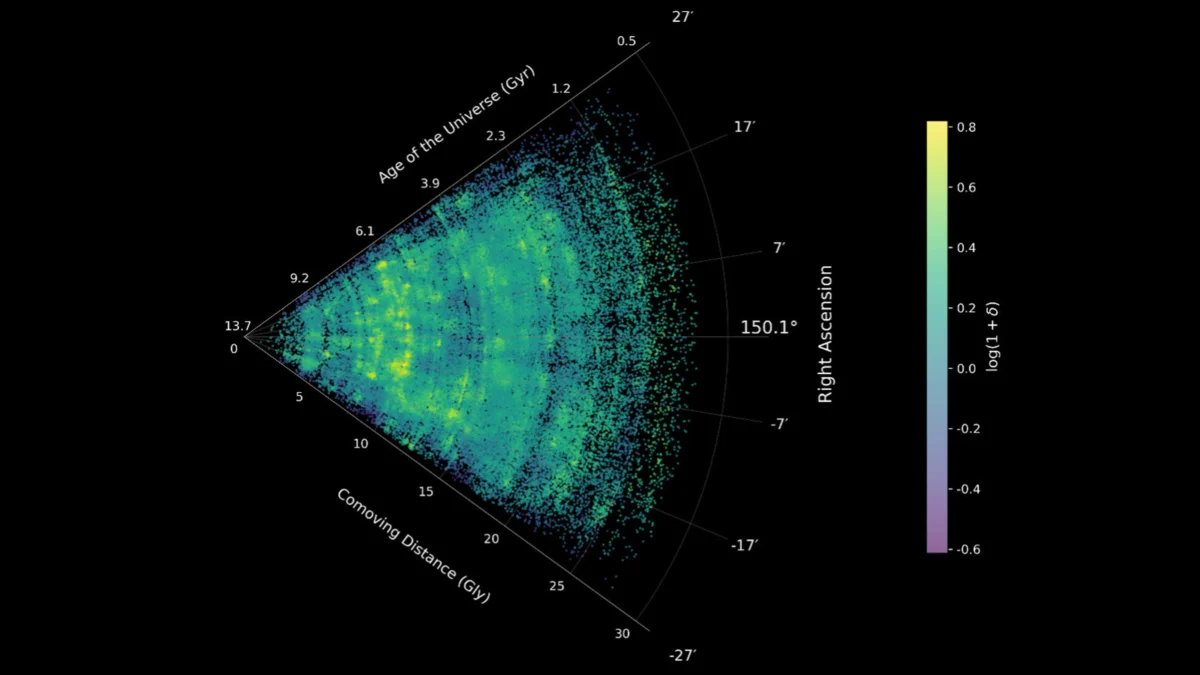
While the public has become accustomed to the James Webb Space Telescope (JWST) delivering breathtaking, high-definition snapshots of colorful nebulae and glittering stellar nurseries, the true power of the $10 billion observatory lies in its ability to peer into the "invisible" foundations of our universe. A groundbreaking new study, recently published in The Astrophysical Journal, has leveraged the unprecedented sensitivity of the JWST to produce the most detailed map to date of the "cosmic web"—the vast, intricate scaffolding of dark matter, gas, and filaments that binds the universe together.
The Architecture of the Cosmos: Main Facts
The cosmic web is not merely a metaphor; it is the physical framework upon which all structure in the universe is built. Think of it as a sprawling, three-dimensional spiderweb that permeates the entirety of space. The "nodes" of this web are massive clusters of galaxies, while the "filaments" are the bridges of dark matter and intergalactic gas that connect them.
For decades, astrophysicists have theorized the existence of this structure, but observing it with clarity has been hampered by the limitations of previous observatories, such as the Hubble Space Telescope. The JWST, operating primarily in the infrared spectrum, has shattered these limitations. By looking further back in time—to an era when the universe was only a few hundred million years old—researchers at the University of California, Riverside (UCR) have successfully mapped these filaments with a level of precision previously thought impossible.
The significance of this achievement cannot be overstated: by mapping the web, scientists are effectively creating a blueprint of the universe’s growth, allowing us to see how matter flows from the void into the dense, star-forming regions where galaxies reside.
A Chronological Journey: Peering into the Dawn of Time
To understand the magnitude of this achievement, one must consider the timeline of the universe. The "cosmic dark ages" followed the Big Bang, during which the universe was a hot, dense soup of particles. As the universe expanded and cooled, gravity began to pull matter toward the densest regions.
The Early Universe (0–500 Million Years)
Before the deployment of the JWST, this epoch was largely a "black box." Astronomers could see hints of structure, but the light from these early filaments was too faint and redshifted for traditional instruments to resolve. The new study captures the universe during this infant stage, providing a snapshot of the scaffolding before the massive, complex galaxies we see today had fully matured.
The Era of Galaxy Formation (1 Billion Years–Present)
As the research team, led by graduate student Hossein Hatamnia, analyzed the data, they were able to track the evolution of these structures over billions of years. By comparing the ancient, primordial web to the structures observed in the "nearby" universe (relatively speaking, in cosmic terms), the team has begun to build a continuous narrative of galactic evolution. This chronological mapping allows scientists to observe how gas is siphoned along these filaments to fuel the voracious star-formation processes that define a galaxy’s life cycle.
Supporting Data: Resolution and Depth
The jump in performance from previous surveys to the JWST-based mapping is described by the researchers as "truly significant." Previous models of the cosmic web were often "smoothed out," showing massive, blurred regions rather than the discrete, complex structures that exist in reality.
Bridging the Resolution Gap
The JWST’s Near-Infrared Camera (NIRCam) and Near-Infrared Spectrograph (NIRSpec) have provided the raw data necessary to deconstruct these blurred regions. Where previous data suggested a singular, monolithic structure, the JWST’s high-resolution imaging reveals a hierarchy of smaller, interconnected filaments and localized clusters.
Key technical advantages provided by the JWST include:
- Infrared Sensitivity: Because the light from the early universe has been stretched by the expansion of space into infrared wavelengths, the JWST is uniquely qualified to detect it.
- Precision Spectroscopy: By analyzing the light signatures of these filaments, researchers can determine the chemical composition and movement of the gas within the web.
- Depth of Field: The telescope’s ability to stare at a single patch of sky for extended periods allows it to collect photons from sources that are millions of times fainter than anything the human eye—or even the Hubble—could perceive.
Official Responses and Expert Insight
The findings have sent ripples through the astronomical community. Bahram Mobasher, a professor at UCR and a primary investigator on the study, emphasized the paradigm-shifting nature of the new data.
"What used to look like a single structure now resolves into many, and details that were smoothed away before, are now clearly visible," Mobasher noted. His remarks highlight the shift from theoretical modeling to empirical observation. We are no longer guessing at the shape of the web; we are looking directly at its seams.
Lead author Hossein Hatamnia echoed this sentiment, focusing on the continuity of the research. "For the first time, we can study the evolution of galaxies in cluster and filamentary structures across cosmic time, all the way from when the universe was a billion years old up to the nearby universe," Hatamnia stated. This ability to trace a single filament across eons provides a "life history" of cosmic structure that had remained elusive until now.
Implications: Why the Cosmic Web Matters
The implications of this study extend far beyond a simple map. By understanding the cosmic web, astronomers are essentially learning the "rules of the game" for the universe.
The Role of Dark Matter
We know that the cosmic web is held together by dark matter—a mysterious substance that exerts gravitational pull but does not interact with light. Because the filaments of the cosmic web are primarily composed of dark matter, mapping them allows scientists to "see" the invisible influence of this substance. Understanding how dark matter clumps and stretches provides essential data for researchers attempting to solve the mystery of what dark matter actually is.
Understanding Galaxy Evolution
Galaxies do not exist in isolation. They are fed by the gas that flows along the filaments of the cosmic web like water in a river. By mapping these "cosmic rivers," scientists can finally explain why some galaxies become massive, active star-formers, while others remain small and dormant. The interaction between a galaxy and its surrounding filaments is the primary driver of its maturity.
Testing Cosmological Models
Our current understanding of the universe, the Lambda-CDM model, relies heavily on the assumption that the universe is structured like a web. This new, highly detailed map acts as a stress test for that model. If the observed filaments align with our simulations, it reinforces our fundamental understanding of physics. If they don’t—if the JWST reveals structures that should not exist according to our current theories—it could signal a need for "New Physics," potentially forcing a rewrite of the standard model of cosmology.
Conclusion: A New Era of Exploration
The work conducted by the team at UCR and the Carnegie Observatories represents a milestone in the history of human inquiry. We have moved from the era of naming the stars to the era of understanding the very fabric that connects them.
As the James Webb Space Telescope continues its mission, providing us with even more data from the deep reaches of space, our map of the cosmic web will only grow more precise. We are peering behind the curtain of the universe, witnessing the intricate, silent dance of matter that has been ongoing since the very beginning of time. While the public will continue to enjoy the aesthetic beauty of Webb’s images, the scientific community will be busy deciphering the structural secrets hidden within them—secrets that ultimately tell the story of where we came from and how the universe arrived at its present, awe-inspiring state.


 Neng Nana
 Sagoh
Sagoh