

In the introduction to the 2021 Tor Essentials edition of Gene Wolfe’s The Book of the New Sun, Ada Palmer offers a profound meditation on the nature of complex systems. She likens Wolfe’s magnum opus to an incomplete jigsaw puzzle, noting that our finite vantage point allows us to glimpse only a fraction of a reality so vast that it would take 100,000 pieces to fully comprehend.
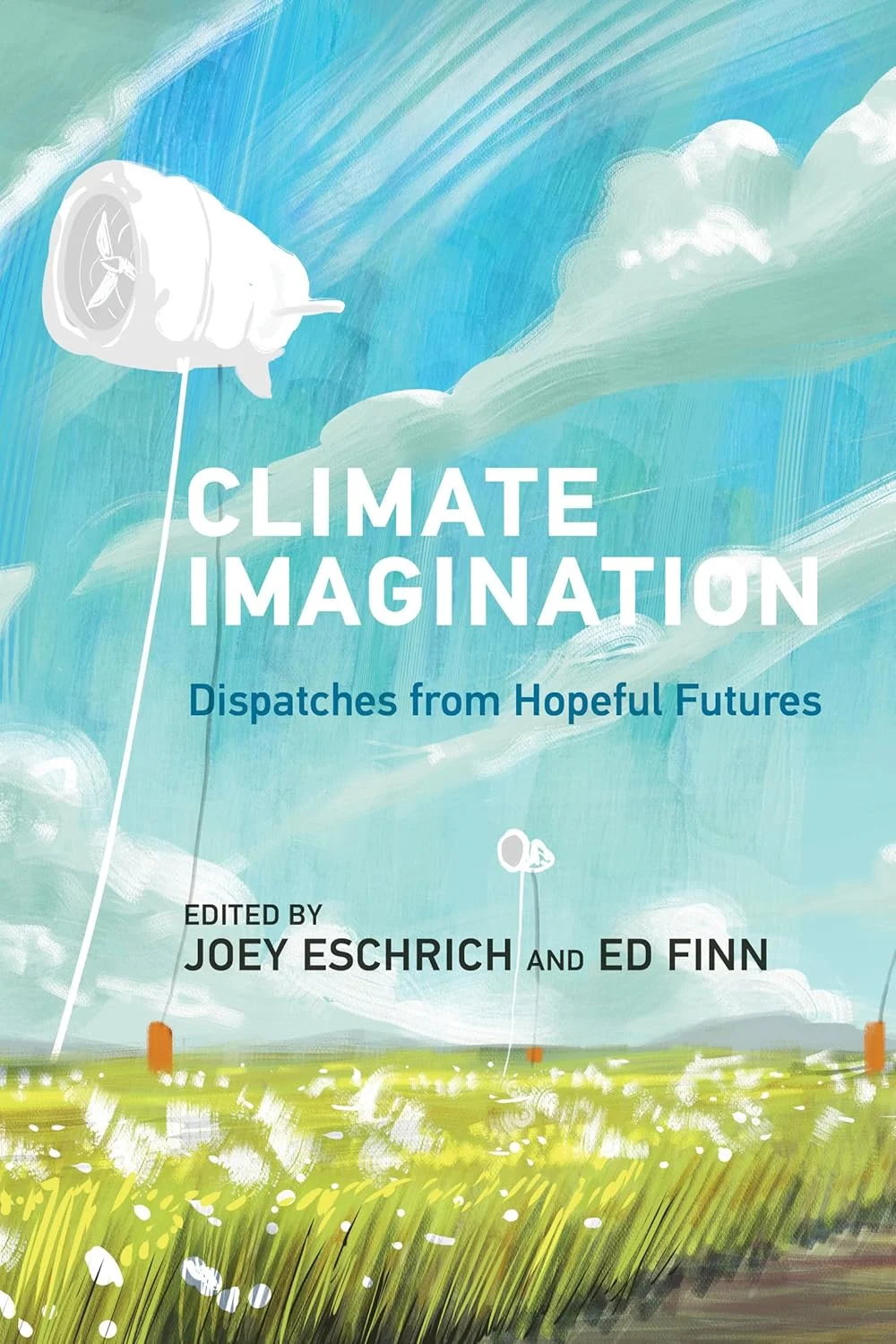
This metaphor serves as the foundational philosophy for Climate Imagination: Dispatches from Hopeful Futures, an ambitious new anthology edited by Joey Eschrich and Ed Finn. The collection argues that anthropogenic climate change is not merely a scientific crisis, but a narrative one. By moving away from the paralyzing "monolith" of apocalyptic thinking, the editors propose that we can only address the climate emergency by embracing the localized, fragmentary, and deeply human details that constitute our lived experiences.
The Fragmentary Nature of the Crisis
We all hold our own "puzzle pieces" of the climate era. For some, it is the sight of iconic skylines vanishing behind the acrid, orange shroud of wildfire smoke; for others, it is the jarring juxtaposition of raising children amidst record-breaking heatwaves or navigating the mundane frustrations of the modern transition, such as waiting in long queues at electric vehicle charging stations.
Climate Imagination acknowledges that these personal moments of "doom jockeying with elation" are not distractions from the climate crisis—they are the very fabric of it. By weaving together fiction, essays, and panel discussions, the anthology creates an eclectic mosaic that seeks to perform the psychological and logistical work of building a viable future.
The collection is meticulously structured, with four sections bookended by leading speculative fiction writers. Each section opens with a long-form novelette and closes with a short story, with analytical essays and expert dialogues positioned in between to ground the fiction in reality. While the print edition features beautiful, green-hued illustrations by João Queiroz, the anthology is also available as an open-access project titled The Climate Action Almanac, which offers additional digital-only content, interviews, and commentary.
A Journey Through Three Worlds: Vandana Singh’s Vision
The anthology opens with Vandana Singh’s novelette, "Three-World Cantata," which establishes the thematic stakes of the book. Singh, a scholar known for her work on teaching the climate crisis and the author of Ambiguity Machines, excels at navigating the tension between high-stakes social criticism and intimate human connection.
The story follows Manny, the CEO of "Ultracorp," who is lured into a climate simulator by Chingari—a storyteller, engineer, and activist. Singh deftly skewers the hubris of the corporate elite, who often believe that top-down, technological "heroism" is the only solution to the problems they helped create. As Chingari observes, "They want to feel like heroes: the elite who will save the Earth. Why not make use of that phenomenal obliviousness to their own role in the hell they’ve made?"
The simulator transports Manny through three distinct worlds, each defined by an "orienting metaphor":
- World Zero: Our current reality.
- World One: A cold, mechanized, and exclusionary future defined by a "clock"—a metaphor for quantification, surveillance, and the rigid, often cruel logic of "Cold Equations" style rationalism.
- World Two: A warm, flexible, and collaborative future defined by a "tapestry."
In World Two, the narrative structure reflects the metaphor; stories are not linear, but networked. Characters utilize terms like "symbiome"—a political unit composed of all living things within a local ecosystem—and "ecocide," a legally recognized crime that forces offenders to perform restorative labor, such as planting mangroves.
The Limitations of Narrative and the Power of Action
One of the most poignant moments in Singh’s work comes when Nilu, a Dalit woman in a World Two forest, finds herself unable to articulate her defense against a developer in human language. Instead, she utilizes a tool of the natural world: a gourd designed to mimic an elephant’s trumpet. She summons a matriarch elephant, whose presence forces the corporate representative into a physical collapse.
It is a striking acknowledgement that human speech, policy, and data have limits. As the story suggests, "human speech can only do so much, but it’s one tool among many." This realization informs the grandmother’s advice to Manny: "Time is thick." While the corporate world views time as a sequential, thin line of quarterly reports and efficiency, the reality of the climate crisis demands a thickening of time—engaging with other people, other beings, and the deep, overlapping layers of history and future.
Urban Planning and the Choice of Sacrifice
The anthology does not shy away from the darker implications of our choices. In "City of Choice," written by Beijing-based urban planner Gu Shi and translated by Ken Liu, we are confronted with the horrifying reality of algorithmic morality.
The story focuses on "Da Yu," an advanced navigation system used during extreme weather evacuations. When a character realizes that the system intentionally abandoned specific citizens because they were statistically calculated to have lower survival odds, the story shifts from a technical thriller into a searing critique of utilitarian ethics. It serves as a reminder that the "sacrifice" of vulnerable populations is a choice, not an inevitable outcome of climate collapse.
Global Perspectives: Reckless Climate Optimism
A recurring theme throughout the anthology is the challenge to Western-centric apocalyptic tropes. Chinelo Onwualu, a Nigerian writer-editor based in Toronto, mounts a potent defense of what she terms "reckless climate optimism" in her essay, "The Case for Reckless Climate Optimism."
Onwualu argues that many people in the Global South have already experienced what the Western imagination classifies as "the apocalypse." Because their history is one of crumbling power systems and radical adaptation, they possess a unique perspective: the belief that the current barriers to change are not as intractable as they appear. This sentiment is echoed by other contributors like Jacqueline Nyathi, who argue for "collective dreaming" as a necessary antidote to the hegemony of Western climate discourse.
The Fractal Approach to Global Change
The anthology’s non-fiction components provide the necessary logistical scaffolding for these fictional visions. Yudhanjaya Wijeratne’s "The Unwalkable City" offers a blistering critique of the "Colombo Megacity Project," illustrating how centralized, overambitious urban planning often ignores the chaotic, vibrant, and necessary serendipity of city life.
Conversely, pieces like Benjamin Ong’s "The Village Within" and Pippa Goldschmidt’s "A Walk in Berlin" highlight the power of "rogue" interventions. Whether it is the rewilding of urban scrubland during the pandemic or the transformation of the Berlin Wall’s "death strip" into a refuge for endangered birds, these essays emphasize that agency exists even in the shadow of grand-scale catastrophes.
In a concluding dialogue, mathematician Nigel Topping and lawyer Farhana Yamin advocate for a "fractal approach"—the idea that implementing climate action at the level of the village, the street, or the individual is more effective than waiting for global summits to solve the crisis. As Yamin succinctly puts it, "Implementing climate action in your High Street or village is easier than trying to imagine what the entire world will look like."
Implications: A Call for Active Imagination
Climate Imagination concludes by refusing to offer a simple, sanitized solution. Instead, it offers a framework for navigation. The editors and contributors recognize that the "messy way forward" is the only one that honors the complexity of the Earth.
The implications for the reader are clear: we must stop waiting for a singular, miraculous solution. We must instead adopt a "thick" view of time and action. Whether it is lobbying for low-emission zones, participating in urban rewilding, or simply changing the way we consume and travel, our daily choices are the puzzle pieces that will eventually form the image of our future.
As the anthology concludes, the dread that often accompanies climate discourse is replaced by a sense of curiosity and shared responsibility. We are left with the realization that "World One and World Two are right here, in World Zero." We are currently in the process of deciding which world we will inhabit. As Singh’s grandmother reminds us, time is indeed thick, and we are, at this very moment, knitting the patterns of the future together.










No comments yet. Be the first to join the conversation!