

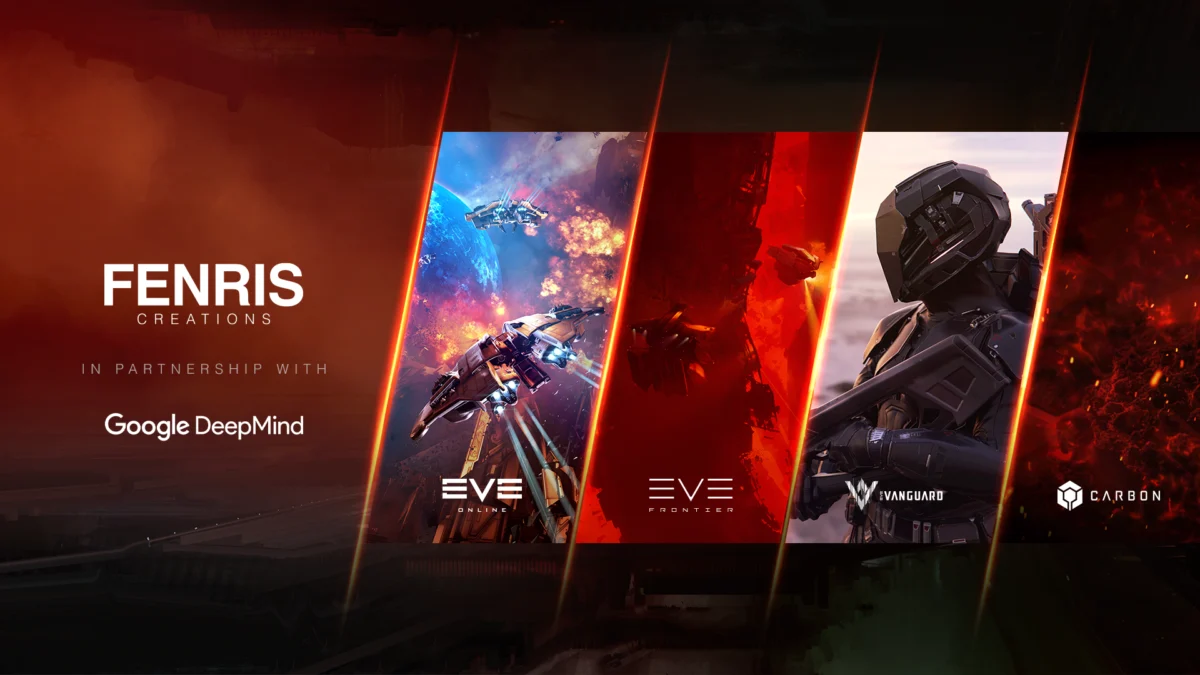
In a seismic shift for the gaming industry, CCP Games—the legendary developer behind the long-running spacefaring MMORPG EVE Online—has officially transitioned into a new era of independence. Following a $120 million management buyout from its former parent company, Pearl Abyss, the studio has rebranded as Fenris Creations. This move marks a homecoming of sorts for the Icelandic developer, which now returns to a structure of direct leadership while simultaneously forging a high-profile, future-facing research partnership with Google DeepMind.
The transition, which concludes a seven-and-a-half-year tenure under the ownership of South Korean publisher Pearl Abyss, brings with it a promise of stability: the company has confirmed that no layoffs or structural reorganizations will occur. As Fenris Creations sets its sights on the next decade of "living universes," the inclusion of Google as a minority stakeholder signals a bold pivot toward the intersection of advanced artificial intelligence and massive-scale virtual worlds.
Chronology: From Icelandic Icon to Global Entity and Back
To understand the weight of this transition, one must look at the turbulent history of the studio’s ownership.
- 1997–2018: The Era of Independence: Founded in Reykjavík, Iceland, CCP Games spent two decades building its reputation as a pioneer of sandbox gaming. EVE Online, launched in 2003, became a cult phenomenon known for its player-driven economy, corporate espionage, and massive space battles.
- 2018: The Pearl Abyss Acquisition: In a deal that shocked the industry, Pearl Abyss—the developers of Black Desert Online—acquired CCP Games for $225 million in cash, supplemented by $200 million in performance-related earn-outs. At the time, the move was seen as a strategic play to diversify Pearl Abyss’s portfolio and gain a foothold in Western markets.
- 2024: The Strategic Divestment: Following shifts in the global gaming economy and changing strategic priorities, Pearl Abyss reached an agreement to sell the studio back to its CEO, Hilmar Veigar Pétursson. The deal, valued at $120 million ($100 million in cash and $20 million in cryptocurrency), represents a significant discount from the original acquisition price.
- The Present: Now operating under the name Fenris Creations, the company retains its headquarters in Vatnsmýrin, Iceland, with auxiliary studios in London and Shanghai remaining fully operational.
Supporting Data: The Economics of the Buyout
The financial optics of this deal are stark. Pearl Abyss’s decision to divest for a price significantly lower than their 2018 investment reflects a broader trend of "right-sizing" in the games industry.
When Pearl Abyss purchased CCP, they were betting on the longevity of the EVE IP and the potential for new, experimental titles. However, the gaming market has since contracted, and major publishers have become increasingly focused on core profitability rather than massive, high-risk acquisitions. A spokesperson for Pearl Abyss stated that the sale price was "determined objectively and comprehensively," considering the current business environment.
For Fenris Creations, the deal is a strategic win. By reclaiming ownership, the leadership team avoids the pressures of a parent company’s quarterly earnings reports, allowing for a long-term investment strategy that aligns with their "decades-long" philosophy of game development.
The Google DeepMind Partnership: A New Frontier
Perhaps the most intriguing aspect of this announcement is the research partnership with Google DeepMind. Google has acquired a minority stake in Fenris Creations, cementing a collaborative effort that promises to redefine how AI functions within complex, player-driven environments.
Advancing Intelligence in Dynamic Systems
The partnership will focus on "advancing understanding of intelligence in complex, dynamic systems." According to representatives from both firms, the research will explore:
- Long-horizon planning: How AI agents can make decisions that yield results over months or years, rather than seconds.
- Memory: Giving AI the capacity to retain history in a way that informs future interactions.
- Continual learning: Creating models that evolve alongside the changing state of a game world.
To facilitate this, Google DeepMind will utilize an "offline" version of EVE Online running on local servers. This sandbox environment allows researchers to stress-test their models without impacting the live player experience. For the developers at Fenris Creations, this represents a unique opportunity to integrate sophisticated AI into the gameplay loop, potentially creating more responsive NPCs, complex economic simulations, or even dynamic narrative systems that react to player behavior in real-time.
Official Responses: A Vision for the Future
The shift has been met with optimism from the leadership of both the newly rebranded studio and its high-profile partner.
Hilmar Veigar Pétursson, CEO of Fenris Creations:
"This transition gives us direct ownership, clear accountability, and the independence to invest in worlds that grow over decades. We’re grateful to Pearl Abyss for their partnership and for the consistent support they’ve shown us over the past seven and a half years. EVE Online exists today because of pioneering thinking, patience, and trust between developers and players. Our new structure and partners enable us to carry that legacy forward—continuously evolving a living universe and actively exploring what it can become, with forever in mind."
Demis Hassabis, CEO and Co-Founder of Google DeepMind:
"I’ve known Hilmar for many years and long admired his work, and I’m thrilled to partner with him and the fantastic team at Fenris Creations to explore new gaming experiences and advance AI research safely inside a player-driven universe as amazingly complex as EVE Online."
Implications: What This Means for the Industry
The rebranding of CCP Games to Fenris Creations and the subsequent tie-up with Google DeepMind carries several critical implications for the future of interactive entertainment.
1. The End of the "Mega-Acquisition" Era
The fact that a major studio was sold back to its management for a fraction of its original purchase price serves as a cautionary tale for the industry. It suggests that the "acquisition spree" seen in 2018–2021 was perhaps unsustainable, and that many firms are now looking to streamline their operations to focus on core competencies.
2. The Rise of "Living Lab" Games
By using EVE Online as a testing ground for AI, Fenris Creations is positioning itself at the vanguard of the next generation of game development. Many industry analysts argue that the next breakthrough in generative AI will come from video games, which provide the most complex, bounded environments for training algorithms. If successful, the tech developed here could have implications far beyond gaming, including in robotics and complex system management.
3. Player Trust and Continuity
For the EVE Online community, the primary concern has always been stability. The explicit confirmation that there will be no layoffs or restructuring is a strategic move to maintain player confidence. By rebranding, the company signals a desire to reconnect with its roots—a "back to basics" approach that values the community-centric development that made the game a success in the first place.
4. AI as a Creative Partner
Earlier this year, the developers at what was then CCP Games made headlines by openly discussing the potential for AI in game development during a dedicated "AI week." This partnership moves that conversation from theoretical discussion to practical application. It suggests that Fenris Creations is not just using AI to automate coding tasks, but to fundamentally change the nature of the player experience.
Conclusion
As the sun sets on the Pearl Abyss era, the dawn of Fenris Creations feels like a return to the studio’s "rebel" roots—but with a significant new ally in Google. The combination of independence and access to world-class AI research provides the studio with a unique runway to innovate. Whether this leads to a new golden age for EVE Online or the creation of an entirely new, AI-driven universe remains to be seen. However, one thing is clear: under the banner of Fenris Creations, the team in Reykjavík is no longer just building a game; they are building a laboratory for the future of intelligence.











No comments yet. Be the first to join the conversation!