

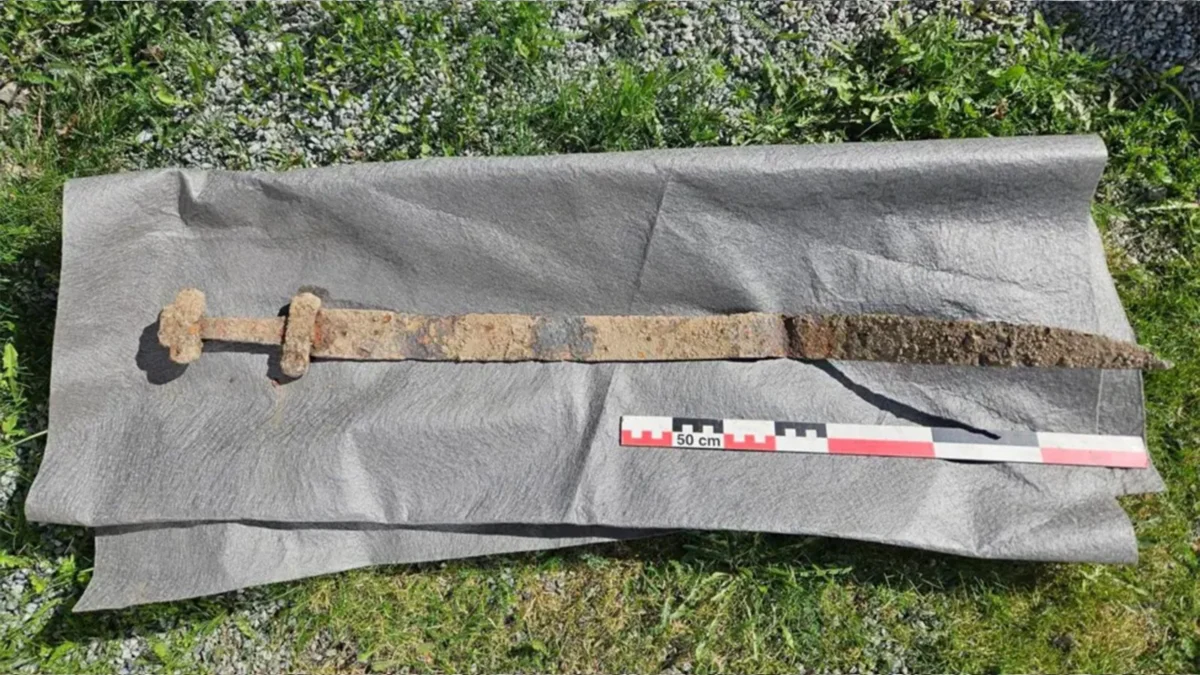
In a remarkable convergence of childhood curiosity and historical preservation, a routine school field trip in Hadeland, Norway, transformed into a significant archaeological event. Six-year-old Henrik, a student whose afternoon trek was intended to be a simple outdoor excursion, inadvertently unearthed a tangible piece of the Viking Age. What initially appeared to be a discarded piece of rusted metal protruding from the soil has been identified by experts as a 1,300-year-old iron sword, providing a rare and electrifying glimpse into the early Norse era.
The discovery, which occurred in May 2026, has sent shockwaves through the Scandinavian archaeological community, prompting a rigorous investigation into a region already steeped in myth and historical importance.
The Moment of Discovery: A Child’s Sharp Eye
The incident took place during a standard educational field trip in the rural landscape of Hadeland. While his peers may have been focused on the immediate surroundings of the trail, Henrik’s attention was captured by an anomaly in the dirt. Protruding from the ground was an oxidized, metallic object that had been hidden from view for over a millennium.
Driven by the innate curiosity characteristic of his age, Henrik pulled the object from the earth. Recognizing that the item felt substantial and distinct from the surrounding roots and stones, he immediately alerted his teachers. The staff, demonstrating commendable prudence, did not dismiss the find as mere scrap metal. They recognized the object’s weight, shape, and the distinctive way it had weathered, and promptly contacted the local authorities at the Innlandet County Municipality’s Department of Cultural Heritage.
Chronology of the Find: From Soil to Science
The timeline of this discovery highlights the efficiency of Norway’s cultural heritage protection systems:
- Mid-May 2026: Henrik discovers the artifact during a school excursion.
- Late May 2026: Educators notify the Innlandet Cultural Heritage authority.
- Early June 2026: Archaeological experts arrive at the site in Hadeland to conduct a preliminary survey of the soil where the sword was found.
- Mid-June 2026: The sword is officially cataloged and transported to the Museum of Cultural History in Oslo for conservation and expert analysis.
- Ongoing: Scientists begin the meticulous process of stabilizing the iron and analyzing its metallurgical composition to determine its origin and history.
Supporting Data: The Scramasax and the Early Viking Age
The artifact has been identified by researchers as a single-edged iron blade known as a scramasax (or simply, a sax). Unlike the iconic double-edged Viking longswords that characterize the later years of the Norse era, the scramasax represents a transitional technology.
The Technical Profile
The scramasax was a versatile tool and weapon, serving both as a sidearm for warriors and a utility knife for daily life. Experts believe this specific blade dates back to the early Viking Age, roughly spanning from 500 AD to 800 AD.
This period, often referred to as the Migration Period transitioning into the early Viking Age, was a time of immense social and political upheaval in Northern Europe. The metallurgy of the blade suggests it was forged by a skilled smith, as the iron required to produce a weapon of this length was a significant capital investment for an individual in the 7th or 8th century.
The Significance of Hadeland
The Hadeland region is no stranger to historical intrigue. It has long been recognized by scholars as a "hotspot" for human activity dating back to the Stone and Bronze Ages. According to regional lore and the Icelandic Sagas, Hadeland was a high-status territory, often cited as a destination where Danish kings and regional chieftains would host elaborate gatherings. The discovery of the sword supports the theory that Hadeland was a seat of power, where elite warriors and regional leaders held significant influence.

Official Responses: Preserving the Past
The Innlandet County authorities have praised both the student and his teachers for their swift action. In a public statement, local archaeologists emphasized that the integrity of the find was preserved specifically because the artifact was not cleaned or mishandled by the discoverers.
"The fact that a six-year-old was able to identify something so significant is a testament to the importance of historical education," said a representative from the Cultural Heritage authority. "By leaving the object largely intact and contacting us immediately, they allowed us to document the site properly, which is crucial for understanding the context of the find."
The Museum of Cultural History in Oslo has since taken over the stewardship of the sword. Conservators are currently using non-invasive imaging techniques to look beneath the thick layer of oxidation to check for decorative inlays or identifying marks on the tang of the blade, which could potentially link the weapon to a specific family or forge.
Implications: A Broader Archaeological Impact
The recovery of the Hadeland sword serves as a poignant reminder that much of human history remains buried just beneath our feet. For archaeologists, this find is not merely about a singular weapon; it is about the "archaeological rabbit hole" it creates.
Expanding the Map
The discovery has led to a renewed interest in the surrounding Hadeland site. Plans are currently in motion for a professional excavation of the area to determine if the sword was a solitary loss, a grave good, or part of a larger, undiscovered hoard. In archaeology, finding one artifact often indicates the presence of a cultural layer, suggesting that the area could be home to burial mounds or residential structures that have yet to be identified.
The "Youth Discovery" Phenomenon
This event joins a growing list of significant archaeological and natural history discoveries made by children. In an age where digital technology dominates youth culture, these instances highlight the enduring value of outdoor education and environmental stewardship. When a child like Henrik makes a find of this magnitude, it inspires a new generation to look at their local landscape with a sense of wonder rather than indifference.
Conclusion: A Bridge Across Centuries
As the scramasax undergoes the slow, meticulous process of restoration in Oslo, it stands as a silent witness to a turbulent time in European history. It is a tangible connection to the people who walked the fields of Hadeland 1,300 years ago—people who, much like the modern students who found the blade, were part of a community shaped by the land.
While the sword will eventually be placed behind glass, the story of its discovery will likely remain a highlight of local history. It is a powerful example of how the past is never truly gone; it is simply waiting, sometimes for over a millennium, for a pair of observant eyes to bring it back into the light. The academic journey that began on a sunny field trip in May 2026 is far from over, and as scientists continue their work, the world waits to see what other secrets the Hadeland soil might yield.












No comments yet. Be the first to join the conversation!