

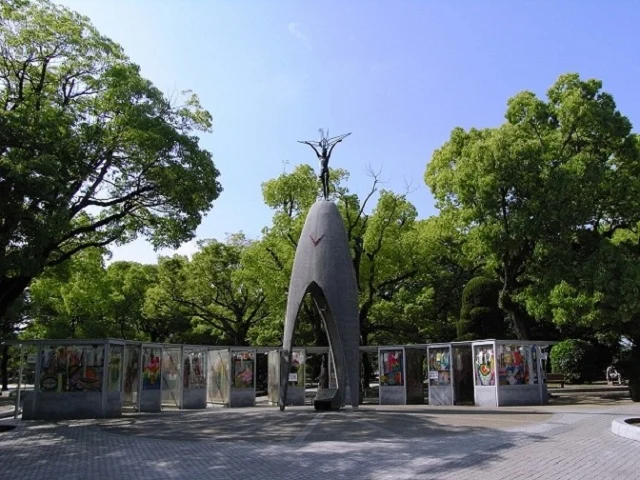
The Hiroshima Peace Memorial Park, a solemn expanse of green situated in the heart of Hiroshima City, serves as a poignant reminder of the fragility of human existence. Standing as a silent witness to the events of August 6, 1945, the park is a landscape of reflection, dotted with monuments dedicated to the victims of the atomic bombing. Among these, the Children’s Peace Monument—a striking sculpture topped with a bronze figure of a child—has long been a focal point for visitors seeking to offer prayers for a world free of nuclear conflict.
However, as of May 18, the monument has fallen into a rare, intentional silence. The rhythmic tolling of its bell, typically a constant soundtrack to the park’s contemplative atmosphere, has been paused. This measure was not prompted by construction or maintenance, but by a delicate, living arrival: a family of sparrows has chosen the interior of the bell as a nursery for their hatchlings. In an act of profound sensitivity, the Hiroshima City government has prioritized the protection of this new life, ensuring that the monument serves its purpose as a symbol of peace in the most literal, biological sense.
The Monument and Its Legacy: A History of Remembrance
To understand the weight of this decision, one must look at the origin of the Children’s Peace Monument. Unveiled in 1958, the monument stands in memory of Sadako Sasaki and the thousands of other children who lost their lives due to the atomic bombing of Hiroshima.
Sadako, who was just two years old when the bomb was dropped, became a global symbol of the suffering endured by the city’s youth. Diagnosed with leukemia a decade later—a consequence of radiation exposure—she began the arduous task of folding 1,000 paper cranes, a traditional Japanese symbol of longevity and health. Though she passed away before completing her goal, her story ignited a global movement. Today, the monument is surrounded by cases filled with thousands of colorful paper cranes sent from school children and visitors across the globe.
The bell suspended beneath the bronze statue of the child is central to the monument’s function. It is designed with a motif echoing the folded paper crane, and for decades, visitors have reached out to pull the chain, sending a resonant toll across the park as a personal declaration of their commitment to world peace.
Chronology of the Nesting Event
The discovery that prompted the recent silence occurred in mid-May. The timeline of events is as follows:
- May 18: A observant visitor to the Peace Memorial Park noticed avian activity within the bell’s structure. Upon closer inspection, it was clear that a pair of sparrows was actively transporting twigs, dried grass, and soft nesting materials into the hollow of the bell.
- May 18 (Afternoon): Park administrators were notified. Following a rapid assessment of the situation, officials verified that the sparrows had begun the construction of a nest, placing it in a location that would be severely disturbed by the vibration and motion of the bell being rung.
- May 18 (Evening): To safeguard the integrity of the nest and protect the potential eggs or hatchlings from falling or being crushed, park officials made the administrative decision to detach the chain used to ring the bell.
- Present Day: The bell remains silent. The city has implemented a "hands-off" policy regarding the structure, allowing the birds to complete their reproductive cycle without human interference.
Supporting Data: Why the Sparrows Chose This Spot
Ecologists note that the choice of the Children’s Peace Monument by the sparrows is not entirely accidental. Urban environments present significant challenges for small birds, particularly regarding predation and climate.
Protection from the Elements
With Japan’s notorious rainy season (tsuyu) fast approaching, the bell offers an ideal micro-climate. The bronze structure provides a sturdy, waterproof roof that shields the nest from heavy downpours and high winds. Its elevation also offers a natural defense mechanism against ground-based predators such as stray cats or snakes.
Predator Avoidance
The height of the monument, combined with the relative openness of the surrounding park, allows the parent birds to keep a clear, 360-degree view of their environment. This is crucial for avoiding crows—the primary avian predator of small bird nests in urban Japanese settings. By nesting inside the bell, the sparrows have secured a location that is both shielded from the weather and difficult for larger birds to infiltrate.
Historical Precedent
This is not the first time nature has claimed this space. Five years ago, a similar incident occurred when a pair of sparrows nested within the same bell. On that occasion, the city also chose to silence the bell until the fledglings were strong enough to leave the nest. This recurring behavior suggests that the monument has become an established, trusted sanctuary within the urban ecosystem of Hiroshima.
Official Responses and Administrative Philosophy
The Hiroshima City government’s response to the situation has been one of grace and public stewardship. Rather than viewing the sparrows as a nuisance or a hindrance to tourist activity, officials have framed the event as an extension of the park’s fundamental mission.
"The Peace Memorial Park is a place of life and hope," a municipal spokesperson noted in a statement to the Chugoku Shimbun. "By protecting this nest, we are upholding the very spirit of peace that this monument was built to honor."
The city has issued a gentle request to the public: "Please be kind to the sparrows during your visit." This request serves to ensure that tourists do not congregate too closely to the monument or attempt to lure the birds, which could cause stress to the parents or lead to the abandonment of the nest. The city has explicitly stated that once the young birds have successfully fledged and vacated the area, maintenance crews will remove the nesting materials and restore the bell’s chain, returning the monument to its full functionality.
Implications: A Living Symbol of Peace
The decision to silence the bell at the Children’s Peace Monument has resonated deeply with the public. In an era often defined by rapid change and digital noise, the act of pausing a monument to accommodate a small family of birds has been widely praised as a profoundly humanistic gesture.
The Intersection of Nature and Memory
The juxtaposition of a memorial to the victims of a man-made catastrophe and the birth of new life in the form of sparrows is rich with symbolism. Peace, after all, is not just the absence of war; it is the presence of the conditions required for life to flourish. By allowing the sparrows to raise their young, the park becomes a living testament to recovery and the continuity of life, even in the wake of immense tragedy.
A Lesson in Compassion
The overwhelmingly positive response on social media platforms underscores a societal desire for empathy. Many visitors have expressed that the sight of the nest adds a layer of warmth to their visit. Rather than detracting from the solemnity of the park, the presence of the birds enhances the message of the Children’s Peace Monument: that the world we seek to build is one where even the smallest lives are valued, protected, and respected.
Future Stewardship
As the city awaits the departure of the sparrows, the incident serves as a blueprint for how public spaces can balance the needs of tourism with the necessities of urban wildlife. It demonstrates that administrative flexibility and a focus on long-term values—compassion, patience, and respect for nature—can coexist seamlessly with the requirements of historical preservation.
In the coming weeks, as the hatchlings emerge and eventually take their first flight from the bronze bell, they will do so in a city that stopped to make space for them. For now, the silence of the bell at the Children’s Peace Monument is perhaps the most eloquent prayer for peace that the park has ever known. It is a quiet, steady reminder that life, in all its fragility, is the ultimate objective of our quest for a more peaceful world.












No comments yet. Be the first to join the conversation!