

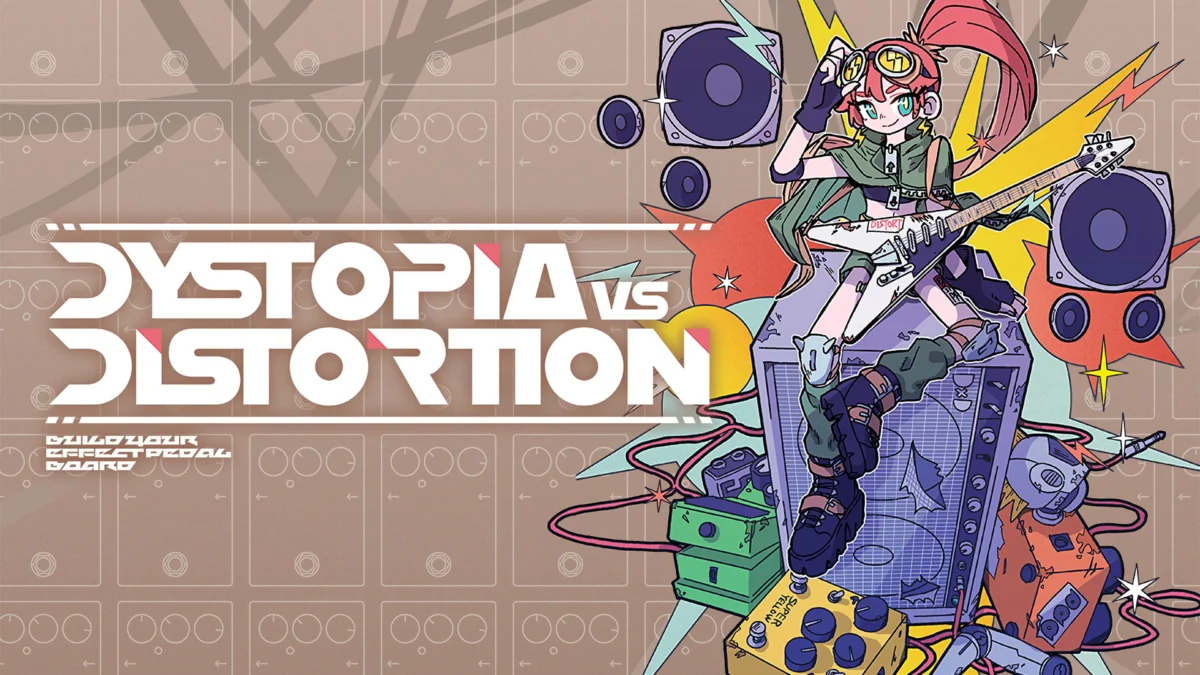
The indie gaming landscape is no stranger to the deck-builder genre. Since the explosive success of titles like Slay the Spire and Balatro, the market has been flooded with roguelike card games attempting to iterate on the formula. However, every so often, a project emerges that pivots away from traditional tropes, daring to marry disparate concepts into a cohesive, high-octane experience. Enter Dystopia VS Distortion, the latest title from Japanese developer MY NEW GAMES, which replaces magical spells and swords with the grit and technical complexity of an electric guitar pedalboard.
Main Facts: A New Frequency in Strategy
Dystopia VS Distortion is a fast-paced, stylish combat game that fundamentally reimagines the deck-building genre. Rather than drawing cards from a deck, the player manages a virtual pedalboard—a modular setup of guitar effects including Overdrive, Distortion, Compressor, Delay, Chorus, and Booster pedals.
The core premise is deceptively simple but tactically profound: in this world, sound is power. By chaining effects, players manipulate "signal flow" to produce devastating attacks, intricate defensive buffs, and complex status effects. If a player places a Distortion pedal before a Compressor, the resulting output differs significantly from a Compressor-first configuration. This approach turns the "deck" into a living, breathing signal chain, where the order of operations dictates the success or failure of a skirmish.
The game is currently available for wishlisting on Steam, signaling a growing anticipation for its unique blend of music-gear simulation and high-speed tactical action.
Chronology: From Concept to Public Reveal
The development of Dystopia VS Distortion has moved with the same frantic energy found in its gameplay. While MY NEW GAMES has remained relatively quiet during the early prototyping phases, the recent public reveal—accompanied by a trailer showcasing the game’s frenetic combat—has thrust the studio into the spotlight.
- Early Prototyping (2025): The team at MY NEW GAMES began experimenting with the idea of "signal flow combat," testing whether the nuances of audio engineering could translate into a satisfying video game mechanic.
- Announcement and Steam Page Launch (May 2026): The developer officially unveiled the title, providing a glimpse into the visual aesthetic and the core mechanics of the pedalboard system.
- Community Feedback Cycle (Ongoing): Following the announcement, the studio has been actively engaging with community feedback regarding the game’s visual direction, specifically addressing concerns regarding asset production.
Supporting Data: Why Signal Flow Matters
In traditional card games, strategy is often binary: play a card, trigger an effect. In Dystopia VS Distortion, strategy is modular and additive. The game’s engine mimics the physics of real-world audio signal processing.
For instance, consider a typical "attack" turn. In a standard game, a "Fireball" card deals X damage. In this game, an "Overdrive" pedal might grant a base damage multiplier. If followed by a "Delay" pedal, that attack could hit multiple times with diminishing returns, or if paired with a "Booster," the damage might stack exponentially.
This system forces players to think like audio engineers. During the heat of battle, players are not merely selecting actions; they are performing real-time board optimization. As the waves of mechanical enemies grow more aggressive, the margin for error shrinks. Players must adapt their signal chain on the fly, creating a loop of constant experimentation. The game succeeds by making the "deck-building" aspect a continuous, dynamic action rather than a passive, pre-battle chore.
Official Responses and the AI Controversy
As the game gained traction on social media, keen-eyed players identified the use of generative AI in certain assets—specifically background environments, enemy designs, and card illustrations. This has become a contentious topic within the indie development community, and MY NEW GAMES has been transparent in their response.
In a statement provided alongside the initial announcement, the studio acknowledged the use of these tools, clarifying their role in the current production pipeline:

"The assets currently showcased, including certain backgrounds and illustrations, utilize generative AI as a temporary measure. Our primary focus during this phase has been refining the signal-flow combat mechanics and ensuring the game feels responsive. We have a clear roadmap to replace these placeholders with fully original, hand-crafted artwork before the final release."
This response addresses the growing demand for transparency in indie development. By acknowledging the temporary nature of these assets, MY NEW GAMES is attempting to maintain goodwill while prioritizing the game’s complex mechanical foundation. Whether this will satisfy the broader industry, which remains skeptical of AI-integrated workflows, remains to be seen.
Implications for the Genre
The emergence of Dystopia VS Distortion raises significant questions about the future of the roguelite genre. Can niche, highly specific themes (like music production) successfully broaden the appeal of mechanical strategy games?
The "Music Gear" Aesthetic
The game’s aesthetic, which blends the starkness of a dystopian future with the tactile, industrial look of analog guitar gear, is a bold stylistic choice. It differentiates the game from the high-fantasy themes that currently dominate the market. By grounding its fantasy in the reality of pedals and cables, MY NEW GAMES has created a unique "language" for its mechanics. Players who have any familiarity with music gear will find an intuitive, albeit heightened, logic to the game’s rules.
Tactical Pacing vs. Traditional Turn-Based
Most deck-builders are turn-based and methodical. Dystopia VS Distortion appears to flirt with a faster, more kinetic pace. The implication here is a potential shift toward "Real-Time Deck-Building," where the pressure of the clock forces players to make suboptimal moves, thereby increasing the difficulty and the thrill of the victory. This moves the genre away from the "puzzle-solving" mindset and toward a "performance" mindset, where the player acts as a soloist in a high-stakes concert.
Looking Forward: A Technical Road Map
As we approach the final launch window, the community’s focus will undoubtedly shift toward the promised replacement of the AI assets. The quality of the final, hand-drawn art will be a critical factor in how the game is perceived by critics and players alike.
However, the game’s success will ultimately hinge on the depth of its "pedalboard" system. If MY NEW GAMES can provide enough variety in the effects—allowing for truly unique "tones" and strategies—they may have a hit on their hands. The ability to save presets, share pedalboard "builds" with friends, or challenge others in a competitive setting could elevate Dystopia VS Distortion from a curiosity to a staple of the indie scene.
In an era where many games feel like iterations of their predecessors, the audacity to build a combat system based on the intricacies of a distortion pedal is commendable. Dystopia VS Distortion is a reminder that the most compelling mechanics are often found in the most unexpected places. Whether you are a seasoned musician or a casual fan of strategy games, this title warrants a place on your Steam wishlist—if only to see if the final product can truly rock as hard as its premise suggests.
Dystopia VS Distortion is currently in development by MY NEW GAMES. For updates on the development process, including the transition away from temporary assets, stay tuned to the developer’s official channels and their Steam store page.











No comments yet. Be the first to join the conversation!