

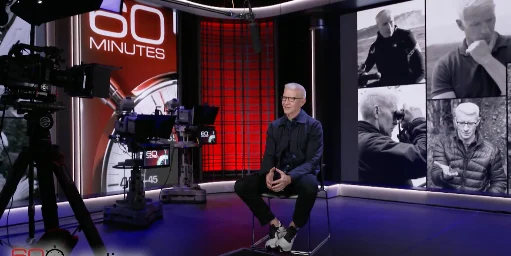
The landscape of American broadcast journalism shifted this past Sunday as Anderson Cooper, one of the most recognizable faces in modern media, signed off from 60 Minutes for the final time. The departure marks the end of a remarkable 20-year tenure with the legendary CBS newsmagazine, a run that saw Cooper evolve from a rising star of cable news into a cornerstone of the nation’s most venerable investigative program.
While the exit was announced earlier this year, the weight of the moment was palpable during the program’s digital-exclusive segment, 60 Minutes Overtime. For Cooper, the decision to step away is not a retirement from journalism, but a recalibration of priorities, driven by a desire to devote more time to his growing family. As he leaves, he departs not only with a legacy of high-stakes reporting but also with a pointed, cautionary hope for the future of the institution he is leaving behind.
A Legacy Built on Global Storytelling
Anderson Cooper’s journey with 60 Minutes began in 2006, an era when the bridge between traditional network news and the burgeoning cable news environment was still being built. When he joined the program as a correspondent, the arrangement was unique: he would contribute approximately five major reports per year, allowing him to balance his demanding daily responsibilities at CNN with the exhaustive, long-form production cycle of the CBS staple.
His first assignment for the show set the tone for his career: an investigative piece on Joe Darby, the whistleblower who brought to light the horrific abuse of Iraqi prisoners at Abu Ghraib. It was a baptism by fire that demonstrated the program’s commitment to holding power to account—a hallmark of the show that Cooper would champion for the next two decades.
Over the years, Cooper’s reporting took him to the frontlines of human suffering, conflict, and societal evolution. From natural disasters to the nuances of global technology, Cooper became known for a style that balanced hard-hitting skepticism with a profound, often visible, human empathy. His final contribution, a deep dive into the resilient taxi industry in London and its refusal to be steamrolled by the encroachment of "big tech," served as a fitting bookend to a career defined by giving voice to those caught in the gears of progress.
The Chronology of a Two-Decade Partnership
- 2006: Anderson Cooper makes his debut on 60 Minutes with an investigation into the Abu Ghraib prison scandal, establishing his credibility as an investigative correspondent.
- 2006–2015: Cooper establishes himself as a frequent flyer for the program, balancing his CNN duties with multi-part features on international crises and domestic social issues.
- 2016–2025: As a veteran contributor, Cooper becomes a permanent fixture of the Sunday night rotation, often covering stories that required a blend of investigative rigor and emotional intelligence.
- February 2026: Cooper officially announces his departure from 60 Minutes, citing a desire to spend more time with his children.
- May 2026: Cooper records his final "I am Anderson Cooper" intro, marking the definitive end of his 20-year tenure on the broadcast.
The Weight of the "I Am" Intro
For the millions of viewers who tune in every Sunday, the opening of 60 Minutes—with its rhythmic ticking clock and the signature "I am…" intros—is a foundational piece of American television culture. During his final Overtime segment, Cooper offered a rare, vulnerable look at the absurdity and gravity of that ritual.
He recalled his early days on the show, noting that the veteran correspondents, including the late, legendary Mike Wallace, would often poke fun at the newcomers as they struggled to nail the delivery of their own names. For Cooper, the act of saying his own name into the camera was "weird," a surreal moment of acknowledging his place in a pantheon of journalists he had long admired. The segment concluded with behind-the-scenes footage of his final recording session, where the composure he maintained for two decades finally wavered, showing a man deeply affected by the finality of the transition.
Official Responses and Institutional Grace
The transition was handled with mutual respect. When the news of his departure broke in February, CBS News released a statement that underscored the high regard in which Cooper is held by his colleagues.
"We’re grateful to him for dedicating so much of his life to this broadcast, and understand the importance of spending more time with family," the network noted. In a gesture that highlighted his standing within the organization, CBS added, "60 Minutes will be here if he ever wants to return," leaving the door open for future collaborations. This public show of support signaled that despite the changing of the guard at the executive level, Cooper’s contributions to the brand remain highly valued.
Implications: The Future of a Titan
While the departure is framed as a personal decision, it occurs at a time of significant transition for CBS News. Under the new leadership of Editor-in-Chief Bari Weiss, 60 Minutes faces questions regarding its editorial direction and its role in a rapidly fragmenting media landscape.
Cooper’s remarks during his farewell were not merely sentimental; they contained a subtle, professional plea for the preservation of the show’s soul. "There are very few things that have been around for as long as 60 Minutes has and maintained the quality that it has," Cooper remarked. He acknowledged the necessity of evolution—"things should evolve and change"—but tempered that with a warning: "I would hope the core of what 60 Minutes is always remains."
He emphasized that the program’s primary currency is trust. In an era of rampant misinformation and declining institutional faith, Cooper argued that maintaining the independence of 60 Minutes is "critical." His words were widely interpreted by industry analysts as a signal of concern regarding the potential for corporate or ideological influence under the new editorial regime. By explicitly stating that the program’s independence is the foundation of its success, Cooper effectively challenged his successors to maintain the high standard that has allowed the show to survive for over 50 years.
The Viewers’ Perspective: A Loss of Stability
The reaction from the viewing public has been one of significant loss. For many, Cooper represented a bridge between the old guard of broadcast journalism and the modern, fast-paced digital age. His ability to distill complex, often harrowing stories into digestible, meaningful narratives made him a staple of American Sunday nights.
Data surrounding the show’s demographics suggest that Cooper was a vital draw for a wide range of viewers, from legacy audiences who have watched the show since its inception in 1968 to younger viewers who followed him from his CNN work. As the show prepares to move forward without him, the challenge for CBS will be to retain that broad coalition of support while navigating the pressures of a 24-hour news cycle that often prioritizes speed over the methodical, month-long investigations that are the hallmark of the 60 Minutes brand.
Looking Ahead: The Evolution of Broadcast Journalism
The departure of Anderson Cooper is symptomatic of a larger trend in television. The "star correspondent" model, which relied on figures with decades of institutional experience, is being tested by shifting economic models and changing consumer habits. However, the success of 60 Minutes proves that there is still a massive, hungry audience for deep-dive journalism.
As Cooper moves into the next phase of his career, he leaves behind a template for how to report on the world with empathy, integrity, and a healthy dose of skepticism. Whether or not 60 Minutes can maintain that "core" of which he spoke remains to be seen. What is certain, however, is that his voice—and his signature intro—will be sorely missed.
In the final analysis, Cooper’s tenure was more than just a job; it was a commitment to the idea that journalism, at its best, serves the public interest by shining a light into the darkest corners of the world. As he steps off the stage, he leaves the program, and his audience, with a simple but profound reminder: trust is earned in drops and lost in buckets. Protecting that trust is the only way for any legacy media institution to survive the next twenty years.












No comments yet. Be the first to join the conversation!