

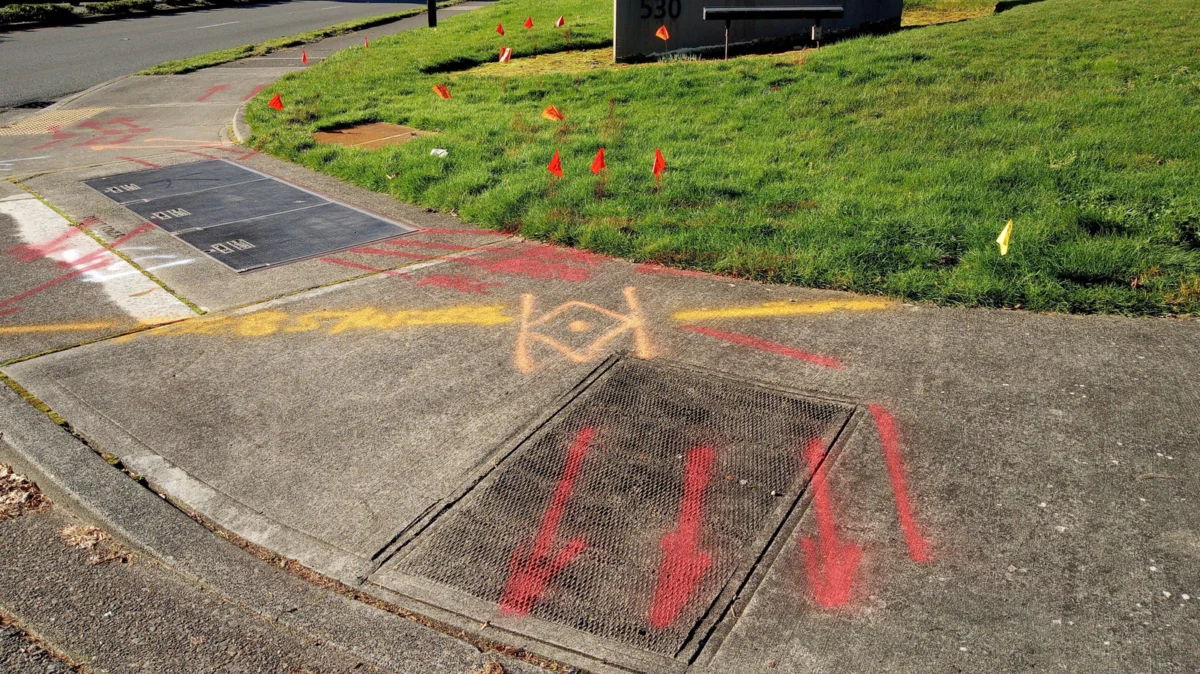
If you were to step outside your front door this morning and find your lawn crisscrossed with vibrant ribbons of neon spray paint and a series of brightly colored flags, your first instinct might be confusion or mild annoyance. You might wonder if a surveyor has lost their way or if an eccentric landscaper has decided to decorate your property. However, according to the standard operating procedures of utility infrastructure management, these markings are far more than mere aesthetic clutter—they are the invisible map of your home’s subterranean lifeblood.
While the pop-culture reference to "The Hitchhiker’s Guide to the Galaxy" suggests we should "don’t panic," the presence of these markings should trigger a specific, proactive response. Whether you are planning a DIY garden project or simply curious about why your yard has been designated as a site of interest, understanding the 811 system is not just a recommendation—it is a fundamental responsibility of property ownership.
The Invisible Network: Understanding What Lies Beneath
Most homeowners view their property as a static surface of grass, concrete, and soil. In reality, the ground beneath your feet is a high-traffic corridor for essential modern services. From complex irrigation systems—including sophisticated smart controllers that manage water usage—to high-voltage electricity, pressurized natural gas, fiber-optic telecommunications, and municipal sewer lines, the subsurface of an average American residence is a marvel of engineering.
Because these lines are buried at varying depths and often lack the documentation necessary for accurate mapping, they remain effectively invisible to the naked eye. This is why the nationwide 811 service exists. By calling 811—a free service that connects callers to local utility notification centers—property owners trigger a process that brings professional locators to their doorstep. These specialists utilize ground-penetrating radar, electromagnetic pipe locators, and detailed municipal archives to map exactly where the danger zones lie before a single shovel enters the earth.
Chronology of Risk: Why Safety Protocols Fail
The necessity of the 811 process is underscored by the catastrophic consequences that occur when safety protocols are bypassed or ignored. History is littered with examples of the "cataclysmic events" that occur when excavation equipment meets pressurized infrastructure.
The Oakland Incident (December 2025)
In December 2025, a residential neighborhood 15 miles south of Oakland, California, became the site of a harrowing reminder of these risks. A routine construction project turned into a disaster when a crew inadvertently struck a major gas line. The resulting explosion leveled a home and caused severe structural damage to the adjacent property. Six individuals were injured in the blast, serving as a stark reminder that a utility strike is not merely a financial inconvenience—it is a matter of life and death.
The Mountain View Contamination
Not all failures result in explosions; some result in long-term public health crises. In Mountain View, California, a project involving the replacement of neighborhood water pipes went awry when a construction crew allowed cement slurry to seep into the local water system. The result was a weeks-long boil-water notice for 67 homes, as bacteria introduced by the slurry rendered the municipal supply unsafe for consumption. This incident highlighted the secondary risks of excavation: when one line is compromised, the integrity of the entire neighborhood’s infrastructure is threatened.
The APWA Uniform Color Code: A Universal Language
To ensure that every contractor, utility worker, and homeowner is speaking the same language, the American Public Works Association (APWA) has established a universal color-coding system. If you see paint or flags, you are looking at a standardized diagnostic code:
- Red: Indicates electric power lines, lighting cables, and conduit.
- Orange: Represents telecommunication, alarm, and signal lines, including fiber optics.
- Yellow: Used exclusively for natural gas, oil, steam, petroleum, or other flammable, pressurized materials.
- Green: Notifies of sewer and drain lines.
- Blue: Identifies potable drinking water lines.
- Purple: Indicates reclaimed water, irrigation systems, and slurry lines.
- Pink: Serves as a catch-all for temporary survey markings or unidentified utility sources.
- White: Outlines the proposed limits of the excavation site.
These colors are not arbitrary; they are mandated by law to prevent confusion. When a homeowner sees yellow flags near a planned fence-post hole, it serves as an immediate red flag—pun intended—that they are working in a zone that could lead to a catastrophic gas leak.
Supporting Data: The Economics of 811 Compliance
The federal government and state utility commissions have long advocated for the "Call Before You Dig" mandate. Data consistently shows that the cost of an 811 inspection is zero, while the cost of a utility strike can reach hundreds of thousands of dollars.
Beyond the immediate repair costs, there are legal implications. In many jurisdictions, the party responsible for the excavation is held liable for the entirety of the repair costs, service outages for the entire neighborhood, and any medical expenses incurred by those affected. Furthermore, state "tolerance laws" often dictate that once a line is marked, the excavator must maintain a "tolerance zone"—usually 24 inches on either side of the mark. Within this zone, mechanical digging is strictly prohibited, and workers are required to use hand tools to carefully expose the line. Ignoring these mandates often results in the loss of insurance coverage and potential criminal negligence charges.
Official Responses and Best Practices
Utility commissions across the United States have consistently emphasized that the "two-day lead time" requirement is the most effective safety barrier against damage. By notifying utility companies at least 48 to 72 hours before a project begins, property owners allow sufficient time for the coordination of multiple utility stakeholders.
"The goal of 811 is to prevent the preventable," says a spokesperson for a regional utility safety board. "When a homeowner decides to bypass the notification process, they are effectively rolling the dice on their own safety and the safety of their neighbors. The markings left by our teams are not suggestions; they are precise engineering indicators that define the boundary between a successful project and a local disaster."
Implications: Building a Culture of Responsibility
The implications of utility neglect extend far beyond the individual property. In an era where cities are increasingly dependent on interconnected, aging infrastructure, a single strike can disrupt internet access, water purity, and power stability for entire city blocks.
If you find markings on your property and you did not request them, the first step is to communicate. Consult your neighbors; it is highly likely a nearby property owner has contracted work that requires an assessment of the utility lines running through your land. If the source remains a mystery, contact your local 811 center immediately. They can provide information on which companies are active in your area and whether the markings are valid or expired.
Ultimately, the goal is to be a responsible steward of your property. Nobody wants to be remembered as the neighbor who caused a neighborhood-wide blackout or a water-system contamination. By respecting the flags, understanding the color codes, and adhering to the 48-hour notification window, homeowners can ensure that their DIY aspirations do not end in a catastrophe that changes their neighborhood—and their reputation—forever. Safety is not a hurdle to clear; it is the foundation upon which every successful home improvement project is built.










No comments yet. Be the first to join the conversation!