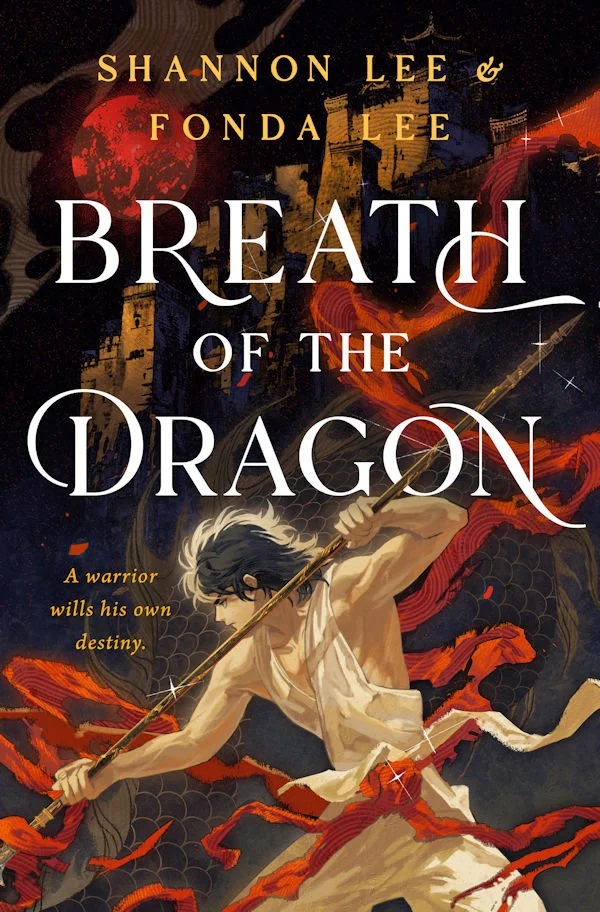
In the landscape of modern Young Adult (YA) fantasy, few collaborations have generated as much curiosity and critical intrigue as Breath of the Dragon. Released in January 2025, this opening volume of the Breathmarked duology represents a unique intersection of literary pedigree and martial arts philosophy. Co-authored by Shannon Lee—CEO of the Bruce Lee Family Companies—and acclaimed fantasy novelist Fonda Lee, the book serves as both a high-stakes adventure and a vessel for the enduring philosophical legacy of Bruce Lee.
Main Facts: A Tale of Two Brothers and a Nation’s Fate
At its core, Breath of the Dragon is a classic coming-of-age story set against a rich, non-European fantasy backdrop inspired by Ancient China. The narrative centers on sixteen-year-old Jun Li, a youth haunted by his family’s past. His father, disgraced and banished, has forbidden Jun from pursuing the life of a warrior, particularly because Jun lacks a "Breath Mark"—the literal patch of dragon scales that grants magical abilities to the chosen elite of his society.
Jun’s twin brother, Sai, is everything Jun is not: marked, gifted, and destined for the prestigious Guardian’s Tournament, a decennial trial held to select the protector of the magical Scroll of Earth. Driven by a desire to restore his family’s lost honor and escape the shadow of his brother, Jun stows away in the wagon of a troupe of traveling performers—the pragmatic Chang and his daughter, Ren—to infiltrate the capital and compete in the tournament. What begins as a personal quest for validation quickly escalates into a political struggle that threatens the stability of the entire nation.
Chronology: From Conception to Critical Reception
The trajectory of the Breathmarked duology has been marked by significant anticipation.
- January 2025: The publication of Breath of the Dragon introduces readers to the world of the Breathmarked.
- Early 2026: As the novel gains traction in YA circles, critics begin to praise its crisp, accessible prose and its departure from traditional Western-coded fantasy tropes.
- October 27, 2026: The scheduled release of the second installment, Mark of the Warrior, promises to conclude the arc initiated in the first volume.
The series is designed as a duology; while Breath of the Dragon provides a satisfying, self-contained emotional arc for Jun Li, it leaves the broader political intrigue of the realm unresolved, effectively funneling readers toward the upcoming conclusion.
Supporting Data: Literary Style and World-Building
One of the most notable aspects of Breath of the Dragon is the stylistic choice made by the authors. Unlike the dense, flowery prose often found in "high fantasy," the writing here is deliberately clean, efficient, and direct. This stylistic decision serves a dual purpose: it mirrors the disciplined, no-nonsense philosophy of martial arts, and it makes the genre significantly more accessible to younger readers who might otherwise be intimidated by overly decorative prose.
A New Cultural Horizon
For readers accustomed to the "medieval Europe" aesthetic—towers, corsets, and hunting harts—Breath of the Dragon offers a refreshing, albeit challenging, shift. The world-building leans into an Ancient Chinese-inspired setting. However, this shift presents a minor hurdle for some readers: the lack of familiar cultural signifiers. Without the common shorthand of European-based fantasy, the early chapters require a period of orientation. While the authors rely on the environment and social structures to establish the setting, some critics have noted that the "modern" tone of the dialogue occasionally masks the specific historical markers of the world, making the temporal and geographical placement feel somewhat fluid.
The Philosophy of the "Breath"
The magic system, based on "Breath Marks," is more than a plot device; it is an allegory for human potential. The dichotomy between the marked (Sai) and the unmarked (Jun) serves as a platform to explore the idea that innate gifts are secondary to hard work and discipline. By weaving Bruce Lee’s real-world philosophies into the narrative, the authors transform the fantasy tournament into a laboratory for character development. As Ren, a central supporting character, poignantly notes: "The gifts we work for are greater than the ones we’re given."
Official Perspectives and Philosophical Underpinnings
Shannon Lee’s involvement is not merely promotional; it is foundational. By integrating her father’s writings on physical and mental discipline, unity, and integrity, the novel functions as an accessible entry point to Jeet Kune Do philosophy.
The authors use the internal conflict within the nation—specifically the corruption and self-serving nature of those in power—to highlight the necessity of unity. The character of Jun serves as the reader’s moral compass. His realization that "the people on the other side of the wall" are not inherently different from his own kin acts as a sharp critique of tribalism and political corruption. The book rejects the "heroic" trope of fighting for glory, instead positioning the pursuit of self-mastery as the ultimate goal.
Implications for the YA Genre
The success of Breath of the Dragon has significant implications for the future of the YA fantasy market.
Accessibility and Content
With a recommended age of fourteen and up, the book strikes a balance between intensity and maturity. While the presence of occasional profanity and violent combat has been noted, the authors avoid the pitfalls of excessive romantic subplots, keeping the focus squarely on personal development and the stakes of the quest. The potential for "world-specific" cursing—whereby authors create original slang to replace modern profanity—remains a missed opportunity for broadening the age appeal even further, but this does little to dampen the impact of the story’s moral core.
The Physicality of Reading
An unexpected point of interest for readers has been the physical production of the book. The use of sprayed edges—where the pages are stained with pigment—has been highlighted as a tactile delight. The need to gently separate the pages, and the resulting "crackly" sound, has contributed to a resurgence in the appreciation for physical books in an era dominated by e-readers. It adds a sensory dimension to the reading experience that aligns with the book’s emphasis on the physical connection between the practitioner and their craft.
Conclusion: The Road Ahead
Breath of the Dragon stands as a testament to the power of collaboration. By blending Fonda Lee’s mastery of narrative structure with Shannon Lee’s commitment to her family’s legacy, the novel achieves a rare equilibrium: it is a fast-paced, exciting adventure that does not sacrifice depth or philosophy.
As we approach the release of Mark of the Warrior, the stakes have never been higher for Jun Li. He has learned that he does not need a dragon scale to command his own destiny, yet the "winter wind" described by his mentor, Chang, suggests that the hardest battles are still to come. For those who have yet to pick up this duology, the journey is one well worth undertaking—not just for the thrill of the tournament, but for the profound lessons tucked within its pages.
Whether one is a devotee of martial arts philosophy or simply a reader in search of a compelling, well-crafted fantasy world, Breath of the Dragon offers a path to self-discovery that is both timely and timeless. As Chang warns, we are all caught in the wind of these dangerous times, but as Jun proves, we possess the internal strength to navigate it.