

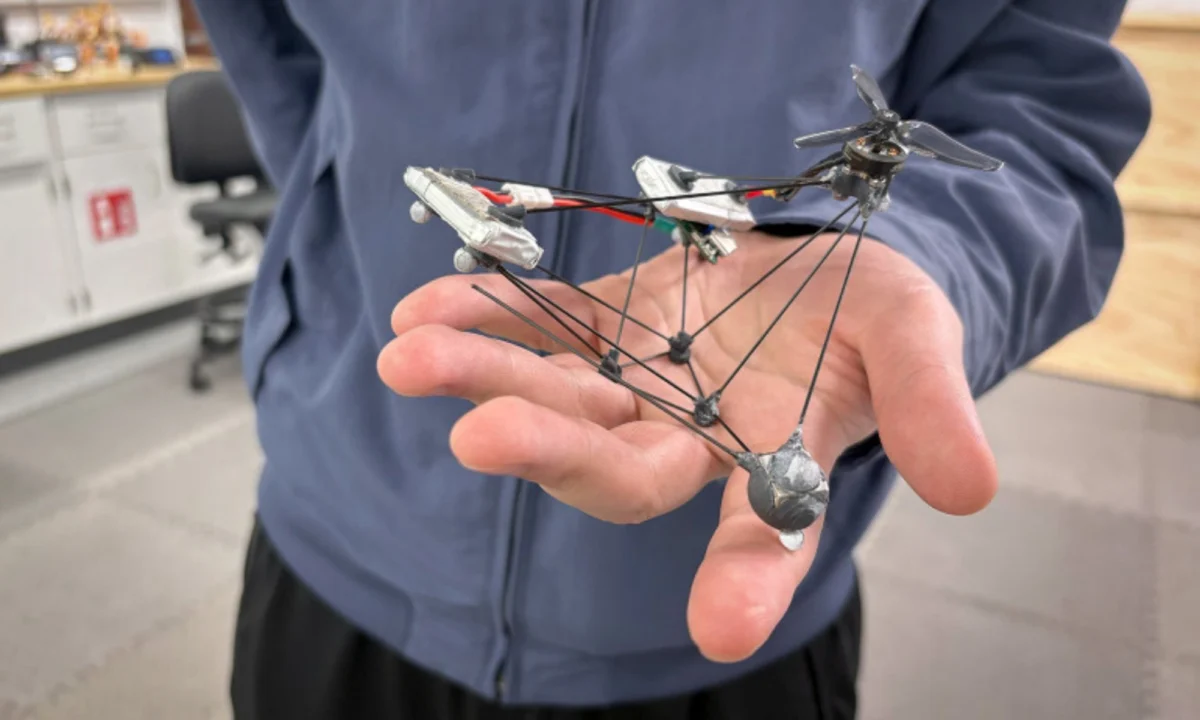
For decades, the pursuit of the "invisible drone" has been dominated by high-concept physics. Engineers have poured billions into metamaterials, sophisticated light-bending optical arrays, and adaptive camouflage coatings that attempt to mimic the surrounding environment. Yet, these methods often remain tethered to the realm of laboratory prototypes, plagued by high costs, heavy hardware, and extreme fragility.
Researchers at Northwestern University have effectively abandoned the quest for true optical invisibility, choosing instead to exploit a fundamental vulnerability in the human cognitive system. Their creation, dubbed "Phantom Twist," does not hide from the light; it hides from the brain. By utilizing high-speed, synchronized rotation, this experimental drone renders itself nearly imperceptible, appearing as nothing more than a faint, ghostly shimmer against the sky.
The project, which made its formal debut at the Robotics: Science and Systems 2026 conference in Sydney, Australia, signals a paradigm shift in how we approach stealth technology in aerial robotics.
The Mechanics of Perception: Why Motion Beats Metamaterials
To understand the genius of Phantom Twist, one must first understand how the human eye interprets rapid motion. If you have ever stared at a ceiling fan spinning at full capacity, you have witnessed the core principle of the Phantom Twist. At low speeds, the individual blades are distinct, measurable objects. However, once the rotational velocity crosses a specific threshold, the eye loses the ability to track individual components. The brain, unable to process the rapid shifting of position, averages the visual information, perceiving a translucent, static blur rather than a spinning mechanism.
Conventional quadcopters fail this test of stealth because they are architecturally static. Their bodies remain fixed while their propellers move, creating a clear, recognizable silhouette that the human eye is evolutionarily primed to identify as a "threat" or an "object of interest."
Phantom Twist discards the stationary chassis entirely. The drone consists of a single motor and a primary propeller; as the propeller drives the craft upward, the entire fuselage rotates in the opposite direction at a staggering 25 revolutions per second. By ensuring that no part of the aircraft remains stationary relative to the viewer, the drone eliminates the visual "anchor points" that allow our brains to assemble a coherent image of a flying machine.
A Digital Evolution: The Role of AI in Stealth Engineering
The development of Phantom Twist was not a product of traditional manual drafting. Rather, it was the result of a massive computational simulation that bridged the gap between raw physics and cognitive psychology.
The 20,000-Design Gauntlet
Before a single piece of carbon fiber was cut, the Northwestern team leveraged artificial intelligence to explore the vast "design space" of the drone. The team generated approximately 20,000 unique drone configurations. These digital models were then subjected to rigorous optimization algorithms that repositioned critical internal components—batteries, circuit boards, motors, and counterweights—in real-time.
The goal of this optimization was singular: stability in rotation coupled with the lowest possible visual profile. The AI sought a balance where the drone’s center of mass remained perfectly aligned, preventing erratic wobbling that would betray the drone’s shape to the human eye.
Simulated Realism
To validate these designs, the researchers simulated the drones against a dataset of 100 diverse, real-world environmental backgrounds, ranging from dense forest canopies to clear blue skies and urban silhouettes. A specialized computer vision model—designed to replicate the human visual cortex’s processing speed and sensitivity—acted as the final judge. Each design was scored based on its "detectability index."
The winning design, which eventually became the Phantom Twist prototype, features a deliberate, asymmetric distribution of components. By spreading the weight and structure across varying heights and angles, the drone ensures that when it reaches its 25 Hz rotational speed, the overlapping silhouettes of the components merge into a uniform, semi-transparent haze.
Supporting Data: Quantifying the Ghost Effect
The implications of this research are backed by significant metrics regarding human reaction times and visual detection thresholds. According to the team’s internal visibility model, the Phantom Twist is approximately 10 times less noticeable than a standard quadcopter of similar size.
- Rotational Velocity: Up to 25 revolutions per second.
- Visibility Reduction: 90% decrease in visual detectability compared to standard drones.
- Cognitive Load: The motion-blur effect forces the human brain to ignore the object as "background noise," significantly increasing the time required for a human observer to consciously identify the craft as an aerial vehicle.
While the drone is not "invisible" in a vacuum, the latency of detection is the primary success factor. In field tests, human observers required several seconds to confirm they were looking at a drone, rather than a bird or a trick of the light, whereas a standard quadcopter was identified almost instantaneously.
Official Perspectives: The Vision of Michael Rubenstein
Project lead Michael Rubenstein, a professor of electrical and computer engineering at Northwestern, has been candid about the project’s limitations and its ultimate potential.
"We weren’t looking for a military-grade cloak," Rubenstein explained during the Sydney presentation. "We were looking for a way to interact with the world without becoming a disturbance. We found that the easiest way to hide something isn’t to bend light around it—which is incredibly difficult and expensive—but to ensure that the human brain never registers the object as a discrete entity in the first place."
Rubenstein emphasized that the "ghostly haze" produced by the drone is a result of playing with the biology of perception. "It is an optical illusion in the truest sense. The drone exists, it is physically there, but it is effectively ‘invisible’ to the human cognitive processing unit because it doesn’t fit the category of ‘thing’ that our brains are trained to track."
Real-World Implications and Future Frontiers
The potential applications for this technology extend far beyond the novelty of a "spinning drone." In sectors where the presence of technology actively alters the environment being studied, Phantom Twist could be a transformative tool.
Wildlife and Ecological Research
Observing nesting birds or sensitive apex predators often requires massive, bulky camera rigs that can frighten the very subjects scientists are trying to record. A drone that appears as nothing more than a blur in the peripheral vision would allow researchers to gain high-fidelity data without changing the natural behavior of the animals.
Urban Infrastructure and Public Spaces
Environmental and structural surveys in crowded cities are often met with public skepticism or privacy concerns. By minimizing the visual footprint of these drones, municipalities could conduct routine maintenance checks on bridges, power lines, and buildings with significantly less public friction and distraction.
The Challenges Ahead
Despite the breakthrough, the team acknowledges that Phantom Twist is far from a finished product. Two major hurdles remain:
- Acoustic Stealth: While the drone has conquered the visual spectrum, it still produces a distinct, high-pitched whine common to high-speed propellers. Future research will need to address the acoustic signature, perhaps by experimenting with advanced blade geometries or silent propulsion technologies.
- Structural Transparency: While the rotation obscures the shape, the support rods and internal wiring remain visible under certain lighting conditions. The team is currently exploring the use of high-strength, transparent polymers to further reduce the drone’s physical density.
Conclusion: The New Face of Stealth
The Phantom Twist is a stark reminder that in engineering, the most complex problems do not always require the most complex solutions. By shifting the focus from the material to the observer, Northwestern University has bypassed the "invisibility" race in favor of a more clever, bio-inspired strategy.
While science fiction has long promised us cloaking fields and light-bending surfaces, the reality of the future may be far more subtle. We may soon share the skies with drones that are not hidden behind advanced technology, but hidden behind the simple, beautiful limitations of our own biology. In the coming years, as this technology matures, we may find that the most effective way to be unseen is simply to blur the lines of what is real.











