

By News Desk
Updated: April 16, 2026, 2:28 p.m. UTC
For thousands of social media users, the early hours of Thursday, April 16, 2026, were marked by a sudden, frustrating silence. Bluesky, the decentralized social media platform frequently positioned as the primary competitor to Elon Musk’s X (formerly Twitter), experienced a significant service disruption that rendered the app and web interface largely inaccessible for a substantial portion of the morning.
While the platform has since returned to full functionality, the outage serves as a stark reminder of the technical challenges inherent in scaling a rapidly growing social network. This report examines the timeline of the disruption, the impact on the user base, and the broader implications for the platform’s infrastructure.
The Chronology of the Disruption
The instability began in the early morning hours of Thursday, catching many users off-guard as they attempted to check their feeds.
6:30 a.m. ET: Initial Reports Surface
The first signs of trouble appeared shortly after 6:30 a.m. ET. Monitoring services, most notably Downdetector, began registering a sharp, vertical spike in user-submitted reports. Within minutes, the number of complaints grew from a handful to over a thousand, indicating a widespread failure rather than an isolated glitch. Users reported an inability to load posts, refresh timelines, or access the login portal across both the mobile application and the desktop browser interface.
6:42 a.m. ET: Official Acknowledgment
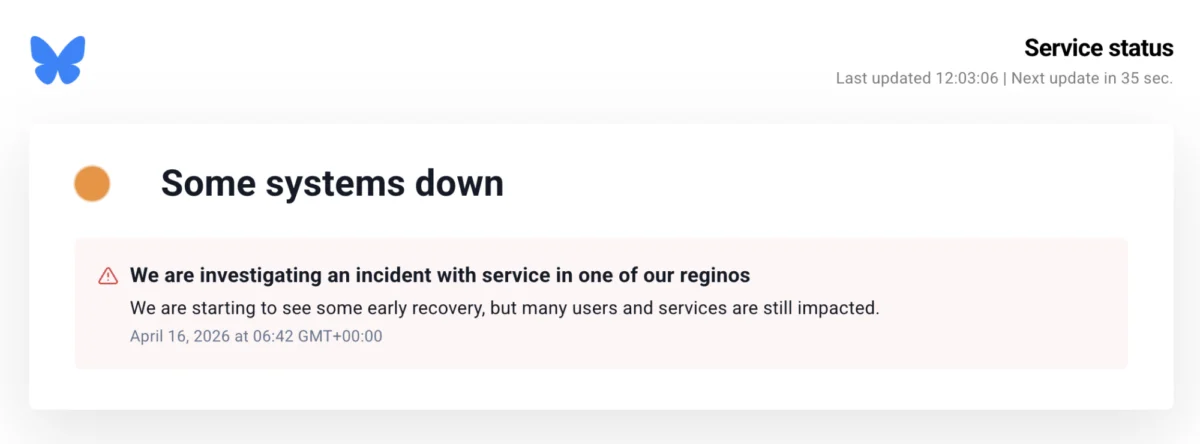
Bluesky’s engineering team acted with relative swiftness, updating their dedicated status page (status.bsky.app) at 6:42 a.m. ET. The company publicly acknowledged an "incident" and confirmed that "some systems [were] down." This transparency is a cornerstone of the platform’s branding, distinguishing it from the often opaque communication strategies of larger, legacy social media giants.
7:00 a.m. – 11:40 a.m. ET: The Recovery Phase
Throughout the morning, the company provided periodic updates. By 7:30 a.m. ET, engineers reported seeing "early recovery" signs; however, the transition back to normalcy was staggered. Many users continued to report "loading issues" and partial outages well into the late morning. By 11:40 a.m. UTC, the service had stabilized significantly, though intermittent latency remained a concern for a segment of the user population.
2:28 p.m. ET: Full Restoration
By early afternoon, the platform’s status dashboard officially transitioned back to an “operational” state. Bluesky confirmed to media outlets, including Mashable, that the technical team had successfully resolved the underlying interruptions.

Supporting Data and Technical Context
The outage was characterized by a massive influx of reports on monitoring platforms. Downdetector, which tracks service disruptions across the web, logged a massive volume of reports that peaked just before 7:00 a.m. ET.
(Disclosure: Downdetector and Mashable are both owned by the same company, Ziff Davis.)
The visual data provided by the status monitoring tools showed a classic "spike and plateau" pattern, common in server-side failures. The screenshots captured during the event highlighted a critical system failure, with the status dashboard turning from the standard green "Operational" color to a warning status indicating system degradation.
While Bluesky has not released a formal “post-mortem” or root-cause analysis (RCA) detailing the specific technical triggers, industry experts suggest that such outages are frequently tied to database congestion, load-balancer failures, or cascading errors within the microservices architecture that powers the AT Protocol (Authenticated Transfer Protocol). Given the decentralized nature of Bluesky, even minor hiccups in the central relay or authentication servers can have an outsized impact on the user experience.
Official Responses and Communication
Throughout the event, Bluesky maintained a consistent, albeit brief, line of communication. A representative for the company provided the following statement to the press:
"We are experiencing some service interruptions and our team is working on the issue. You can find the latest updates at status.bsky.app or the Bluesky Server Status account."
This approach underscores a deliberate strategy of directing users to a single source of truth. By funneling reports toward their status page, the company aimed to minimize misinformation and provide real-time updates to its community. Despite the frustration felt by users, the platform’s commitment to keeping its status page updated is a development that many observers view as a “best-in-class” practice for modern tech companies.
The Broader Implications: Bluesky vs. The Giants
The outage invites a broader conversation regarding the stability of social media alternatives. Bluesky has spent the last year aggressively onboarding new users who are disenchanted with the changing landscape of X. However, the expectations for a platform that aspires to be a "digital town square" are immense.

Infrastructure at Scale
As Bluesky grows, the complexity of its infrastructure grows exponentially. Managing a federated network that supports thousands of concurrent users requires robust, redundant server architecture. When a platform is in a high-growth phase, technical debt and scaling bottlenecks are often inevitable. For many in the tech community, this outage is viewed as a "growing pain" rather than a systemic failure.
User Trust and Platform Loyalty
The reaction from the Bluesky community was, in many ways, a testament to the platform’s unique culture. Unlike users on older platforms who often express outrage or cynicism during outages, a significant portion of the Bluesky community responded with patience and, in some cases, humor. This indicates a high level of "brand equity" that the company has built through its open-source philosophy and direct engagement with its user base.
The Decentralization Factor
One of the core promises of Bluesky is the AT Protocol, which aims to give users more control over their data and their feeds. Critics of centralized social media often point to the "single point of failure" problem inherent in platforms like X or Facebook. Paradoxically, even though Bluesky is designed to be decentralized, it still relies on core services that, when interrupted, affect the entire user base. This serves as a reminder that "decentralized" does not inherently mean "invulnerable."
Future Outlook
Following the resolution of the incident, the focus for the Bluesky team will likely shift to preventing a recurrence. Technical teams often conduct comprehensive audits following such events to identify the "bottlenecks" that led to the service failure.
For the average user, the takeaway is simple: the platform is maturing. With maturity comes the necessity for enterprise-grade reliability. As the company continues to expand its feature set—including video integration, improved moderation tools, and expanded developer APIs—the technical burden on its servers will only increase.
As of the latest update on April 16, 2026, the platform appears to be operating normally. Users who were unable to log in during the morning hours are now back on their feeds. While the outage was a significant hurdle, the speed with which the team responded and restored service suggests that the platform is well-equipped to handle the growing demands of its global audience.
For now, the Bluesky community remains active, with the platform continuing its trajectory as a key player in the evolving landscape of digital communication. Whether this incident will lead to further infrastructure investments remains to be seen, but it is certain that the team will be under increased pressure to maintain high uptime as the platform’s reputation for reliability becomes as important as its reputation for innovation.












No comments yet. Be the first to join the conversation!