

In the ever-evolving landscape of digital culture, TikTok has long served as an unofficial laboratory for relationship dynamics. From the "orange peel theory," which tested a partner’s willingness to perform small acts of service, to the "bird test," designed to gauge emotional attentiveness, these social media benchmarks often blur the line between playful experimentation and genuine concern. However, the latest trend—a seemingly simple literacy test—has transcended the realm of "couple goals" to ignite a sobering, widespread debate regarding the state of American education and the intellectual habits of a generation.
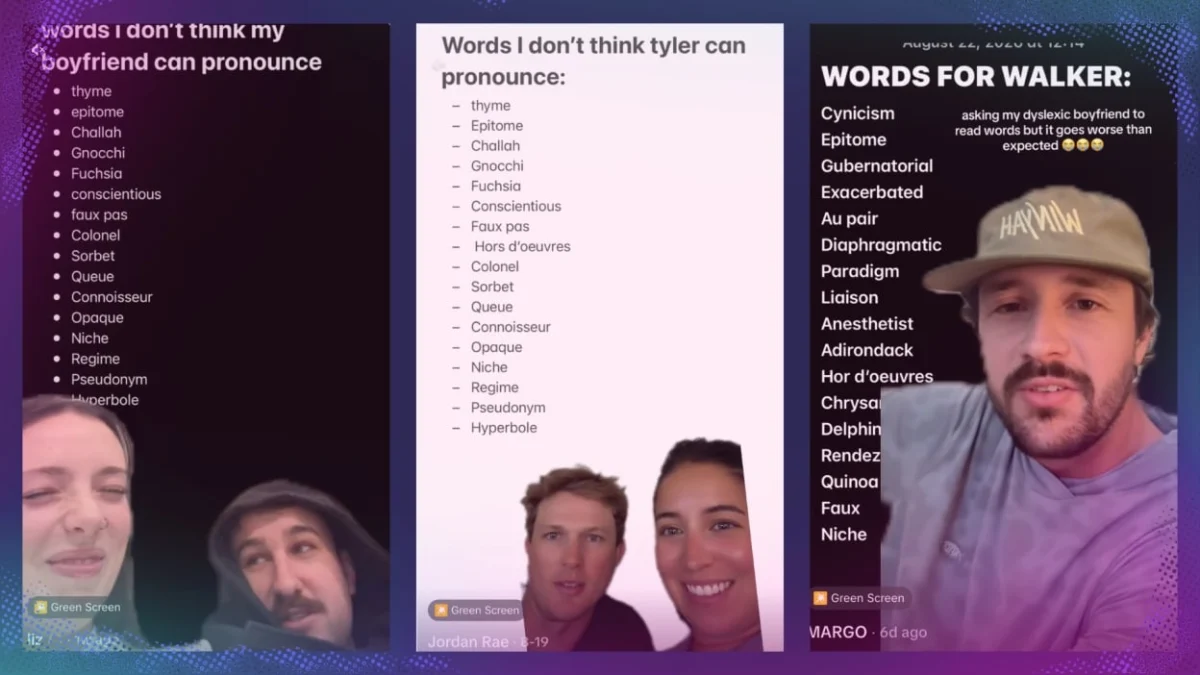
The premise of the new viral challenge is starkly straightforward: women present their boyfriends or husbands with a list of words that are notoriously tricky to pronounce based on their English spelling—such as "epitome," "colonel," "hyperbole," "quinoa," and "niche"—and record their attempts to read them aloud. What begins as a lighthearted, giggly exercise in many videos often devolves into a cringeworthy display of linguistic stumbling, as partners struggle to decipher words that most would classify as common vocabulary.
The Chronology of a Viral Phenomenon
The trend did not emerge in a vacuum. It represents the latest iteration of the "boyfriend test" genre, a specific category of content that relies on the audience’s voyeuristic desire to evaluate the intelligence or dedication of a stranger’s partner.
Earlier this summer, the cultural conversation began to shift toward a more critical assessment of vocabulary and verbal articulation. Much of this scrutiny was directed at the cast of Love Island USA Season 8. As viewers tuned in, they weren’t just watching the romantic entanglements; they were analyzing the contestants’ syntax and vocabulary. Moments where participants mispronounced foundational words or failed to grasp common idiomatic expressions became fodder for viral clips. When a contestant like Sincere struggled with "epitome"—the very word that would later become a cornerstone of the TikTok literacy trend—or when others mangled simple expressions, the internet did not just laugh; it began to diagnose.
By late August 2026, the skepticism surrounding the Love Island cast had permeated the broader TikTok ecosystem. Users began stress-testing their own significant others, and the results were, for many, a wake-up call. The videos, once a source of comedic relief, began to trigger a deeper, more existential anxiety among viewers.

Supporting Data: Beyond the Memes
While TikTok videos are anecdotal by nature, they have become a diagnostic mirror for a much broader, statistically supported reality. The anxiety fueling this trend is rooted in tangible shifts in American literacy rates.
According to the most recent federal data from the National Center for Education Statistics (NCES), the landscape of adult literacy is shifting in a concerning direction. The percentage of American adults aged 16 to 65 performing at the lowest literacy level—Level 1 or below—surged from 19 percent in 2017 to 28 percent by 2023. The data reveals that while the decline is widespread, the shift is particularly pronounced among men, whose representation at the lowest literacy tier climbed to 29 percent.
These statistics are bolstered by a decline in engagement with long-form text. Federal data indicates that the proportion of adults reading at least one book per year has plummeted from 54.6 percent in 2012 to 48.5 percent in 2022. Even more striking is the decline in daily reading habits among 13-year-olds, which has been cut nearly in half over the same period.
Educational institutions are feeling the pressure of this transition. College professors across the country have reported a marked shift in the classroom, with many feeling compelled to shorten reading lists because students are increasingly unable or unwilling to complete full-length texts. The rise of generative AI tools, such as ChatGPT, has provided a convenient, if detrimental, bypass for students looking to summarize complex literature rather than engage with the nuance of the source material.
The Digital Echo Chamber: Responses and Reactions
The discourse surrounding the "Can your boyfriend read?" trend has been polarized, reflecting a deep divide in how society views the intersection of social media trends and serious societal issues.

On one side, there is the alarmist reaction. Creators like Isabella Von Ghoul have voiced genuine concern, stating, "The state has failed your man, and I’m scared." This perspective argues that these videos are not merely entertainment but a symptom of a systemic collapse in public education. On Reddit and X (formerly Twitter), the sentiment is often harsher, with users suggesting that partners should treat a lack of basic literacy as a "red flag" significant enough to warrant re-evaluating the relationship.
Conversely, some high-profile influencers have questioned the ethics of the trend. Tinx, a prominent voice in digital culture, famously asked, "Why are you guys boasting that your boyfriends can’t read?" This critique highlights the performative nature of the trend; for many, the girlfriend is not just exposing her partner’s ignorance, but using it as a prop for engagement. As creator Daniel Bennett pointedly remarked, "In the videos, the girlfriends are giggling. But we aren’t laughing with you. We’re laughing at you."
This friction suggests that the trend is less about the boyfriend’s ability to pronounce "hyperbole" and more about the cultural value we place on intelligence, presentation, and the optics of a partner’s perceived status.
Implications for a "Post-Literate" Age
The broader implications of this trend point toward a shift that The Atlantic recently characterized as the dawn of a "post-literate" age. This theory suggests that while the population remains technically literate—most people can process text on a screen—the act of sustained, deep reading is becoming an increasingly rare skill.
In this environment, language is processed in fragments. Words like "niche" or "epitome" are increasingly encountered in digital environments where they are rarely spoken aloud. Consequently, the disconnect between the visual appearance of a word and its oral pronunciation grows wider. When a young adult encounters these words primarily through text-based social media or AI-generated captions rather than through books, the phonetic bridge is never built.

The "boyfriend literacy test" is a crude instrument, but it acts as a cultural lightning rod. It forces a collision between the short-form, rapid-fire consumption of content that defines modern life and the traditional academic standards of the past.
Conclusion: The Mirror of the Screen
Ultimately, the trend serves as a reminder that our digital habits are not detached from our cognitive habits. While a few mispronounced words on a smartphone screen are far from a definitive diagnostic of a national crisis, they are reflective of a culture that is moving further away from the slow, deliberate work of reading and articulation.
Whether or not one chooses to test their partner, the viral nature of this challenge suggests that we are collectively worried about the same thing: the loss of a common intellectual foundation. As the trend inevitably fades and the next "relationship test" takes its place, the underlying question—can we still engage with the depth of our own language?—will likely remain. For now, the giggles on TikTok serve as a nervous mask for a growing, uncomfortable truth about the state of our shared, written world.











