

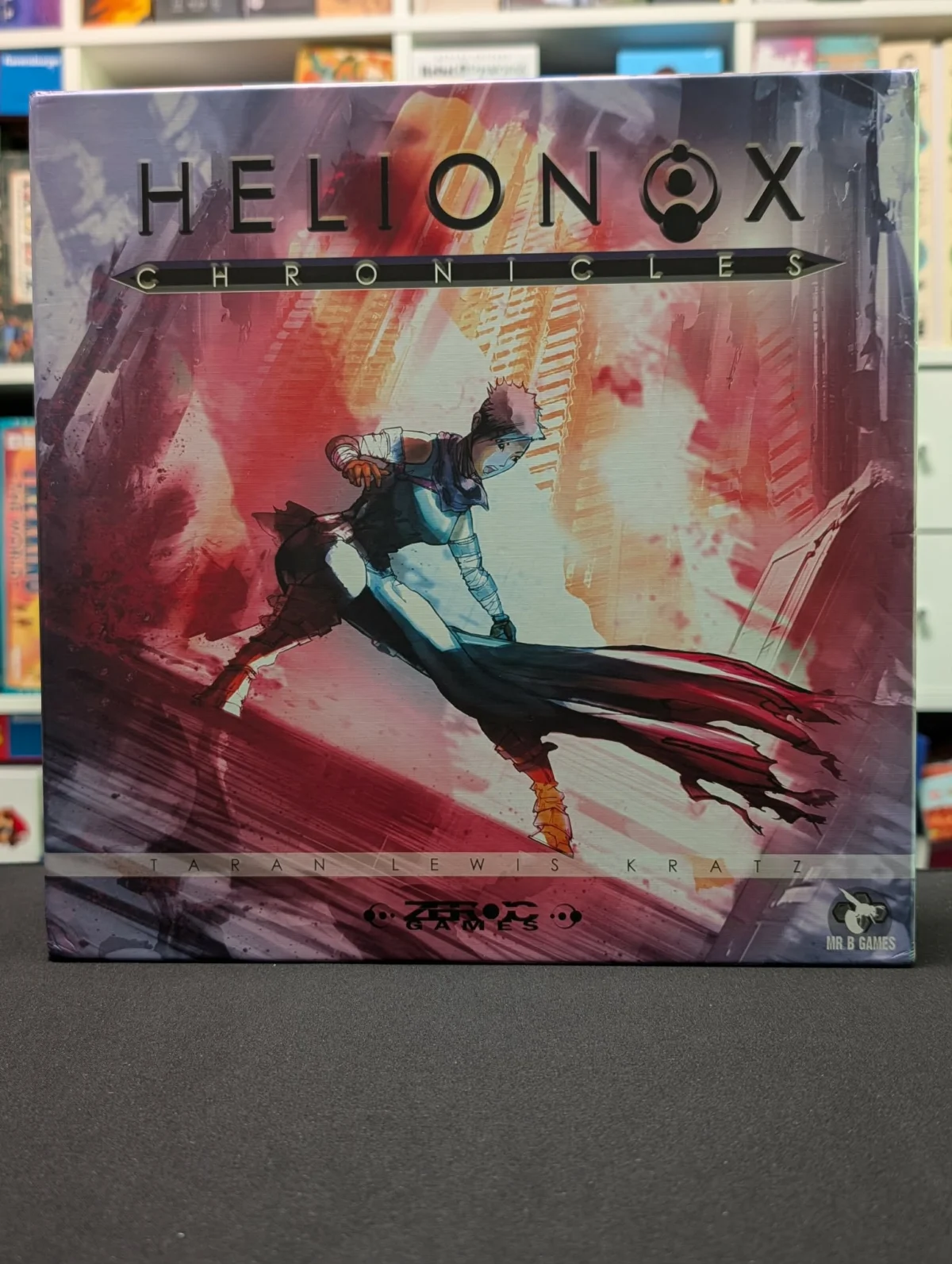
In the crowded landscape of cooperative tabletop gaming, titles often lean heavily on established tropes: stop the virus, save the city, or fend off a zombie horde. Helionox: Chronicles, the latest offering from Zeroic Games, attempts to elevate the genre by scaling these stakes to a galactic level. Designed by Taran Lewis Kratz, with artistic contributions from Luke Green, Kratz, and Seth Rutledge, the game tasks players with managing the collapse of an entire solar system. It is a sprawling, ambitious endeavor that blends deck-building, worker placement, and resource management into a high-tension narrative experience.
Main Facts: The Anatomy of a Solar Collapse
At its core, Helionox: Chronicles is a cooperative strategy game that places players in the shoes of architects responsible for maintaining order across Earth, Mars, Mercury, and the Moon. The game is played over four distinct eras, with the primary objective being the mitigation of escalating crises—riots, political instability, economic failures, and external sabotage—all while staving off a mysterious, encroaching enemy force.
The game is designed for 1–4 players, with an estimated playtime of 30 to 45 minutes per person. The mechanics revolve around a clever dice-selection system where rolls dictate the available actions for each turn. Players must use these actions to travel between planets, deploy resources, clear "devastation" markers, and upgrade their personal decks. Unlike simpler cooperative titles, Helionox demands constant triage; there are rarely enough actions to handle every threat, forcing players to engage in rigorous debate over which planetary disasters pose the most immediate existential threat to the solar system.
Chronology: The Four Eras of Stewardship
The gameplay structure is defined by its four-era progression, which serves both as a timer and a narrative arc.
Era I: The Fragile Peace
In the opening stages, players are introduced to the core mechanics. The board is relatively quiet, allowing architects to focus on building their decks and establishing infrastructure. However, the seeds of chaos are already sown as event cards begin to trigger minor disasters across the planetary map.
Era II: The Escalation
As the game progresses, the frequency and severity of event cards increase. Players find that the simple strategies used in Era I are no longer sufficient. The "enemy presence" mechanic begins to manifest, requiring players to split their focus between clearing internal crises and defending against external threats.
Era III: The Crisis Point
This era is characterized by "all hands on deck" gameplay. The resource pool becomes tighter, and the board state becomes volatile. It is during this phase that the game’s cooperative nature truly shines; individual heroics are insufficient. Success in Era III requires highly coordinated efforts, often involving multiple players pooling resources to resolve large-scale events.

Era IV: The Final Stand
The climax of Helionox is a desperate race against the clock. Players must confront the primary antagonist in a final, decisive showdown. The tension here is palpable, as the cumulative damage from previous eras often limits the players’ options. Success hinges on how well the group managed their resources and deck efficiency during the preceding three eras.
Supporting Data: Mechanics and Depth
The depth of Helionox: Chronicles is facilitated by a robust, non-linear engine. The "dice-as-action-selector" mechanic is the heartbeat of the game. In solo play, a user manages three dice, while in multiplayer settings, the distribution of two dice per player creates a specialized economy of movement and action.
The Deck-Building Integration
Unlike many co-ops where player power remains static, Helionox utilizes deck-building to represent the evolution of the architects. By investing resources, players acquire cards that grant more powerful actions, better mobility, or unique defensive capabilities. This adds a satisfying layer of progression—watching a weak starting deck transform into a finely-tuned engine of planetary management is a core draw for strategy enthusiasts.
The "Eternal Mode" and Campaign Longevity
Beyond the core six-episode campaign, which serves to introduce players to the game’s mechanics gradually, Zeroic Games has included an "Eternal Mode." This mode is the primary driver of the game’s replayability. By allowing players to mix and match locations, enemies, and difficulty modifiers, the game effectively functions as a puzzle-generator. This is vital for a game of this complexity, as it ensures that the experience remains fresh even after the primary narrative arc has been completed multiple times.
Official Perspectives: Design Philosophy and Intent
The design philosophy behind Helionox: Chronicles is one of "narrative-through-systems." According to designer Taran Lewis Kratz, the goal was not to create a game that felt like a series of disjointed math problems, but rather one that told a cohesive, cinematic story.
The inclusion of multiple planets is a direct result of this philosophy. By forcing players to travel between Earth, Mars, Mercury, and the Moon, the game creates a sense of scale that would be lost if the action were confined to a single board. The "fiddliness" often associated with games of this scale—the setup time and the management of numerous decks—is a deliberate trade-off for the depth of the experience. Zeroic Games emphasizes that the game is intended for players who view the setup and the "maintenance" of the board as part of the ritual of play, rather than a barrier to entry.
Implications: Where It Fits in the Genre
Helionox: Chronicles sits in a unique niche. It is more complex than the Pandemic series but more accessible than heavy "4X" space games that can consume an entire afternoon. It bridges the gap for players who crave the "triage" style of cooperative play—where the board state is always one step ahead of the players—but who also want the long-term satisfaction of deck-building.

The "Table Presence" Factor
The visual design by Luke Green and the team is integral to the game’s appeal. In an industry where art is often a secondary concern, the aesthetic of Helionox—reminiscent of hard science fiction staples like The Expanse or Mass Effect—is a major selling point. The components are sturdy, and the iconography is designed to be functional despite the density of information. The "table footprint" of the game is substantial, which creates a visual spectacle that reinforces the theme of a massive, failing civilization.
Critical Reception and Community Impact
Early responses to the game highlight its success as a "brain-burner." While it is not a casual experience, the sense of accomplishment earned after a difficult victory is substantial. The primary critique often centers on the learning curve; the sheer number of moving parts can be intimidating for new players. However, for the demographic of mid-to-heavy weight strategy gamers, this is often seen as a feature rather than a bug.
Final Verdict: A Modern Space Epic
Helionox: Chronicles is a standout release that rewards patience and communication. It successfully balances the tension of a ticking clock with the strategic depth of deck management. While it requires a significant time investment to master, the payoff—a genuinely tense, thematic, and rewarding cooperative experience—is well worth the effort.
For those who enjoy the political tension of Battlestar Galactica or the high-stakes puzzle management of Tesseract, Helionox is a must-play. It is a rare example of a modern board game that manages to feel like a "space epic" without losing the intimacy of a group of friends working together against the odds. As the solar system burns, the question isn’t just whether you can save it—it’s whether you can hold your nerve long enough to see the final era through.
In summary, Helionox: Chronicles earns its place on the shelf as a definitive title for the modern cooperative gamer. With an 8.5/10 rating, it stands as a testament to what is possible when deep, mechanical design meets a compelling, high-stakes science fiction narrative. Whether you are playing solo or with a full table of four, the experience remains consistently engaging, challenging, and, most importantly, memorable.












No comments yet. Be the first to join the conversation!