

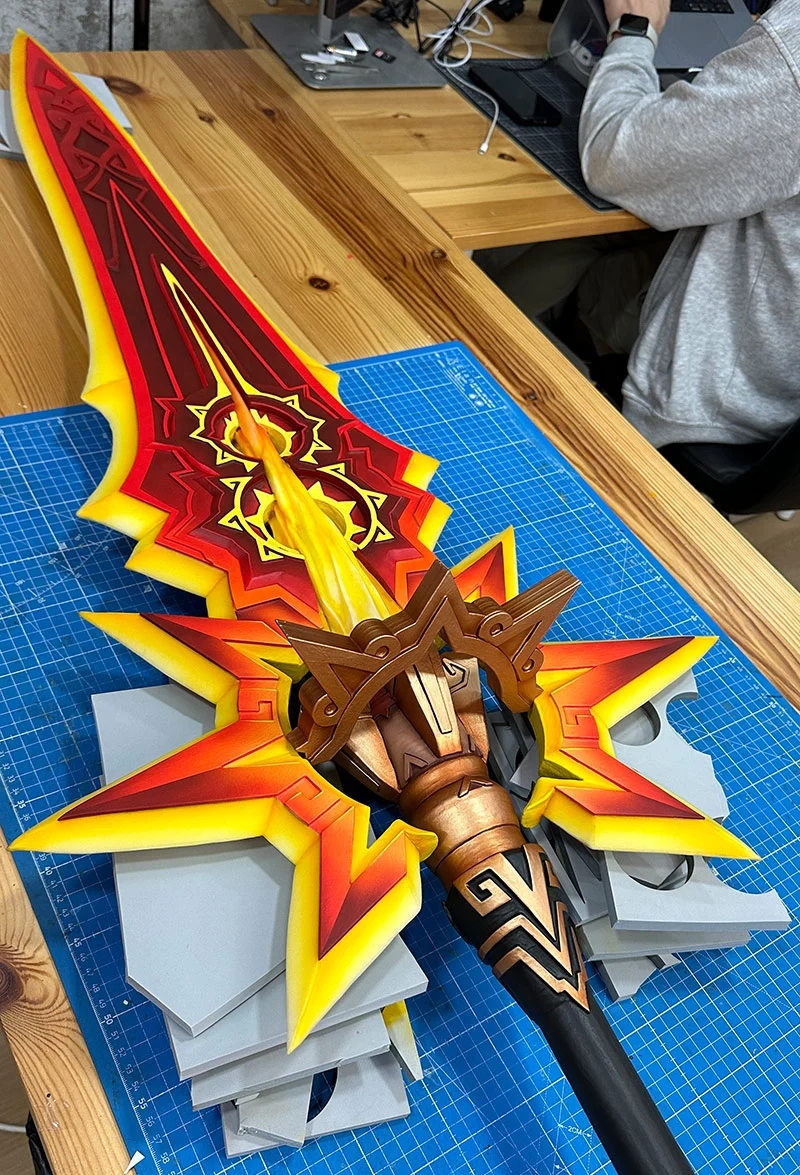
In the ever-evolving world of cosplay, where digital artistry meets physical craftsmanship, few names command as much respect as Kamui Cosplay. Known for their intricate armor builds and mastery of EVA foam, the duo recently undertook their most ambitious collaboration to date: bringing "A Thousand Blazing Suns," the legendary greatsword wielded by Mavuika, the Fire Archon of Genshin Impact, into the physical realm. This project, commissioned by HoYoverse, represents a bridge between high-end digital character design and traditional prop-making, highlighting the complexities of scaling, electronics, and professional-grade finishing.
The Intersection of Passion and Partnership
The project began not as a commission, but as an organic spark of interest. Having previously built iconic weapons and armor for characters like Yelan and Beidou, the creators were naturally drawn to the bold, fiery aesthetic of Mavuika. "Cosplay is all about combining passions," the team notes, citing their long-standing love for Genshin Impact and their obsession with integrating LED lighting into their builds.
The timing could not have been more fortuitous. HoYoverse reached out to the creators to develop official promotional content for the release of the Fire Archon. The assignment—creating engaging video content to showcase Mavuika’s arrival—dovetailed perfectly with their existing desire to tackle the sword. What followed was a high-pressure, seven-day sprint that pushed the boundaries of their workshop’s capabilities.

Step One: The Blueprint and Digital Translation
Translating a 3D asset from a game engine to a physical prop is a process fraught with technical hurdles. The team relied heavily on official 3D models sourced from Aplaybox, a database for HoYoverse assets.
The Challenge of Scaling
While the digital model provides a perfect visual reference, it rarely translates 1:1 to reality. The original weapon, as seen in Genshin Impact, features proportions that are designed for the surreal physics of an anime-style game. To ensure the prop remained manageable and "natural" for a human cosplayer to carry, the team made a strategic decision to scale down the sword. They settled on a two-meter length, a compromise that maintained the weapon’s "massive" aesthetic while ensuring it didn’t overwhelm the user or become structurally unsound.
The process of creating a blueprint serves as the foundation for the entire project. It is here that the creators calculate material requirements and identify potential structural failures before the first cut is made. For those looking to replicate this level of detail, the team has made their custom blueprints available, emphasizing that precise planning is the difference between a prop that collapses under its own weight and one that lasts through a convention weekend.

Step Two: Foam Crafting and Structural Integrity
The "burning" aesthetic of Mavuika’s sword required a departure from simple, flat-plane construction. The core of the blade needed to mimic the look of a rocket engine, glowing with intense yellows and oranges.
The Role of High-Density Foam
Stability was the primary concern. To support the sheer size of the prop, the team utilized a thick PVC pipe as the internal spine. Over this, they layered 10mm EVA foam, chosen for its structural density and shape retention. To achieve the specific light-diffusing effects, they utilized specialized LED foam (Plastazote LD45), which allows light to bleed through in a soft, ethereal glow rather than showing harsh, individual LED dots.
Technological Advancements in Crafting
A significant factor in the speed and precision of this build was the integration of a C02 laser cutter. By using vector files derived from their blueprints, the team could cut complex patterns in seconds, a task that would have taken hours of manual labor with a box cutter. However, the creators are quick to note that the laser cutter is not a "magic button." It requires a highly polished, vector-based blueprint, meaning the time saved in cutting is simply shifted to the design phase.

Step Three: The Electronics of Fire
The "wow factor" of the sword lies in its lighting. The team aimed for a reactive, intelligent lighting system. They utilized an Adafruit Prop-Maker FeatherWing paired with a Feather M4 Express, a robust combination that has become the gold standard for high-end prop making.
Advanced Animation Programming
The sword was programmed with a custom pulsing fire animation. The most challenging aspect was the interaction design: the team programmed a motion trigger so that when the weapon is struck against the ground, the pulsing fire animation is interrupted by a brilliant, blinding white flash. This level of interaction—where the prop responds to the user’s physical performance—elevates the build from a static prop to a living piece of character equipment. The assembly included 300 individual pixels, all managed within the confined space of the grip, proving that effective prop engineering is as much about cable management as it is about aesthetics.
Step Four: The Marathon of the Paint Job
If the build was the body, the paint job was the soul. The process was a three-day marathon, described by the team as "a sprint and a marathon at the same time."

The Precision of Airbrushing
Using Vallejo airbrush colors, the team sought to create a gradient that would remain translucent. Because they needed to apply layers of red, orange, and yellow without muddying the colors, the process required extensive masking. Every section had to be taped off, painted, and then untaped—a process that carries a significant risk. If tape is left on too long, it can peel the underlying paint; if left on too short, the paint won’t cure properly.
By six in the morning on the final day, after twelve hours of continuous work, the two-sided paint job was complete. Final details were added by hand using high-pigmentation acrylics and fine-tip brushes, bringing the "A Thousand Blazing Suns" to life with a vibrancy that matched the digital source material.
Official Implications and Community Impact
This collaboration between HoYoverse and Kamui Cosplay highlights a shift in how game developers interact with their community. By commissioning professional-grade, behind-the-scenes content, HoYoverse is not only marketing a new character but is also validating the cosplay community’s technical skill.

The Value of Professional Craft
The success of this project lies in the team’s refusal to prioritize spectacle over function. By balancing the "insane proportions" of the fictional weapon with the physical reality of the human form, they created a prop that feels authentic to the game while remaining practical for the creator.
For the broader cosplay community, this project serves as a masterclass in modern techniques:
- Blueprint Efficiency: Using vector files and laser cutters to reduce manual labor.
- Electronics Integration: Moving beyond static lights to motion-triggered, reactive effects.
- Professional Finishing: The importance of layering, masking, and color theory when dealing with translucent materials.
Conclusion: The Final Result
When the sword was finally finished, the result was a weapon that appeared as if it had been pulled directly from the screen. The combination of structural engineering, complex programming, and painstaking paint application resulted in a piece that stands as a testament to the dedication required in professional cosplay.

As the creators reflect on the final product, the sentiment is one of pride—not just in the finished sword, but in the process itself. For those inspired by the project, the lesson is clear: while tools like laser cutters and advanced microcontrollers make the work easier, the final quality of a piece is still defined by the human element—the patience to mask a dozen layers of paint, the discipline to spend hours on cable management, and the creative vision to bring a digital dream into the physical world. Through this collaboration, Kamui Cosplay has set a new benchmark for what is possible when professional craftsmanship meets the boundless passion of the Genshin Impact community.










No comments yet. Be the first to join the conversation!