

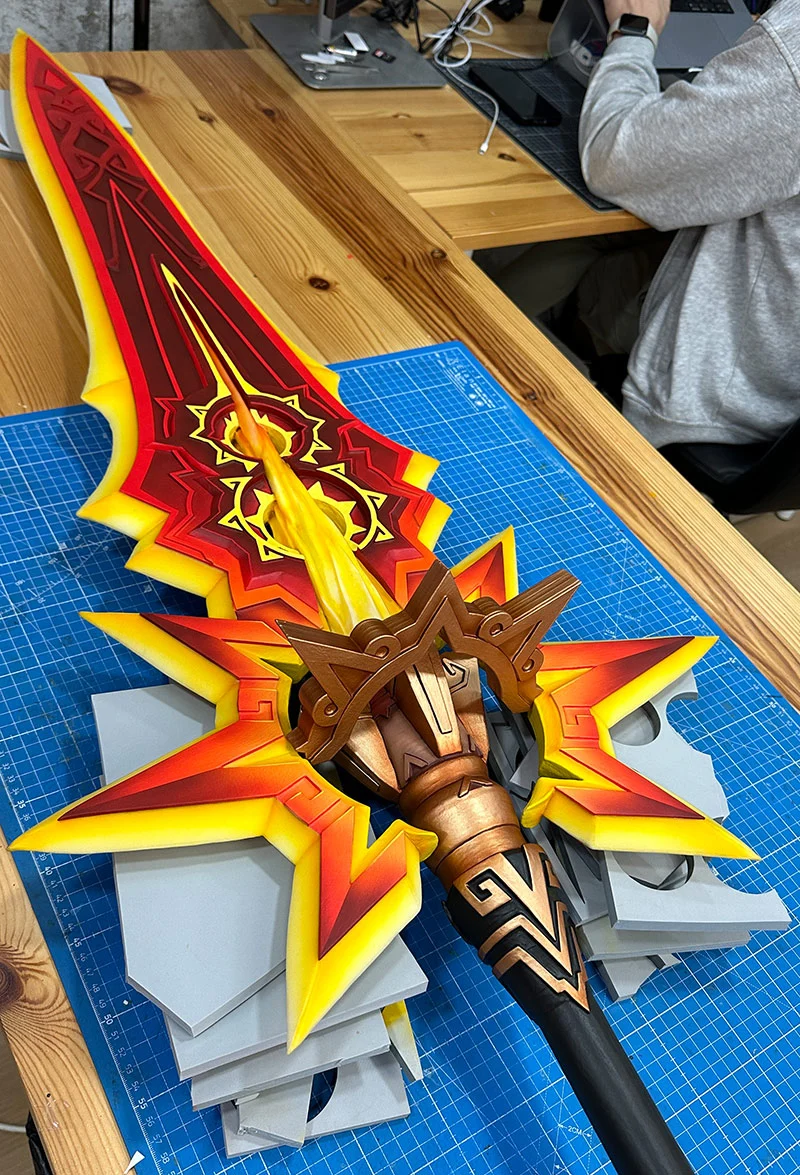
In the high-stakes world of professional cosplay, few names carry the weight of craftsmanship and technical innovation like Kamui Cosplay. Known for pushing the boundaries of what is possible with EVA foam and integrated electronics, the team has recently completed their most ambitious project to date: "A Thousand Blazing Suns," the iconic greatsword wielded by Mauvika, the Fire Archon of Natlan from HoYoverse’s global phenomenon, Genshin Impact.
This project represents more than just a costume accessory; it is a convergence of digital artistry, mechanical engineering, and high-level marketing. Commissioned by HoYoverse as part of an official promotional campaign, the build required a mastery of both traditional crafting techniques and modern digital fabrication.
The Convergence of Passion and Profession
The collaboration between Kamui Cosplay and HoYoverse began with a shared vision: to bring the breathtaking design of the Fire Archon into the physical realm for her highly anticipated release. For Kamui, the choice of project was organic. Having already tackled complex characters like Yelan and Beidou, the allure of Mauvika’s weapon—a massive, glowing engine-inspired blade—was irresistible.

"Cosplay is all about combining passions," the team noted. "I’m a huge fan of Genshin Impact, love working with EVA foam, and always enjoy adding as many LEDs as possible. When HoYoverse reached out for an official collaboration to promote the new Fire Archon, Mauvika’s sword was the perfect, coincidental project."
This collaboration underscores a growing trend in the gaming industry: the formalization of relationships between game developers and the top-tier creators who sustain community engagement through high-fidelity fan art and cosplay.
Chronology of a Masterpiece
The creation of "A Thousand Blazing Suns" was a process of intense research, precise fabrication, and exhausting manual labor. The project was broken down into four distinct phases, each requiring different skill sets.

Phase 1: Blueprinting and Digital Modeling
The foundation of the build relied on 3D data. The team utilized official 3D models provided by HoYoverse through aplaybox.com. While navigating a Chinese-language platform presented a hurdle, the use of translation tools allowed the team to extract the exact geometry needed to translate the weapon from a digital asset to a physical form.
The challenge of scale was significant. The in-game sword is gargantuan, designed with the impossible physics of a video game. The team opted for a two-meter length—scaled down from the source material—to ensure the prop remained manageable for a human wearer while maintaining an imposing, natural aesthetic.
Phase 2: Structural Foam Crafting
With the blueprints finalized, the focus shifted to the structural integrity. The sword’s central core was constructed using a sturdy PVC pipe to act as a chassis for the weight. This was encased in layers of 10mm high-density EVA foam. To achieve the "rocket-engine" aesthetic of the blade, the team meticulously integrated hundreds of LEDs into the foam core, ensuring the wires and battery packs remained concealed within the grip.

In a move to optimize efficiency, the team employed a CO2 laser cutter for the foam pieces. While this accelerated the cutting process, the team emphasized that it did not necessarily make the build "easier." The requirement for precise vector files meant that the preparation phase was more complex than traditional hand-cutting methods.
Phase 3: Electrical Integration
The "soul" of the sword lies in its lighting. Utilizing an Adafruit Feather M4 Express and a Prop-Maker FeatherWing, the team programmed a dynamic fire-pulsing animation. The circuitry powers 300 individual digital RGB pixels. A notable feature is the interactivity: the sword is programmed to respond to physical movement, specifically a "stomp" motion that overrides the pulsing fire animation with a brilliant, solid white flash, simulating the sword’s activation.
Phase 4: The Marathon of Painting
The final, and perhaps most draining, stage was the paint application. The team opted for airbrushing with Vallejo metallic colors to achieve a finish that was both vibrant and translucent enough to allow the underlying LEDs to glow through the foam. This process was a logistical nightmare: because the sword had to be painted in sections to maintain the intricate color scheme of yellow, orange, and red, each section required taping off.

"Painting everything took us three full days," the team recounted. "The tape had to be removed within 12 hours to prevent damaging the paint underneath, leading to a 24-hour cycle of masking, spraying, and unmasking. We finished at six in the morning."
Supporting Data: The Anatomy of the Build
To achieve the level of professional quality expected in a HoYoverse-sanctioned project, the build relied on specific, high-grade materials:
- Materials: 10mm and 2mm LED-diffusing EVA foam.
- Electronics: 300 NeoPixel digital RGB LEDs, Adafruit Feather M4 Express controller.
- Tools: CO2 Laser Cutter, Iwata Eclipse HP-CS Airbrush, and a 1/5hp compressor.
- Time Investment: Approximately seven days of full-time, round-the-clock labor for construction and painting.
The project highlights the necessity of "Pro-sumer" grade tools in the modern cosplay industry. The reliance on laser cutters and programmable microcontrollers marks a shift from "hobbyist crafting" to "small-scale manufacturing."

Official Responses and Community Engagement
The collaboration has been hailed as a success by both the creator and the publisher. By integrating the build into their official marketing videos, HoYoverse successfully bridged the gap between the virtual world of Teyvat and the physical world of their players. The content created around the sword serves as a bridge for the Genshin Impact community, providing both entertainment and technical insight for aspiring cosplayers.
For the developers, this partnership serves as a high-value marketing tool. A professionally crafted, light-up replica generates significantly more engagement on social media platforms like TikTok and YouTube than traditional static advertisements.
Implications for the Cosplay Industry
The success of "A Thousand Blazing Suns" carries several implications for the future of the cosplay craft:

- The Rise of "Hybrid" Crafting: The future of top-tier cosplay lies in the marriage of traditional foam-smithing with 3D modeling, laser cutting, and advanced electrical engineering. The barrier to entry for professional-grade props is shifting toward technical proficiency in software like CAD and Arduino programming.
- Corporate-Creator Synergy: As game developers look for authentic ways to engage their player base, they are increasingly recognizing that independent creators are the most effective bridge. We can expect to see more "Official Collaborations" where companies provide assets (like 3D models) to creators to facilitate high-quality promotional content.
- The "Addiction" to Complexity: As demonstrated by the integration of 300 LEDs and motion-triggered sensors, the baseline for "quality" in cosplay props is rising. Creators are no longer satisfied with visual accuracy; they are now pursuing functional accuracy, where props must behave as they do in the game.
Conclusion
The project remains a testament to the dedication required to bring digital fantasies into reality. While the physical exhaustion of a 12-hour painting session or the complexity of 300-pixel LED arrays might deter the casual hobbyist, for Kamui Cosplay, the result—a blade that looks as though it were pulled directly from the hands of the Fire Archon herself—is the ultimate reward.
For those inspired by the project, the team has made their blueprints available, encouraging the community to take the leap into advanced prop building. As the industry continues to evolve, projects like Mauvika’s sword demonstrate that with enough foam, wire, and sheer persistence, the line between fiction and reality can become beautifully, and brilliantly, blurred.










No comments yet. Be the first to join the conversation!