

With the FIFA World Cup 2026 scheduled to kick off on June 11, the global excitement is palpable. However, as billions of eyes turn toward the host nations—the United States, Canada, and Mexico—tech giant Meta is preparing for a different kind of challenge. Recognizing that the world’s most popular sporting event serves as a magnet for both fervent fan engagement and malicious exploitation, the parent company of Facebook, Instagram, and WhatsApp has announced a comprehensive, multi-layered security strategy designed to safeguard players, officials, and fans from the rising tide of digital abuse and fraud.
The High Stakes of Global Connectivity
The FIFA World Cup is more than a tournament; it is a cultural phenomenon that bridges borders. For Meta, this connectivity is the platform’s greatest strength and its most significant liability. In an official statement, Meta acknowledged the inherent tension of the event: “In the coming months, soccer fans across the globe will use our apps to connect around the FIFA World Cup 2026. While most will be rooting for their favorite teams and players, unfortunately, there may be bad actors who will try to lure people into scams or harass and abuse others—offline and online.”
Meta’s proactive stance reflects a maturation of its platform governance. As the digital landscape becomes increasingly weaponized by bad actors, the company is moving beyond reactive moderation, seeking instead to dismantle threat networks before they can reach the average user.
Combating the Scourge of Tournament Fraud
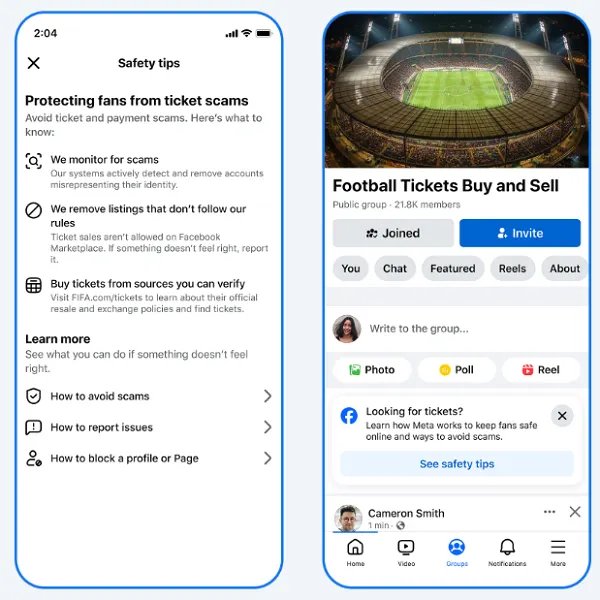
One of the most pressing threats during major global events is the proliferation of financial scams. History has shown that when demand for tickets, travel, and lodging spikes, cybercriminals follow. Meta has identified three primary areas of concern: fraudulent ticketing, misleading accommodation offers, and fake immigration services.
A Multi-Pronged Defense Strategy
To address these risks, Meta is deploying dedicated monitoring teams that leverage both human intelligence and machine learning to enforce community standards. By identifying accounts that mimic official FIFA branding or promote deceptive gambling content, these teams aim to cut off the oxygen to scam networks.
Crucially, Meta is expanding its collaborative efforts through two specific initiatives: the Global Signal Exchange (GSE) and the Fraud Intelligence Reciprocal Exchange (FIRE). These programs are designed to break down the "silos" that often exist between tech companies, financial institutions, and law enforcement.
The Visa Partnership: A Case Study in Disruption
A notable example of the efficacy of these partnerships is Meta’s collaboration with Visa. Through the GSE, Visa’s Scam Disruption team provided actionable intelligence that allowed Meta to identify and systematically dismantle a Facebook network. This network had been linked to sophisticated, spoofed websites that perfectly mimicked official FIFA World Cup 2026 branding to lure victims into fake gambling schemes. By cutting off the traffic at the source, the partnership prevented potential financial losses for countless unsuspecting fans.
Furthermore, Meta has begun rolling out in-stream notifications. These warnings serve as a digital "speed bump," educating users about the red flags associated with unofficial ticket sales and guiding them toward verified, legitimate channels.
Protecting the Human Element: The Battle Against Abuse
While financial scams represent a monetary threat, the human toll of online abuse is perhaps even more severe. The specter of the 2021 race-based attacks against Premier League players on Instagram serves as a grim reminder of the platform’s previous failures. Following those incidents, in which stars from Manchester United, Chelsea, and Liverpool were subjected to vitriolic racist abuse in their direct messages (DMs), the footballing world issued a unified demand for systemic change.
Lessons from 2021
The 2021 crisis forced a shift in Meta’s moderation philosophy. The company introduced stricter penalties for accounts engaging in hate speech and empowered users—specifically public figures and athletes—with more granular controls over who is permitted to contact them.
For the 2026 World Cup, Meta is doubling down on these protections. The company has reaffirmed its "clear rules against bullying and harassment, violent threats, and hateful conduct." The current approach focuses heavily on Instagram DMs, the primary channel where players reported receiving the most egregious abuse.
AI and Proactive Detection
Meta is no longer relying solely on user reports to police content. The company is leaning heavily into AI-driven moderation to preemptively flag and remove prohibited content. According to data provided by the company, this strategy is seeing significant success. Between October and December 2025, Meta reported the removal of 2.6 million pieces of hateful content across Facebook and Instagram. Most impressively, over 74% of that content was identified and actioned by automated systems before it was ever flagged by a user.
Collaborative Awareness Campaigns
Recognizing that technology alone cannot solve the problem of human malice, Meta is taking its message offline. A significant component of its strategy is the partnership with Mexico’s Consumer Protection Agency (PROFECO). This collaboration involves a creator-led awareness campaign designed to educate the public on how to spot common tournament scams. By utilizing popular influencers and local voices, the campaign aims to reach demographics that might otherwise miss traditional warnings.
Chronology: A Roadmap to Security
To understand the gravity of these measures, one must look at the timeline of Meta’s evolution:
- 2021: A wave of racist abuse against UK-based players forces Meta to overhaul its DM privacy settings and moderation tools.
- 2023-2024: Development of the Global Signal Exchange (GSE) and Fraud Intelligence Reciprocal Exchange (FIRE) to improve cross-industry data sharing.
- Late 2025: Implementation of high-scale AI moderation, achieving a 74% proactive removal rate for hateful content.
- Early 2026: Launch of the PROFECO awareness campaign and integration of in-stream fraud notifications.
- June 11, 2026: Kick-off of the FIFA World Cup, with live monitoring teams activated to respond to real-time threats.
Implications for the Future of Social Media
The measures taken by Meta for the 2026 World Cup carry profound implications for the future of digital safety. First, it signals that "moderation" is no longer a static feature but a dynamic operation that must scale with the intensity of global events. Second, it highlights the necessity of "cross-sector intelligence." A social media company cannot effectively stop financial fraud without the data held by credit card companies and banks; Meta’s partnership with Visa is likely the blueprint for future tech-finance collaborations.
Furthermore, the emphasis on protecting players from abuse signals that platforms are finally accepting responsibility for the "environment" they create. By proactively shielding high-profile figures from abuse, Meta is not just protecting the players; it is protecting the integrity and the viewing experience of the sport itself.
Conclusion: A Test of Resilience
As the clock ticks toward the opening match in June, the true test of Meta’s infrastructure will begin. While the company has equipped itself with advanced AI, strategic partnerships, and a clear set of enforcement policies, the unpredictability of human behavior remains a constant variable.
However, by addressing the dual threats of financial exploitation and interpersonal abuse with such rigor, Meta is signaling a shift toward a more responsible era of digital governance. For the millions of fans preparing to travel to the Americas or watch from home, these security measures provide a vital layer of protection, ensuring that the passion of the FIFA World Cup remains focused on the beautiful game, rather than the dark corners of the internet. The digital stadium is being reinforced, and for once, the guardrails are being put in place long before the first whistle blows.












No comments yet. Be the first to join the conversation!