In the pantheon of gaming history, few devices hold as much reverence as the Nintendo Entertainment System (NES). Released in North America in 1985, the console saved the video game industry from the brink of collapse, establishing a cultural touchstone that persists four decades later. However, the NES was strictly a closed ecosystem—a machine designed to run cartridges, not code. That limitation has recently been shattered by YouTuber Throaty Mumbo, who has successfully transformed the iconic grey-and-black chassis into a fully functional, internet-capable personal computer.
Dubbed the "NESPC," this project represents a feat of engineering that bridges the gap between 1980s hardware and modern computing demands. With a functional desktop environment, web browsing capabilities, DVD playback, and the ability to run the seminal 1993 shooter Doom, the NESPC is more than just a novelty; it is a profound testament to the adaptability of retro hardware.
The Genesis of the NESPC: A Full-Circle Journey
The irony of the project is not lost on its creator. Nintendo’s original Japanese console was branded the "Famicom"—a portmanteau of "Family Computer." Despite the name, the Famicom/NES never possessed the architecture to function as a traditional PC.
In a sprawling 55-minute documentary-style video, Throaty Mumbo detailed his inspiration for the build, citing a growing fatigue with the homogenization of modern gaming. "I was getting kind of sick of video games," Mumbo explained. "I wanted to turn my NES into something resembling a 1990s computer." This desire to reclaim the "computer" promise of the Famicom label drove the project through months of trial and error.
The Chronology of Development
The path to the NESPC was far from linear. Mumbo’s initial experiments were plagued by hardware bottlenecks and software incompatibilities.
- Phase One: The Bootleg Era: Mumbo began by attempting to force-run a bootleg version of Windows 98. The results were disastrous, with the system suffering from extreme latency and frequent crashes.
- Phase Two: The Linux Struggle: Next, the creator pivoted to a Linux-based emulator. While more stable than his previous attempt, the system was agonizingly slow, rendering the "desktop" experience unusable.
- Phase Three: The FPGA Breakthrough: Realizing that the original 8-bit Ricoh CPU was fundamentally incapable of handling modern processing tasks, Mumbo integrated an EverDrive N8 Pro cartridge. By leveraging the cartridge’s onboard Field-Programmable Gate Array (FPGA), he offloaded the heavy x86-style processing tasks from the NES hardware, allowing the console to act as a bridge for a much more powerful digital engine.
Technical Specifications and Capability
To call the NESPC a "functional computer" is an understatement. Once the core hardware was stabilized, Mumbo implemented a custom desktop environment that feels remarkably nostalgic.
The User Interface
The system features a complete GUI, including a functional Start menu, a robust file manager, and a digital trash bin. To ensure the experience felt authentic to the 1990s aesthetic, Mumbo included staples of the era, such as a fully playable version of Minesweeper and the classic "flying toasters" screensaver.
Peripherals and Connectivity
An NES controller is hardly designed for word processing or file management. To solve this, Mumbo engineered a custom USB adapter that allows the console to interface with modern keyboards and mice. He even added support for MIDI keyboards, transforming the console into a makeshift music production station.
Multimedia and the NESCD
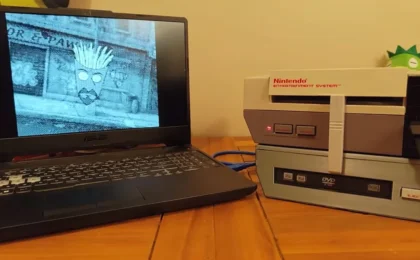
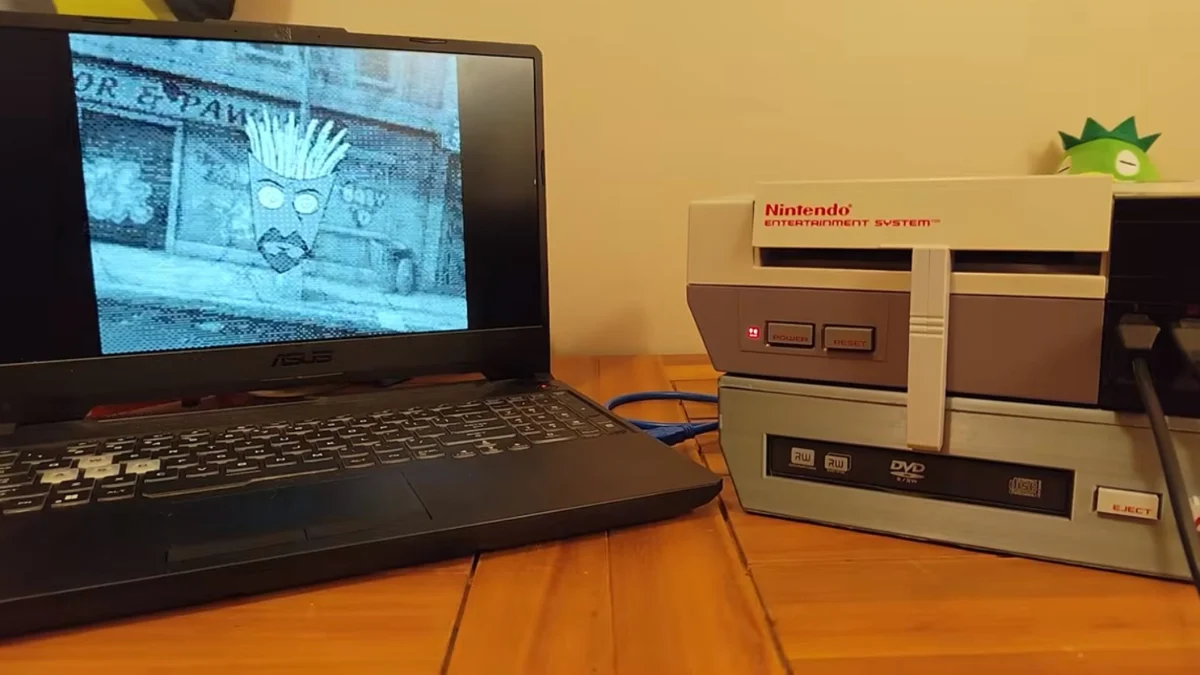
Perhaps the most ambitious aspect of the build is the integration of the "NESCD" accessory. Through this custom modification, the console can read CDs and DVDs. In his demonstration, Mumbo played an episode of Aqua Teen Hunger Force. While the visuals are rendered in a "crunchy" black-and-white aesthetic due to the limitations of the NES video signal, the fact that a 40-year-old console is outputting video from a modern optical disc is a milestone in retro-modding.
The "Doom" Factor: Why It Matters
No project of this nature is complete without the gaming world’s ultimate litmus test: Doom. Since the release of the source code in the late 1990s, the "Can it run Doom?" challenge has become a rite of passage for hardware hackers.

Mumbo’s version of Doom runs on the NESPC, though it is far from the smooth 60fps experience modern gamers expect. The graphics are characteristically glitchy, and the frame rate is pushed to its absolute limit. However, by utilizing the FPGA hardware within the EverDrive cartridge, Mumbo has successfully ported the game to a system that, on paper, has no business running a 3D environment.
This achievement places the NES in a rare class of hardware. In August 2026, developers successfully ported Doom to a Canon DSLR camera, proving that the desire to run the game on non-traditional hardware is stronger than ever. The NESPC joins this lineage of "bizarre device" gaming, serving as a bridge between the 8-bit past and the technological future.
Implications for Retro-Computing and Enthusiast Communities
The success of the NESPC project carries significant weight for the enthusiast community. It demonstrates that the lifespan of "obsolete" hardware is limited only by the creativity of the user.
Open Source Accessibility
Rather than keeping his methods proprietary, Mumbo has uploaded the entire NESPC architecture to GitHub. By making the project available for open-source modification, he has invited a global community of developers to optimize the code, suggest improvements, and perhaps even push the NES hardware toward even more absurd computational tasks.
The Preservationist Perspective
While some purists argue that modifying a vintage NES is a form of sacrilege, the majority of the retro-gaming community views such projects as a form of digital preservation. By expanding the functionality of the NES, Mumbo is not erasing its history; he is contextualizing it within the broader history of personal computing.
"Very strange and impractical, but definitely very neat," Mumbo admitted. His sentiment captures the essence of the "Maker" movement: the goal isn’t always to build a better tool, but to see if a tool can be used in ways its designers never intended.
Conclusion: The Infinite Life of the NES
The NESPC is a reminder that the Nintendo Entertainment System is more than a piece of plastic and circuitry; it is a platform. Whether it is playing Pokemon via Game Boy emulation, browsing Wikipedia via Wi-Fi, or fighting through the corridors of Doom, the NES has transcended its original purpose.
As technology advances, the "legacy" of these consoles often shifts from the games themselves to the machines that house them. By turning a console that once defined childhood afternoons into a tool for productivity and exploration, Throaty Mumbo has ensured that the NES will remain relevant for decades to come.
For those interested in attempting their own build, the GitHub repository is active and receiving community contributions. As for the rest of us, the NESPC stands as a fascinating, glitchy, and deeply impressive monument to human ingenuity—proving that even at 40 years old, the NES is still full of surprises.