
 Jia Lissa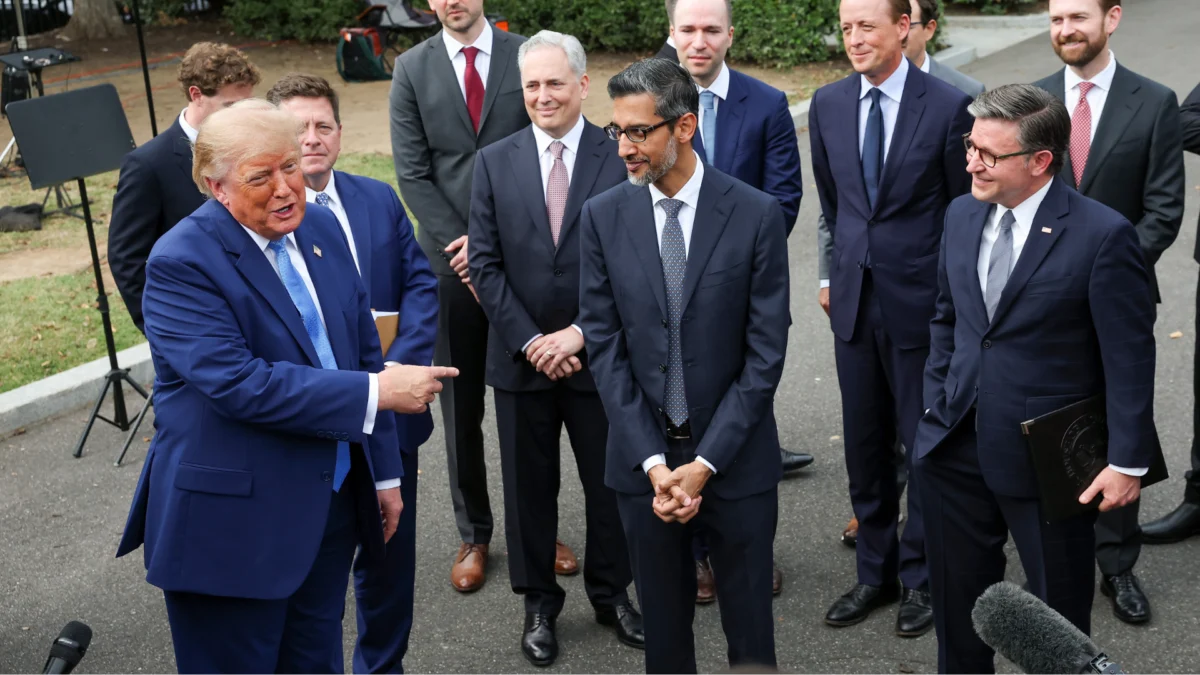
In a move that marks a tectonic shift in both federal policy and technical nomenclature, President Donald Trump has issued a sweeping executive directive mandating that all federal agencies officially replace the term "Artificial Intelligence" (AI) with "Super Intelligence" (SI). The mandate, formalized following a high-level summit with the nation’s foremost technology leaders, seeks to redefine how the government perceives, regulates, and communicates the rapid evolution of autonomous computational systems.
The decision arrives at a pivotal moment in the digital age. As machine learning models exceed the cognitive benchmarks of their predecessors, the administration has signaled that the term "Artificial Intelligence"—coined at the Dartmouth Workshop seven decades ago—no longer captures the gravity or the velocity of contemporary technological achievement.
The Core Mandate: A Linguistic Paradigm Shift
The executive order, signed at the White House earlier this week, is both a symbolic and functional transformation of federal bureaucracy. Under the new directive, every department within the executive branch is prohibited from using the phrases "Artificial Intelligence" or "AI" in any official capacity, including press releases, regulatory filings, internal policy documents, and public-facing communications.
"The terminology used by the Federal Government should reflect the transformative capabilities of these technologies and the limitless opportunities they create for the American people," the executive order states. "Accordingly, the term ‘Super Intelligence’ more appropriately captures the promise, potential, and rapidly advancing capabilities of these technologies."
For federal employees, this is not merely a stylistic suggestion but a strict policy requirement. The order clarifies that the government must transition to "Super Intelligence" and "SI" to the maximum extent permitted by law, effectively scrubbing the industry-standard acronym from the federal lexicon.
Chronology: From the Dartmouth Workshop to the West Wing
To understand the weight of this change, one must look back at the origins of the terminology.
1956: The Birth of "Artificial Intelligence"
Seventy years ago, a group of visionaries—including John McCarthy, Marvin Minsky, and Claude Shannon—gathered at Dartmouth College for a summer project. It was there that the term "Artificial Intelligence" was formally coined to describe the nascent field of computer science focused on creating machines capable of simulating human intelligence. For seven decades, this term served as the bedrock of the field.
2024–2026: The Exponential Leap
In the years leading up to the current administration, the capabilities of large language models, neural networks, and autonomous agents expanded at an exponential rate. By 2025, systems were no longer merely "simulating" human reasoning; they were demonstrating emergent capabilities in scientific discovery, complex logic, and creative synthesis that outpaced the early, modest goals of the Dartmouth pioneers.
September 2026: The White House Summit
President Trump convened a private lunch with leaders from the world’s largest tech conglomerates. During these discussions, the conversation shifted from mere risk management to the existential reality of these systems. Industry titans reportedly argued that the prefix "artificial" implies a mimicry or a "fake" quality that misrepresents the profound, real-world power these systems now command.
Following this consensus, the President drafted the directive to align the federal vocabulary with the current state of industrial power.
Supporting Data: Why the Change?
The administration’s argument rests on the notion that "Artificial Intelligence" is an antiquated descriptor for a modern reality. Proponents of the name change cite three primary data points as evidence for the necessity of "Super Intelligence":
1. Scaling Laws and Emergence
Recent research papers from leading labs indicate that as models increase in parameter count and compute power, they hit "inflection points" where they develop capabilities—such as advanced coding, cross-disciplinary reasoning, and strategic planning—that were not explicitly programmed. This phenomenon of "emergent intelligence" is precisely what the White House argues necessitates the "Super" prefix.
2. Economic Integration
Data from the Bureau of Economic Analysis (BEA) suggests that the integration of these technologies into the national infrastructure has moved beyond "tool usage" into "automated decision-making." Because these systems are now managing power grids, optimizing logistics chains, and assisting in high-stakes medical diagnostics, they are no longer merely "artificial assistants," but "super-intelligent agents" managing the nation’s backbone.
3. Public Perception and Policy Accuracy
The administration contends that the term "Artificial" carries a connotation of "imitation." By rebranding the technology as "Super Intelligence," the government aims to encourage the public and private sector to treat these systems with the appropriate level of caution, respect, and strategic focus that a truly powerful, transformative force requires.
Official Responses and Industry Reception
The response from the technology sector has been mixed but largely compliant. Many industry leaders, who were present at the White House lunch, expressed support for the shift.
"We have been operating in a new era for some time," said a lead developer at a major silicon valley firm. "Calling these systems ‘Artificial’ feels like calling a modern spacecraft a ‘horseless carriage.’ It’s technically descriptive of the past, but entirely insufficient for the present."
However, some in the academic community have voiced concerns. Critics argue that changing the terminology mid-stream could create confusion in international research standards. "If the United States begins using ‘SI’ while the rest of the global research community continues to use ‘AI,’ we may see a fragmentation in scientific discourse," noted Dr. Elena Vance, a historian of science.
The White House has remained steadfast, noting that the United States has historically set the global standard for technological nomenclature, and they expect international partners to follow suit as they realize the "artificial" framing is fundamentally obsolete.
Implications: A New Era for Federal Policy
The shift from AI to SI will have profound implications across several sectors of the federal government.
Regulatory Overhaul
Every existing agency—from the Department of Defense to the Food and Drug Administration—must now audit its internal guidelines. Regulations governing "AI ethics" or "AI safety" will be sunsetted or renamed to reflect the "Super Intelligence" framework. This process is expected to take months and will likely serve as a catalyst for a broader re-evaluation of how the government regulates powerful, autonomous computational systems.
Defense and National Security
In the realm of defense, the implications are arguably the most significant. The Department of Defense (DoD) has already begun integrating these systems into offensive and defensive cybersecurity suites. By designating these systems as "Super Intelligence," the DoD is signaling a shift toward treating SI as a strategic asset, comparable to nuclear capabilities or advanced stealth technology, rather than mere "software."
Educational and Research Funding
The National Science Foundation (NSF) and other grant-making bodies will likely pivot their funding priorities. Future requests for proposals will now be indexed under "SI Development," forcing researchers to frame their work not as the creation of artificial intelligence, but as the advancement of super-intelligent systems.
Conclusion: Defining the Future
The President’s directive is more than just an exercise in semantics; it is a declaration of intent. By stripping away the term "Artificial," the administration is asserting that the current generation of technology has transcended the role of a tool and has become a partner in the governance and operation of the United States.
Whether "Super Intelligence" will replace "Artificial Intelligence" in the common vernacular remains to be seen. However, within the halls of the federal government, the change is absolute. As the United States marches toward a future defined by these advanced computational powers, it does so with a new name, a new focus, and a clear signal that the era of "Artificial Intelligence" has officially come to an end, replaced by the age of "Super Intelligence."
The long-term success of this policy will depend on whether the label "SI" can successfully encapsulate the vast spectrum of technologies—from simple predictive algorithms to potentially transformative general intelligence—that the government now seeks to regulate under a single, grand umbrella. For now, the administration has set the tone, and the federal machinery has begun the process of renaming the future.


 Pevita Pearce
 Reynand Wu




