
 Asro
Asro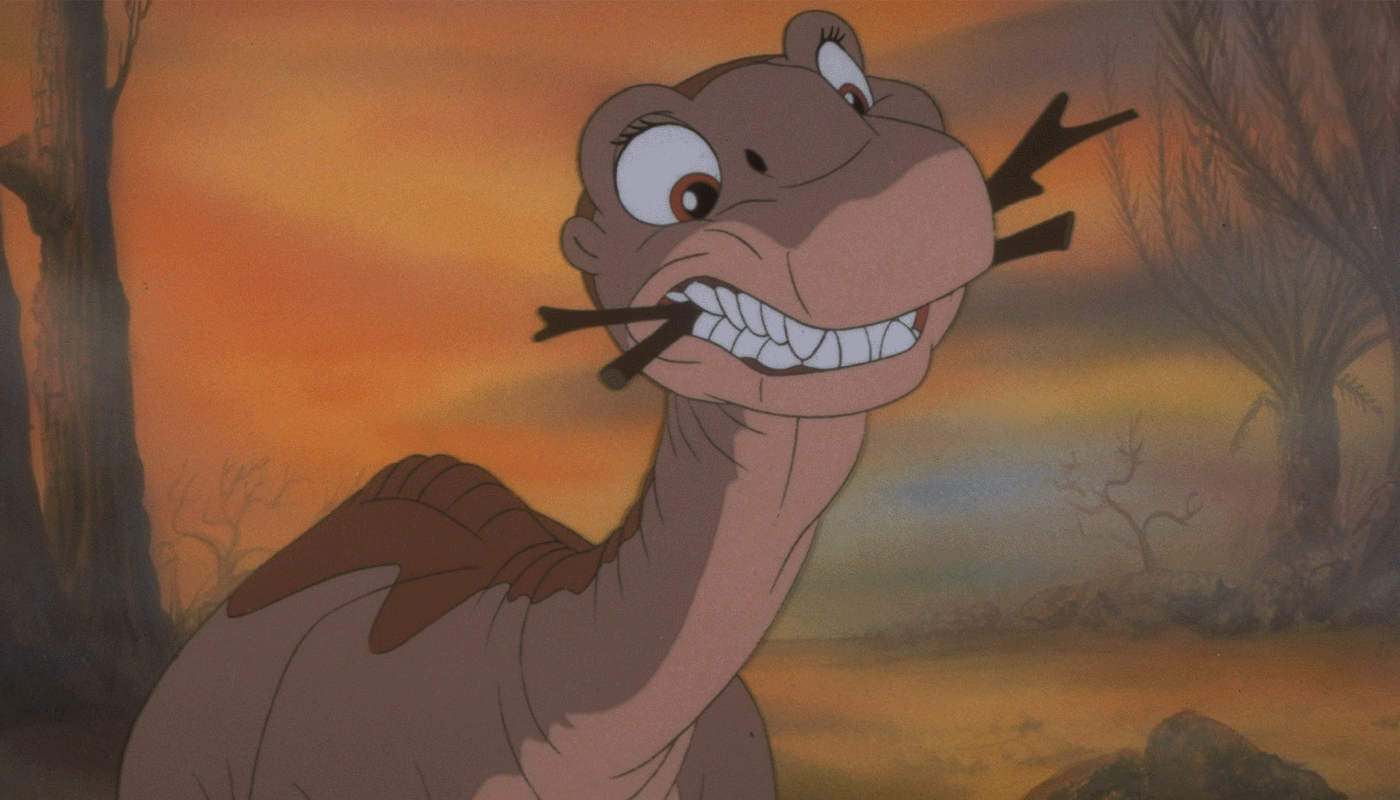
In the pantheon of 1980s cinema, few films cast as long a shadow—or evoke as much nostalgia—as Don Bluth’s 1988 animated feature, The Land Before Time. On the surface, it is a straightforward, albeit melancholic, children’s odyssey. Following the tragic loss of his mother to a predatory Tyrannosaurus rex and his subsequent separation from his grandparents, a young Apatosaurus named Littlefoot journeys across a volcanic, desolate landscape. Accompanied by a motley crew of fellow hatchlings—the headstrong Cera, the playful Ducky, the anxious Petrie, and the silent, ever-hungry Spike—he navigates the perils of a dying world to reach the sanctuary of the lush Green Valley.
Yet, to categorize the film merely as a "dinosaur movie" is to overlook the seismic shift it represented in both animation and the public’s relationship with prehistoric life. By anthropomorphizing dinosaurs, The Land Before Time effectively ended a century-long cinematic tradition that cast these creatures exclusively as monsters, beasts, or biological curiosities.
A Chronology of the Dinosaur on Screen
To understand why the shift in The Land Before Time was so radical, one must look at the evolution of the dinosaur in pop culture. In the nascent days of cinema, Winsor McCay’s Gertie the Dinosaur (1914) offered a glimpse of a playful, agile, and oddly human-adjacent creature. However, this was an outlier.
For the better part of the 20th century, the prevailing image of the dinosaur was dictated by the "beast" archetype. In The Lost World (1925), dinosaurs were dangerous big-game targets in an untamed, primeval wilderness. By the 1950s, the Cold War era saw the rise of the monster flick. In films like The Beast from 20,000 Fathoms (1953) and the seminal Godzilla (1954), the dinosaur became a vessel for post-war anxieties—a destructive, radioactive force of nature.
Even when scientific curiosity took center stage, as in Journey to the Beginning of Time (1955), the creatures remained cold, detached entities. It wasn’t until the 1980s that a narrative shift occurred. Baby: Secret of a Lost Legend (1985) began to pivot the audience’s empathy toward the dinosaur, framing the narrative around protection and the sanctity of the family unit rather than survival or escape. When Bluth and producer Steven Spielberg arrived at their concept in 1988, they were essentially attempting to blend the emotional stakes of Disney’s Bambi (1942) with the grand, orchestral scope of the Rite of Spring sequence from Fantasia (1940).
The Science Behind the Sentiment: The Dinosaur Renaissance
The transformation of the dinosaur from "cold-blooded monster" to "relatable character" was not a purely creative whim; it was fueled by the "Dinosaur Renaissance" of the 1960s and 70s.
For decades, the public perception of dinosaurs had been frozen in the early 20th-century view: sluggish, swamp-dwelling, and unintelligent. That changed in 1964 when paleontologist John Ostrom unearthed Deinonychus in Montana. These fossils suggested a bipedal, fast-moving, and potentially pack-hunting creature that shared a deep, evolutionary connection with birds. Robert Bakker, a student of Ostrom, further radicalized this view with his 1975 Scientific American article, "Dinosaur Renaissance." Bakker argued that dinosaurs were not evolutionary dead ends but warm-blooded, active animals with complex social structures.
This intellectual shift filtered down into public consciousness. Museums began updating their displays, books popularized the new research, and children—the primary consumers of dinosaur media—became obsessed. By the time Bluth and Spielberg were in production, the culture was primed to accept the idea that a dinosaur could possess a personality, a family, and a soul.
The Production Conflict: Bluth vs. Spielberg
Despite the film’s eventual success, the production was marred by a fundamental ideological conflict between the two creative giants: Don Bluth and Steven Spielberg.
Bluth, fresh off the success of the darker, more atmospheric The Secret of NIMH (1982), envisioned a film that did not shy away from the harsh realities of nature. He wanted to maintain a tone of apocalyptic tension. Spielberg, however, was acutely aware of the potential for the film to traumatize its target demographic.
According to various production accounts, Spielberg insisted on significant cuts, fearing that the T. rex sequences and the film’s grim landscapes would send mothers fleeing from theater lobbies with crying children. Approximately ten minutes of footage—much of it depicting more intense, violent, or sorrowful moments—were excised from the final cut. While these edits likely softened the film, they also introduced a narrative imbalance that critics like Roger Ebert noted at the time. Ebert argued that by forcing the dinosaurs into human roles, the filmmakers stripped the creatures of their "deliciously alien" nature.
Cultural Implications and Legacy
The irony of the "relatable dinosaur" is that it effectively paved the way for the very thing Spielberg feared: the return of the monster. By establishing that dinosaurs could be characters, the industry opened the door for them to be protagonists in every genre.
Following The Land Before Time, we saw an explosion of dinosaur media: Dino-Riders (1988), the sitcom Dinosaurs (1991–1994), and the pervasive Barney & Friends (1992–2010). James Gurney’s Dinotopia (1992) took the concept to its logical extreme, imagining an entire civilization built on human-dinosaur cooperation.
However, this cultural familiarity also allowed the subsequent re-emergence of the monster in Jurassic Park (1993) to hit with more force. The "raptors" in Crichton’s novel and Spielberg’s film were terrifying not because they were just big, but because they were intelligent, pack-hunting creatures—the direct, albeit darker, descendants of the scientific shift that allowed Littlefoot to exist.
The Tragedy of Ducky
No discussion of The Land Before Time is complete without addressing the profound tragedy of Judith Barsi, the child actor who voiced the character of Ducky. Barsi’s bright, emotive performance was instrumental in grounding the film’s emotional stakes. Tragically, she was murdered by her father in July 1988, just months before the film’s release. Her death remains a somber footnote in the film’s history, a stark reminder of the fragile lives of the children the movie was designed to enchant.
Conclusion: A Lingering Presence
Today, The Land Before Time is remembered as a cornerstone of late-20th-century animation. It occupies a unique space, balanced between the traditional "cute" animal trope and a surprisingly bleak, post-apocalyptic setting. While the scientific accuracy of the film is nonexistent—with species from different geological eras living side-by-side—its cultural accuracy was spot on.
It captured the zeitgeist of a generation that grew up in the shadow of the Dinosaur Renaissance. We didn’t want to just fear these creatures; we wanted to walk with them, to mourn with them, and to see ourselves reflected in their struggles for survival.
Whether one finds the film heartwarming or unsettling, its impact is undeniable. It transformed the dinosaur from a symbol of primordial terror into a mirror of the human condition. As we look back, it is clear that The Land Before Time did more than just tell a story about migration; it told the story of how our own imagination learned to evolve alongside the fossils beneath our feet.
The next time you watch a modern blockbuster featuring a prehistoric beast, pay close attention to the way the camera treats it. You are likely seeing the echoes of Littlefoot—the first dinosaur who taught us that even in the most dangerous landscapes, there is room for a story about family, hope, and the long, arduous journey toward a greener valley.

 Nana Wu
 Ali Ikhwan





