

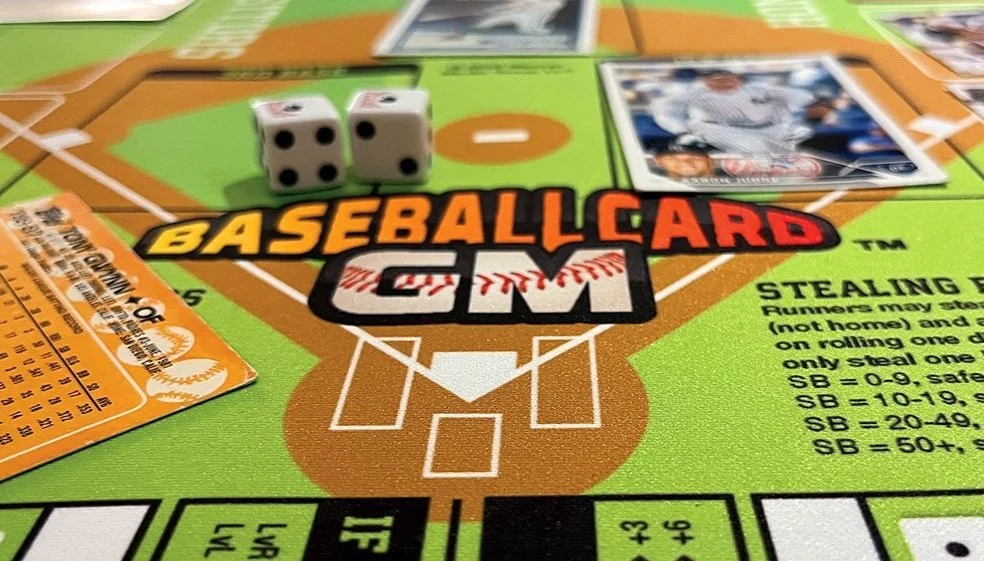
Designers: Matthew Weaver & Garrett Weaver | Publisher: Weaver Media Group | Players: 1-2+ | Playtime: 30 Minutes
For decades, the standard lifecycle of a baseball card has been depressingly predictable: a brief moment of excitement upon pulling it from a pack, followed by a permanent, dusty retirement in a plastic binder, a shoebox in the attic, or a neglected closet shelf. Collectors have long harbored the romanticized notion that these cardboard slips might one day fund a retirement or pay for a child’s tuition. But for most, they simply occupy space.
Enter Baseball Card GM, a refreshing tabletop project from designers Matthew and Garrett Weaver. The game poses a radical, long-overdue question: What if, instead of waiting for these cards to appreciate in value, we actually had fun with them today? The result is a surprisingly sophisticated sports simulation that transforms static statistics into high-stakes drama, dream-team construction, and an almost irresistible urge to raid your local hobby shop for fresh booster packs.
The Genesis of a New Sport
From Static Stats to Dynamic Play
The core premise of Baseball Card GM is elegant in its simplicity. Rather than utilizing generic tokens or predetermined player sets, the game requires players to curate their rosters from their own personal collections. Whether a player favors modern superstars, legendary icons of the 1980s, or even the "bulk" cards that typically populate basement storage, every card becomes a viable piece of hardware.
The game functions as a bridge between the physical hobby of card collecting and the strategic depth of tabletop simulation. By utilizing the actual statistics printed on the back of the cards—such as batting average, home runs, ERA, and stolen bases—the game anchors itself in the reality of the sport. The gameplay loop is intuitive: players assemble a lineup, and once the game commences, they roll two dice against a specialized neoprene playmat. This mat acts as the engine of the game, mapping dice outcomes against the player’s specific stats to determine everything from strikeouts and walks to clutch home runs and defensive plays.
Chronology of the Experience: A Game in 30 Minutes
The pacing of Baseball Card GM is one of its most commendable features. In an era where many sports simulations are bogged down by hours of complex record-keeping and overhead, this title streamlines the experience into a brisk, 30-minute affair.
Phase 1: The Roster Construction (Pre-Game)
The strategy begins long before the first pitch. Players must evaluate their collection, weighing the offensive prowess of a high-slugging outfielder against the defensive reliability of a seasoned infielder. This is where the "GM" title feels earned; players must consider synergy, bench depth, and the statistical profiles of their bullpen.
Phase 2: The Inning-by-Inning Grind
Once the game begins, the flow is rhythmic and addictive. A player bats through their lineup, advancing runners based on dice rolls and card stats. Outs and innings are tracked via provided markers. The game utilizes a tiered complexity system: beginners start with "favorite player" exhibition games, while seasoned veterans can introduce advanced modifiers such as lefty/righty splits, bullpen fatigue, and strategic pinch-hitting.
Phase 3: The Climax
Because the game avoids "take-that" mechanics or aggressive disruption, the tension is purely organic. It replicates the classic duel between a pitcher and a batter. The speed of the game—often just a few minutes per half-inning—eliminates the dreaded "downtime" that plagues many tabletop games, maintaining a sense of momentum that mirrors the intensity of a real-world televised broadcast.
Supporting Data: Why It Works
The success of Baseball Card GM lies in its ability to leverage the inherent "collectibility" of the cards themselves. By turning the "useless" common cards into tactical assets, the game provides a second life to the entire hobby.
- Accessibility: The game requires minimal equipment—a mat, two dice, and a deck of cards. This low barrier to entry makes it an ideal introduction to the world of sports simulation for younger players or those intimidated by the dense manuals of traditional wargames.
- The "Draft" Factor: For those who enjoy the competitive aspect, the game supports drafting formats. This shifts the focus from static collecting to active competition, where "sniping" a key reliever from an opponent becomes a genuine tactical triumph.
- Production Philosophy: Weaver Media Group has opted for a minimalist production style. By focusing on a high-quality, information-dense neoprene mat rather than an oversized box filled with plastic filler, they have prioritized utility and portability. The mat serves as the board, the rulebook, and the scorecard, ensuring that everything a player needs is constantly visible.
Official Perspective: The Designer’s Vision
While official statements from the Weavers emphasize the "sandbox" nature of the game, the design intent is clear: to democratize sports simulation. By removing the need for a proprietary set of cards, they have essentially created an "open-source" baseball engine.
In a recent industry analysis, it was noted that Baseball Card GM occupies a unique "third space" in the market. It is not quite a Trading Card Game (TCG) like Magic: The Gathering, nor is it a traditional board game. It is a utility for the existing baseball card community. The designers have purposefully kept the rules flexible to allow for "house rules," encouraging players to create their own tournament brackets or historical leagues. This fosters a community-led evolution of the game, where the players define the meta-game rather than a developer issuing constant, costly expansions.
Implications: A New Lease on Life for the Hobby
The implications for the baseball card industry are profound. For years, the hobby has been bifurcated into two camps: the "investors" chasing high-value PSA-graded slabs, and the "casuals" who have no outlet for their bulk cards. Baseball Card GM offers a compelling reason for both groups to engage with the product as a game rather than just a financial asset.
The Impact on Secondary Markets
As players seek out specific stats to round out their "perfect" lineup, we may see a shift in the demand for certain cards. A player with a mediocre hobby value but stellar statistical modifiers in the game could suddenly become a "must-have" for local gaming groups. This could revitalize the secondary market for "junk wax" era cards, which have historically struggled to gain traction among serious collectors.
The Social Component
By providing a social, tabletop framework, Baseball Card GM encourages face-to-face interaction. In an age of digital baseball simulations and mobile apps, there is a distinct, tactile satisfaction in holding an actual card—perhaps one you’ve owned since childhood—and using it to defeat an opponent in a game-winning bottom-of-the-ninth scenario.
Final Verdict: A Home Run for the Kitchen Table
Baseball Card GM is not a simulation designed for those who want to spend three hours calculating wind speed and stadium dimensions for every pitch. It is not for the person who demands a hyper-realistic, mathematically perfect recreation of every possible baseball variable.
Instead, it is a brilliant, streamlined sandbox. It is for the fan who wants to feel the thrill of the ballpark, the tension of the bullpen, and the satisfaction of building a winning team—all while giving those dusty, forgotten cards a reason to see the light of day. It is an accessible, nostalgic, and deeply satisfying experience that transforms the passive hobby of collecting into an active, competitive, and highly replayable sport.
Whether you are a veteran collector looking to purge your storage bins or a family looking for a rainy-day activity that doesn’t require a screen, Baseball Card GM succeeds because it understands what makes baseball, and baseball cards, so enduringly magical. It is, quite simply, a game that puts the "play" back into playing cards.
Score: 8/10
Baseball Card GM is highly recommended for baseball enthusiasts, TCG fans seeking a new format, and anyone looking for a fast-paced, low-friction sports gaming experience.











No comments yet. Be the first to join the conversation!