

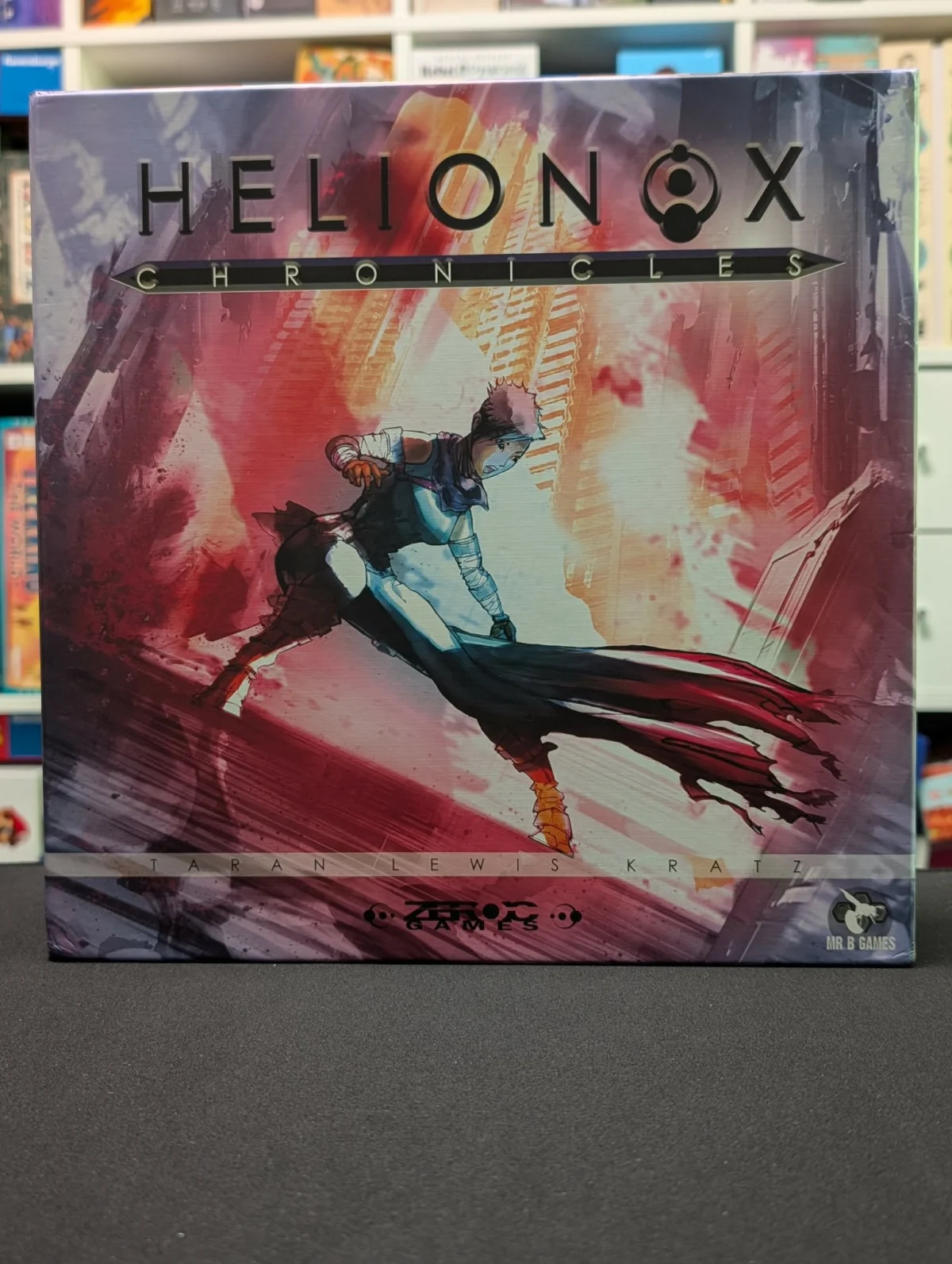
In the crowded landscape of cooperative tabletop gaming, titles often fall into two distinct camps: the frantic, fire-fighting efficiency of Pandemic or the sprawling, narrative-heavy epics that require a weekend to finish. Helionox: Chronicles, the latest offering from Zeroic Games, attempts a daring synthesis of these two extremes. Designed by Taran Lewis Kratz with art direction by Luke Green, Kratz, and Seth Rutledge, the game tasks players with a seemingly impossible mission: maintaining the stability of a fracturing solar system while balancing political unrest, economic collapse, and an encroaching, otherworldly threat.
The Core Concept: A Solar System on the Brink
Helionox: Chronicles is not merely a game about "saving the world"—it is a game about managing a systemic decline. Players are thrust into a future where the solar system is a powder keg. Earth, Mars, Mercury, and the Moon are not just static locations; they are interconnected hubs of industry and unrest.
The game is structured across four distinct eras. In each, players face a mounting onslaught of event cards that dictate the shifting political and environmental climate. These events are not flavor text; they are functional, ticking time bombs that force players into constant triage. A riot on Mars might limit resource production, while a sabotage attempt on Earth could deplete your ability to draw new cards. The overarching objective is to mitigate these crises while keeping the team’s collective score ahead of a relentless opposing track.
Chronology of Play: The Four Eras of Crisis
The rhythm of Helionox is dictated by its era-based structure, which serves to simulate a cinematic arc of escalation.
The Early Eras: Stabilization
During the first and second eras, the game focuses on infrastructure and foundation. Players spend their resources—represented by action dice—to invest in new cards and shore up planetary defenses. In solo play, the player manages three dice; in multiplayer, each participant is typically allotted two. This limitation forces a agonizing prioritization: Do you spend your die to suppress a riot, or do you use it to draw a card that might be essential for the endgame?
The Mid-to-Late Eras: The Escalation
As the game progresses into the third and fourth eras, the complexity spikes. The enemy presence, initially a background concern, becomes an active, aggressive force. The dice-as-action-selector mechanic becomes increasingly punishing; every roll now triggers enemy movement, leading to cascading failures if the board isn’t properly managed.

The Final Stand
The game culminates in a "final stand" scenario where players must confront the enemy presence head-on. The transition from the defensive posture of the early game to the aggressive requirements of the final era provides a narrative rhythm that feels earned rather than forced. By the time the fourth era arrives, the board state is usually so complex that the final turns feel like a high-stakes puzzle where every move must be perfectly synchronized between players.
Supporting Data: Mechanics and Interaction
The mechanics of Helionox rely heavily on a refined action-selection system. By using dice to dictate available moves, the game creates a deterministic yet unpredictable environment.
- Action Selection: Dice determine which actions—moving, researching, fighting, or gathering—are available. This removes the "analysis paralysis" common in games with too many open options, as players are constrained by their rolls.
- Cooperative Dependency: The game is designed so that no single player can effectively hold back the tide. Certain high-level crises require multiple players to commit resources simultaneously. This enforces a high level of verbal communication.
- The "Eternal Mode": Beyond the primary six-episode campaign, Zeroic Games has included "Eternal Mode." This is a sandbox component that allows players to customize the difficulty, locations, and enemy types. It effectively turns the game into a modular engine, significantly extending its lifespan for those who master the base campaign.
Implications for the Cooperative Genre
Helionox: Chronicles stands as a significant evolution in the deck-building cooperative genre. It bridges the gap between the "tight puzzle" school of design (seen in Tesseract or Pandemic) and the "thematic narrative" school (seen in Battlestar Galactica or Mass Effect).
The primary implication of this design is the shift from "luck mitigation" to "risk management." In many games, players try to eliminate bad outcomes. In Helionox, players accept that bad outcomes are inevitable; the goal is to choose which fires to let burn so that the system as a whole does not collapse. This shift in perspective makes for a much more intellectually stimulating experience.
Furthermore, the game’s physical presence—the board, the sturdiness of the components, and the clear iconography—suggests a maturity in Zeroic Games’ design philosophy. While the setup is undeniably "fiddly" due to the sheer number of tokens and cards, it creates a tactile experience that justifies the table space it occupies.
Official Perspective and Design Philosophy
In discussions regarding the game’s development, the design team at Zeroic Games has emphasized the importance of "narrative emergence." Rather than relying on heavy text blocks to tell a story, the game uses the mechanical interaction of its systems to foster a story in the player’s mind.

"We didn’t want the theme to be window dressing," a representative for the design team noted during a recent briefing. "We wanted the frustration of managing a failing colony on Mars to feel real. When a player realizes they can’t save both Earth and the Moon in the same turn, that’s where the story happens. That moment of sacrifice is the narrative."
This design philosophy is evident in how the architects (player characters) function. By utilizing different architects, players can lean into various strategies—some focusing on support and resource generation, others on aggressive containment. This encourages replayability not just through the scenarios, but through the varied ways groups can approach the same crisis.
Strategic Considerations for New Players
For those looking to dive into Helionox: Chronicles, the learning curve is steep but rewarding.
- Prioritize Communication: Because of the resource-sharing mechanics, a team that does not communicate will lose by the second era. Discussing how to spend dice before they are committed is mandatory.
- Embrace the "Fiddliness": The game requires organization. Invest in deck boxes or a small tray system. Managing the tokens and cards efficiently will reduce the "down-time" between rounds, allowing the game’s cinematic pacing to shine through.
- Study the Architect: Each architect has a unique ability that can be the difference between a win and a loss. Understand your role early in the campaign. If you are the support player, do not waste your dice on aggressive maneuvers that a different architect is better suited for.
- The Solo Experience: Helionox is remarkably well-balanced for solo play. Controlling three dice effectively simulates the "team" dynamic without the need for multiple players. For those who prefer a solitary, high-intensity puzzle, this is one of the best releases of the year.
Conclusion: A Stellar Addition to the Tabletop
Helionox: Chronicles earns an impressive 8.5/10. It is not a casual game; it is an ambitious, sometimes punishing, and deeply rewarding experience. It successfully marries the tension of a political thriller with the mechanical rigor of a high-end strategy game.
While the barrier to entry—specifically the setup time and the weight of the rules—might deter those looking for a light gaming night, the payoff is immense. For fans of hard sci-fi, political drama, and cooperative puzzles, Helionox: Chronicles is a definitive must-play. It manages to make the player feel like a commander in a crumbling empire, forced to make impossible choices in a race against time. In an era where many games feel like variations on a theme, Helionox stands out as a unique, cinematic, and intellectually demanding masterpiece.
As the solar system drifts toward its final era, one thing remains certain: the decisions you make will echo long after the final card is played.












No comments yet. Be the first to join the conversation!