

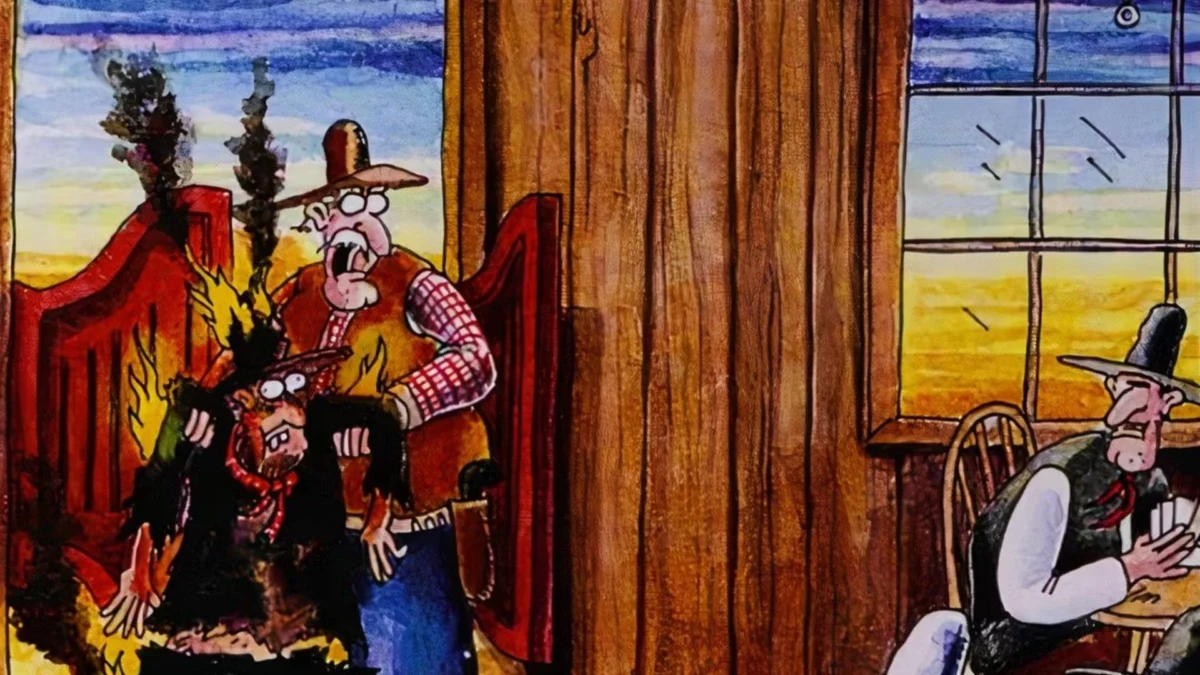
In the pantheon of 20th-century American humor, few cultural touchstones have cast a shadow as long—or as peculiar—as Gary Larson’s The Far Side. Debuting in 1980, the single-panel comic strip quickly transcended the boundaries of the daily newspaper, evolving from a niche, local curiosity into a genuine national phenomenon by the mid-1980s. While Larson’s repertoire explored everything from amoebas to aliens, there was one recurring motif that stood out for its sheer, destructive audacity: the obsession with things catching on fire.
For Larson, combustion was not merely a source of danger; it was a narrative engine. Whether it was the literal burning of a structure or the metaphorical "heat" of a punchline, Larson utilized the imagery of flame to underscore the chaotic, unpredictable, and often darkly bureaucratic nature of the universe he created. This article examines the legacy of these "fire-themed" panels, tracking their evolution across the three distinct acts of Larson’s storied career.
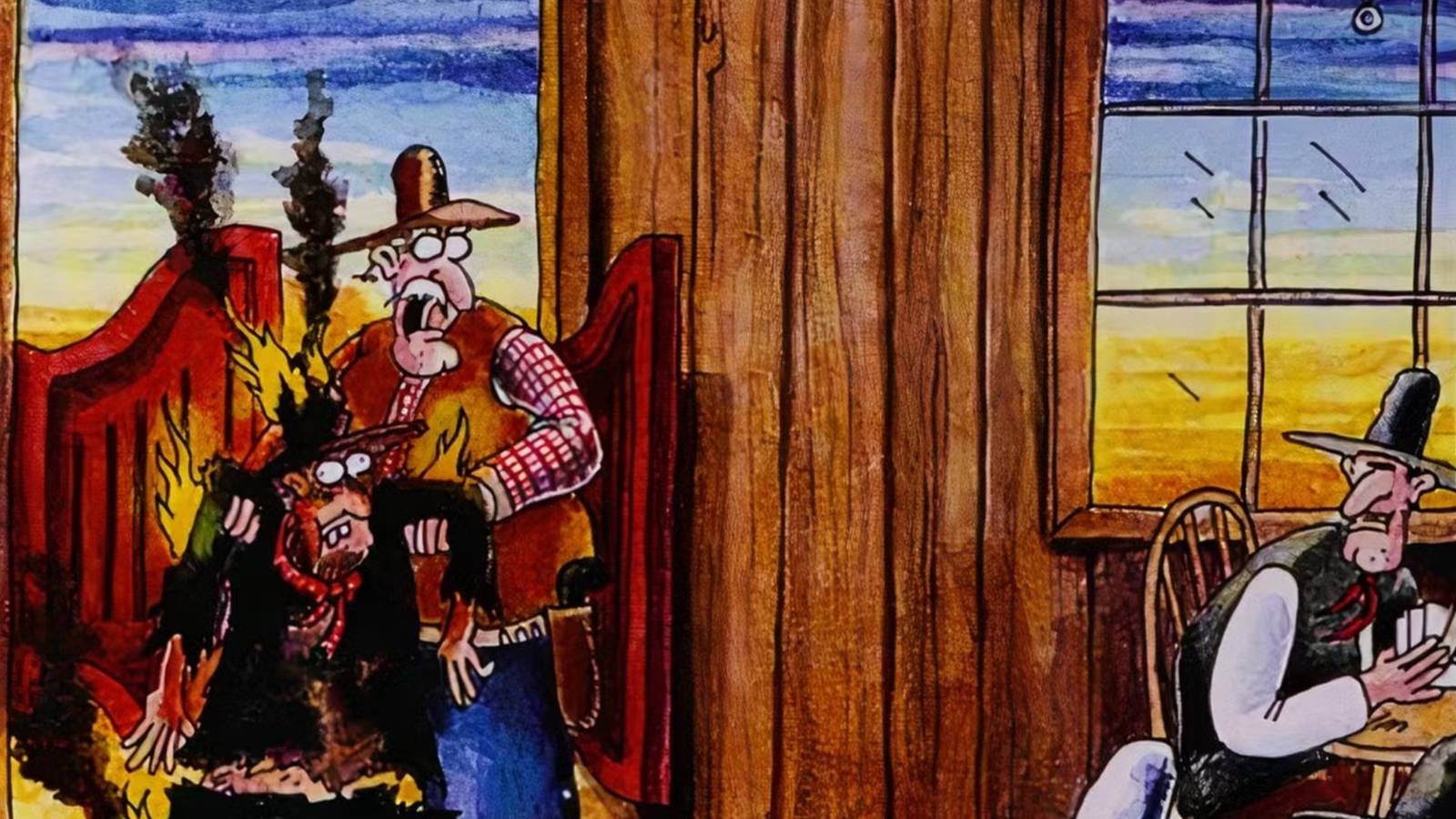
The Genesis of Chaos: Larson’s Early Years (1980–1984)
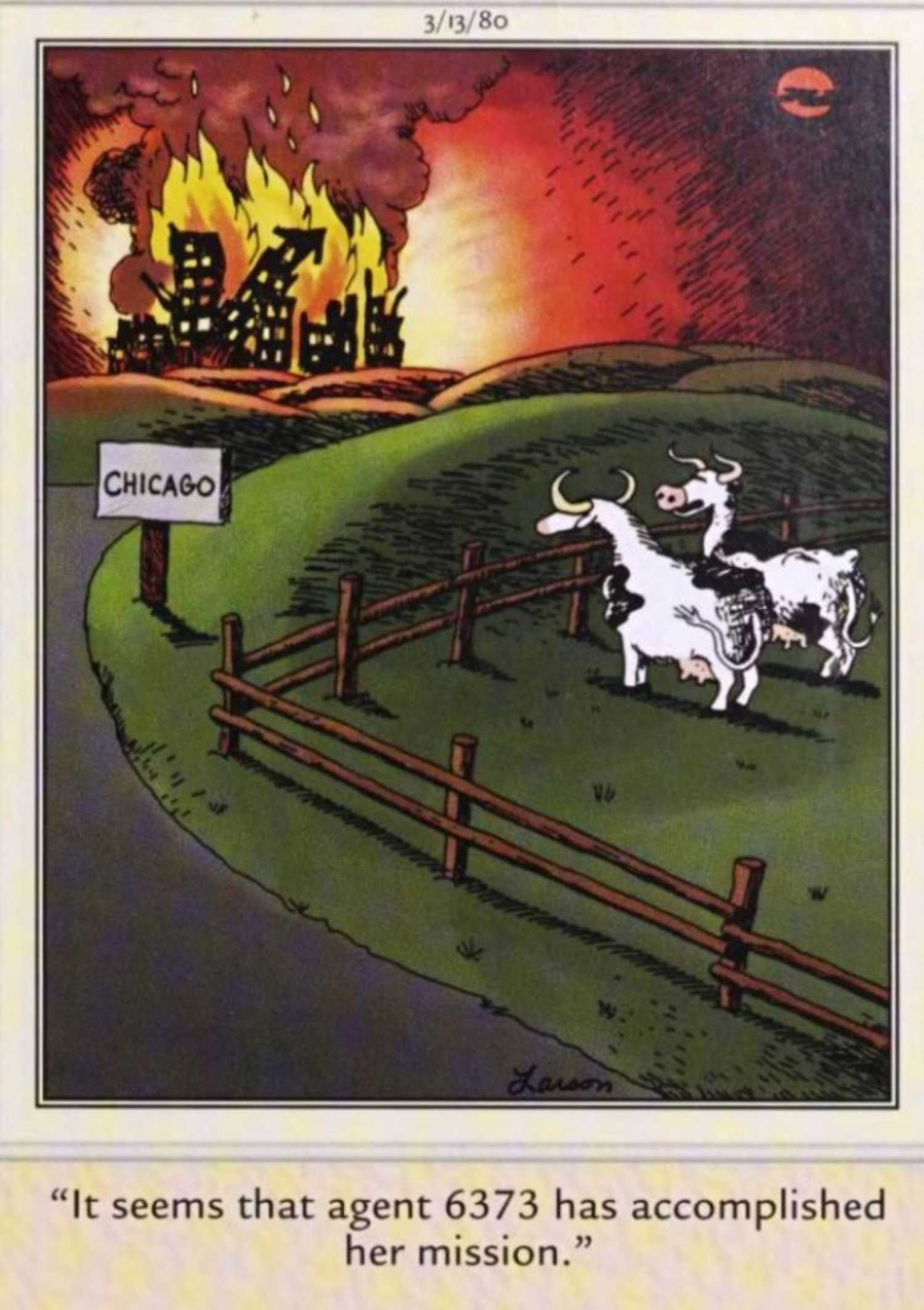
When The Far Side launched on January 1, 1980, it brought with it an aesthetic that was distinctly "outsider." Larson did not aim to comfort the reader; he aimed to catch them off guard. Among the earliest indications that Larson was obsessed with mayhem was the iconic March 13, 1980, panel revealing the "true" origins of the Great Chicago Fire.
In this seminal work, two cows watch as Chicago burns, with one remarking, "It seems that agent 6373 has accomplished her mission." This panel serves as the foundational text for what would become a hallmark of The Far Side: the "alternate history" conspiracy. By pinning the destruction of a major American city on a bovine secret society, Larson effectively signaled that in his world, the mundane was merely a thin veil over a vast, ridiculous, and often malevolent reality.
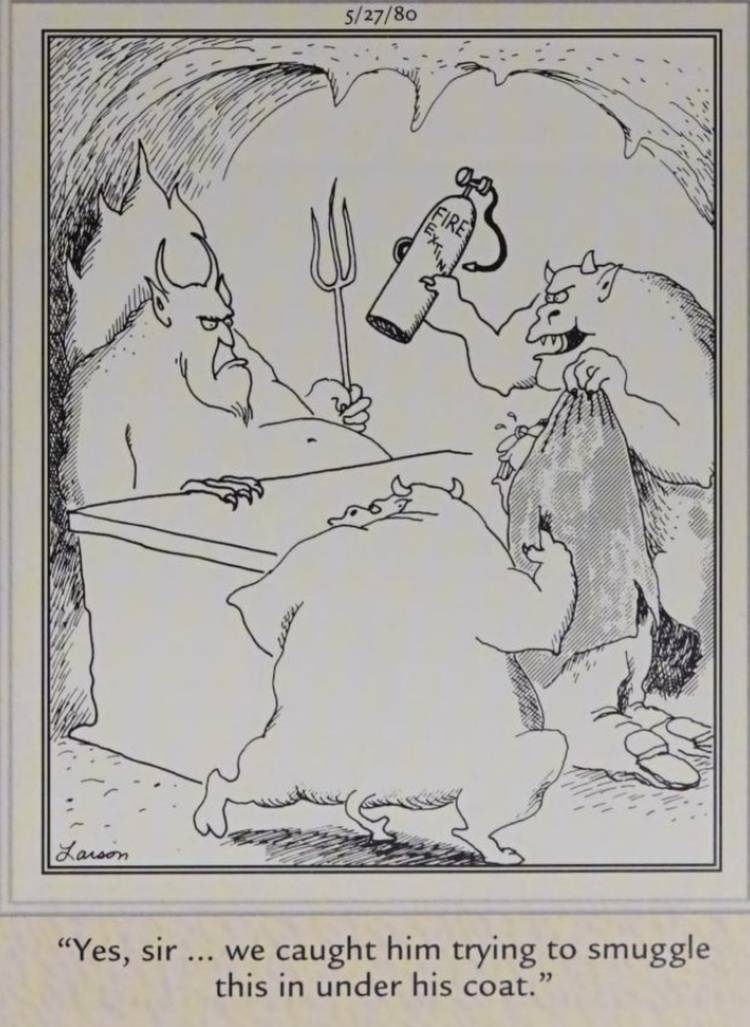
This period also established the recurring setting of Hell. In a May 27, 1980, cartoon, Larson introduced the bureaucratic misery of the afterlife, depicting a man being dragged into the Devil’s office for the "crime" of trying to smuggle a fire extinguisher into the fiery pit of damnation. The humor here is twofold: the absurdity of the man’s optimism and the depiction of Satan as a weary, middle-management type overseeing an endless, tedious process of suffering.
Chronology of Conflagration: From Spark to Inferno
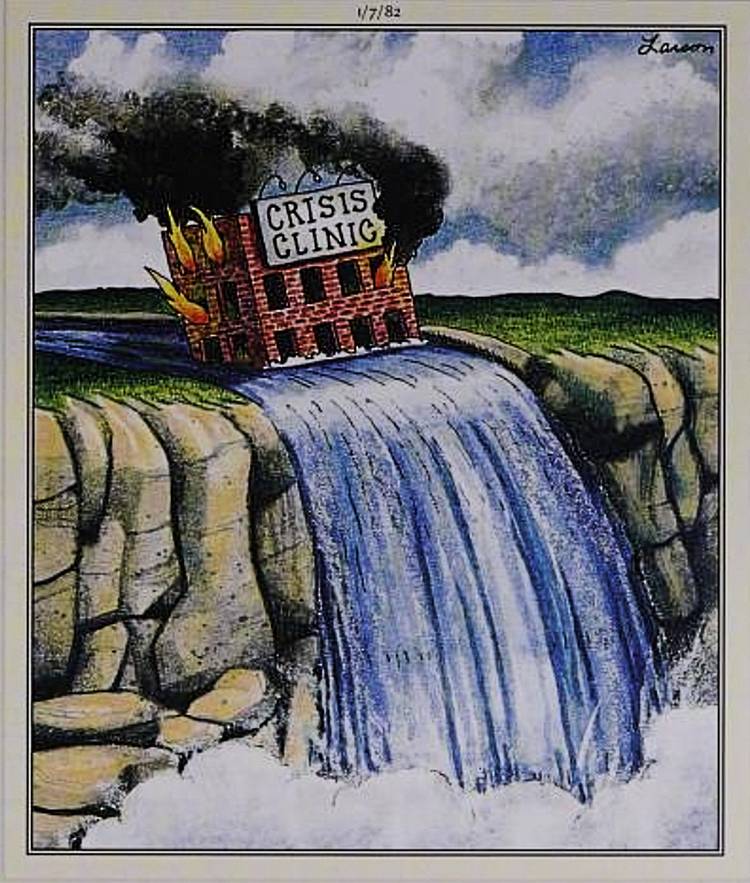
As the 1980s progressed, Larson’s career began to "heat up" in tandem with his subject matter. By 1982, the complexity of his visual jokes had sharpened significantly. The January 7, 1982, panel featuring a "Crisis Clinic" that is simultaneously on fire and drifting toward a massive waterfall serves as a masterclass in visual storytelling.
The brilliance of this panel lies in its rejection of traditional logic. There is no explanation provided for why the clinic is on fire, nor how it found itself in a river, nor why the river leads to a waterfall. By leaning into the absurd, Larson forces the reader to accept the "Murphy’s Law" reality of his world: if a situation can be disastrous, it will be.
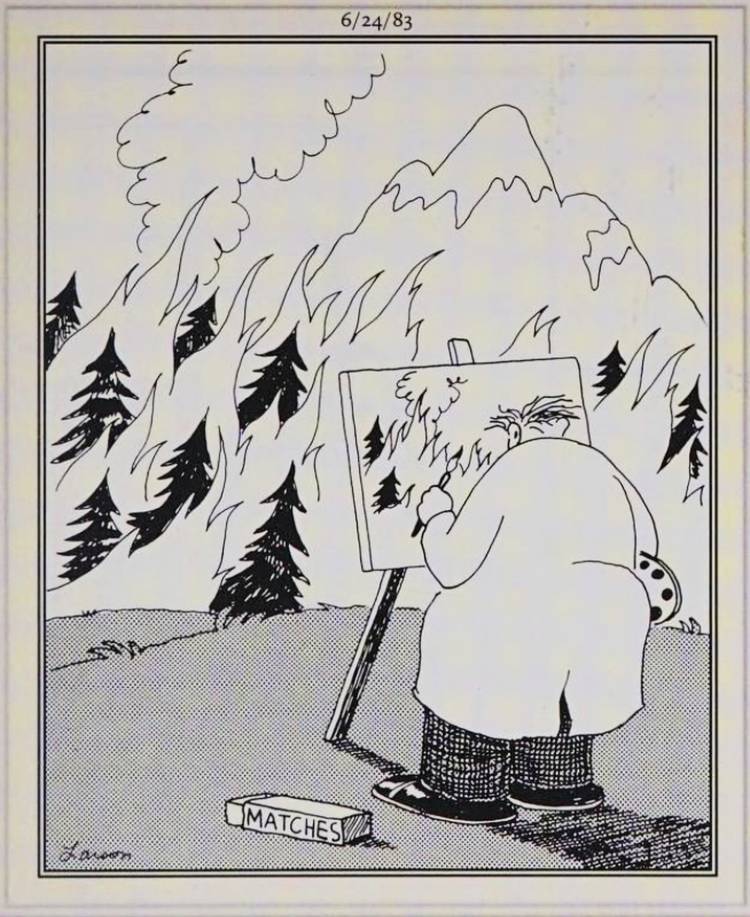
By 1983, Larson moved toward darker, more nuanced territory. The June 24, 1983, wordless panel featuring a painter setting a forest on fire simply to capture the "perfect" landscape on his canvas remains one of the most chillingly effective jokes in the strip’s history. It required the reader to participate in the storytelling—connecting the box of matches at the artist’s feet to the raging inferno behind him. It remains a pinnacle of Larson’s ability to highlight the moral bankruptcy of humanity through a single, static image.
Supporting Data: Why We Laugh at Destruction
What was it about fire that resonated so deeply with the audience of the 1980s and 1990s? Scholars of comedy suggest that Larson’s work tapped into a specific type of relief-based humor. By placing characters in situations of extreme, life-threatening peril—such as a burning house, a forest fire, or the literal pits of hell—and having them respond with mundanity or incompetence, Larson allowed readers to process the "scary things" of life through a lens of controlled absurdity.
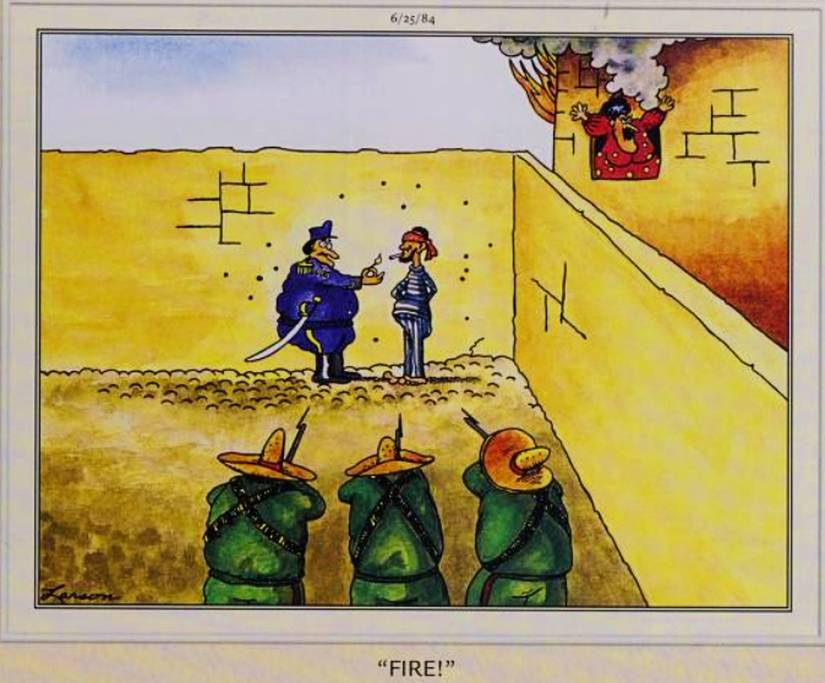
Consider the June 25, 1984, cartoon: a woman yells "Fire!" from a window in a burning building, which causes a soldier to fire his rifle at a condemned man during an execution ceremony next door. The pun on the word "fire" is a classic linguistic trick, but the execution of the joke—the sheer timing—is what makes it legendary. It captures a "wrong place, wrong time" scenario that resonates with the universal anxiety of being misunderstood or caught in the gears of a chaotic system.
The "Inside" Perspective: Science and the Supernatural
Larson’s scientific background frequently bled into his work, leading to bizarrely imaginative takes on natural phenomena. The August 27, 1986, cartoon depicting a man inside the sun whose sole job is to flip a "rise/set" switch is a perfect example of Larson taking a scientific concept and applying a "What if?" scenario that is both profoundly silly and logically consistent within the context of the strip.
The image of the man sitting in the sun, sweating, reading the Sun Tribune with his feet up, humanizes the celestial body in a way that feels inherently "Larsonian." It suggests that the vast, terrifying, and burning reality of our universe is actually just another day at the office for a beleaguered worker. This theme of the "blue-collar" supernatural would return again and again, most notably in the July 16, 1990, panel featuring a demon couple casually discussing their dog, who is currently catching fire in the living room. The nonchalance of the demon wife—"I think it’s your turn to put him out"—turns a catastrophic domestic event into a relatable marital squabble.
Implications of the "Larsonesque" Style
The enduring appeal of these comics lies in their ability to bridge the gap between "smart" and "dumb" humor. You do not need to know the history of the Great Chicago Fire to find the cow conspiracy funny, nor do you need to be a student of physics to appreciate the man inside the sun. Yet, for those who seek depth, the layers are there.
The implication of Larson’s work is that the world is inherently precarious. Whether it is a woman bouncing on a trampoline from one burning building into another (March 31, 1991), or a nerd in hell asking, "Hot enough for ya?" (October 1, 1987), the characters in The Far Side are constantly subjected to the whims of a universe that does not care about their comfort or safety.
Conclusion: A Legacy That Still Burns
Gary Larson’s The Far Side remains a singular work of creative vision. In the decades since the strip’s conclusion, the "fire" of his humor has not diminished. If anything, the ability of these panels to capture the absurdity of existence—the way we struggle to maintain order in the face of inevitable, fiery chaos—has only become more relevant.
Larson’s work is a testament to the idea that humor is the ultimate survival mechanism. By turning the most terrifying scenarios—death, fire, damnation, and destruction—into the punchlines of a single-panel cartoon, he didn’t just entertain a generation; he provided a way to look at the fragility of our own lives and laugh. The Far Side was, and remains, a masterclass in the art of the spark, proving that even when everything is going up in flames, there is still room for a well-timed joke.











No comments yet. Be the first to join the conversation!