
 Asep Darmawan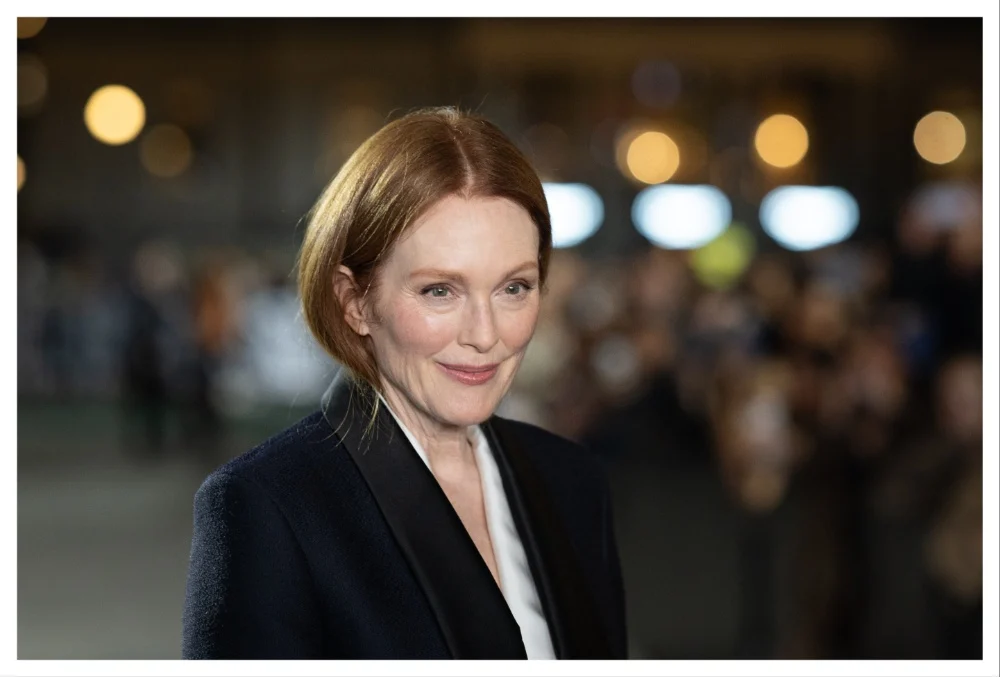
A Legacy Honored in the Eternal City
The Rome Film Festival has officially announced that Academy Award-winning actress Julianne Moore will be the recipient of its prestigious Lifetime Achievement Award at this year’s edition, which is scheduled to run from October 13 to October 25. The accolade serves as a testament to a career defined by fearless choices, transformative performances, and an unparalleled ability to bridge the gap between high-art independent cinema and compelling mainstream narratives.
The announcement was formalized by Salvatore Nastasi, president of the Fondazione Cinema per Roma, the governing body behind the festival. Moore’s presence at the festival will be underscored by the Italian premiere of her latest project, The Debut, directed by Jesse Eisenberg. In a poetic gesture of mutual respect, Eisenberg—who has directed Moore in two of his three feature films—will personally present the award to the actress, cementing a creative partnership that has become one of the most intriguing collaborations in contemporary independent film.
A Chronology of a Storied Career
To understand the weight of the honor being bestowed in Rome, one must look at the trajectory of Julianne Moore’s career. Born in North Carolina, Moore’s ascent in the 1990s was characterized by a rare combination of vulnerability and intensity. Her breakout performance in Paul Thomas Anderson’s Boogie Nights (1997) earned her the first of several Oscar nominations, establishing her as an actress capable of navigating the darker, more complex corners of the human psyche.
The subsequent decades saw a string of performances that solidified her status as an industry heavyweight. She received Academy Award nominations for her work in The End of the Affair (1999), Far From Heaven (2002), and The Hours (2002). Her pursuit of excellence led her to become one of the few actors in history to win Best Actress awards at the "Big Three" European film festivals: Cannes (Maps to the Stars), Venice (Far From Heaven), and Berlin (The Hours).
This culminated in her long-overdue Oscar win in 2015 for her gut-wrenching portrayal of a linguistics professor diagnosed with early-onset Alzheimer’s in Still Alice. Since then, Moore has refused to rest on her laurels, pivoting toward projects that challenge the boundaries of character-driven storytelling, leading directly to her current collaboration with Eisenberg.
Supporting Data: The "Eisenberg-Moore" Creative Arc
The Debut marks the second time Moore has worked under the directorial lens of Jesse Eisenberg. Their first collaboration, 2022’s When You Finish Saving the World, was noted for its nuanced exploration of the generational divide. The Debut, Eisenberg’s third directorial outing, represents an evolution in his style, moving from the grounded dramedy of his debut toward a more satirical, meta-theatrical exploration of ego and art.
The film follows Mona Friedman (Moore), a shy, unassuming housewife who finds herself cast in a minor role at a local community theater. What begins as a hobby rapidly devolves into an obsessive, high-stakes battle for artistic control. Mona, shedding her "crumpled wallflower" persona, transforms into a militant Method actor, willing to sabotage the entire production to protect the integrity of her bit part against the theater’s domineering director.
The film’s critical reception has been nothing short of rapturous. Following its world premiere at the Telluride Film Festival, the movie moved to the Zurich Film Festival in September, where Moore was honored with the Golden Icon Award. Variety chief film critic Owen Gleiberman, in his review, praised the film as a "twisted love letter to the glory of community theater," highlighting the synergy between Eisenberg’s sharp, poking script and Moore’s "utterly astonishing" performance.
Official Responses and Festival Implications
The selection of Moore for the Lifetime Achievement Award is a strategic and celebratory move for the Rome Film Festival. By aligning her visit with the premiere of The Debut, the festival ensures a high-profile red carpet event that bridges the gap between Hollywood’s elite and the European art-house circuit.
In his statement, Salvatore Nastasi emphasized that the award is not merely a reflection of past achievements but a recognition of an artist who continues to push the medium forward. "Julianne Moore is a singular talent," Nastasi noted. "Her ability to inhabit characters that feel lived-in, flawed, and profoundly human is the reason she remains one of the most important figures in modern cinema. Bringing her to Rome, particularly with a film that highlights her range as a comedic and dramatic force, is a highlight of our program."
For Jesse Eisenberg, the opportunity to present the award to his muse is a full-circle moment. Having transitioned from a celebrated actor to a writer-director with a distinct voice, Eisenberg has often cited Moore as the anchor for his scripts. "Writing for Julianne is a privilege because she finds the ‘corner’ of every scene that no one else sees," Eisenberg stated in a recent press junket. "She doesn’t just play the role; she dismantles it and puts it back together in a way that feels dangerous."
Analyzing the Impact: Why ‘The Debut’ Matters
The critical buzz surrounding The Debut is indicative of a broader trend in independent cinema: the "meta-theatrical" drama. By casting a star of Moore’s caliber as a woman obsessed with the "artistic integrity" of a bit part, Eisenberg is commenting on the nature of celebrity and the often-absurd lengths to which actors go to feel validated.
The implications for the film’s awards season prospects are significant. While the project is firmly rooted in the indie circuit, the combination of a high-profile directorial effort from Eisenberg and a career-best performance from Moore has put the film on the map for various guilds and precursors. Furthermore, by premiering at Rome, the film gains additional European visibility, which is essential for its international rollout.
Beyond the specific success of The Debut, the award at Rome acts as a validation of Moore’s late-career pivot. Unlike many of her contemporaries who gravitated toward high-budget franchise work, Moore has consistently sought out projects that interrogate the nature of performance itself. Her choice to work with younger, unconventional directors like Eisenberg has kept her work feeling fresh and unpredictable.
The Cultural Significance of the Rome Film Festival
The Rome Film Festival, held annually at the Auditorium Parco della Musica, has increasingly positioned itself as a bridge between the commercial success of American cinema and the auteur-driven traditions of Europe. By honoring an American actress who is deeply respected by the European festival circuit, the organizers are reinforcing their mission to celebrate "cinema as a global language."
The festival, running from October 13 to October 25, is expected to draw a record number of international critics and industry executives. The spotlight on Moore, however, serves as the anchor. It is a rare moment in the festival calendar where the focus shifts from industry politics to the sheer, unadulterated craft of acting.
Conclusion: A Living Legend
As Julianne Moore prepares to step onto the stage in Rome to accept her Lifetime Achievement Award, the narrative surrounding her is one of continuity and evolution. She is not merely an actress receiving a "thank you" for years of service; she is an artist at the height of her powers, currently delivering some of the most complex, subversive work of her career.
From her early days in indie theater to her Oscar-winning turn in Still Alice, and now to the manic, method-obsessed depths of The Debut, Moore has consistently proven that the best way to maintain a career is to never stop blooming. As she prepares to accept the tribute in the Eternal City, the world of film waits to see what "bit part" or "leading role" she will choose to dismantle next. The Rome Film Festival honor is a well-deserved bow, but for Moore, it appears to be just another act in a performance that shows no signs of closing.


 Pevita Pearce
 Raul Delapena Setiawan




