

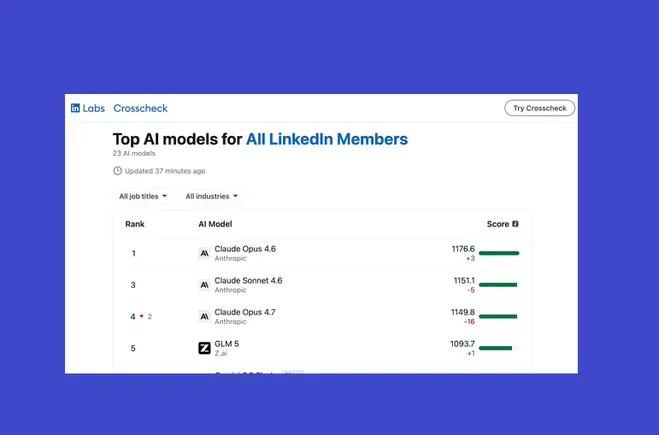
In an era where Artificial Intelligence has transitioned from a niche technical novelty to an essential workplace companion, the challenge for professionals is no longer whether to use AI, but which AI to use. Recognizing this fragmented landscape, LinkedIn has officially begun the rollout of its innovative "Crosscheck" tool to its U.S. user base this month, with plans for a broader global expansion in the coming months.
By allowing users to pit top-tier AI models against one another in a blind, comparative environment, LinkedIn is positioning itself not just as a professional networking hub, but as a critical arbiter of AI utility in the enterprise sector.
The Core Mechanism: How Crosscheck Works
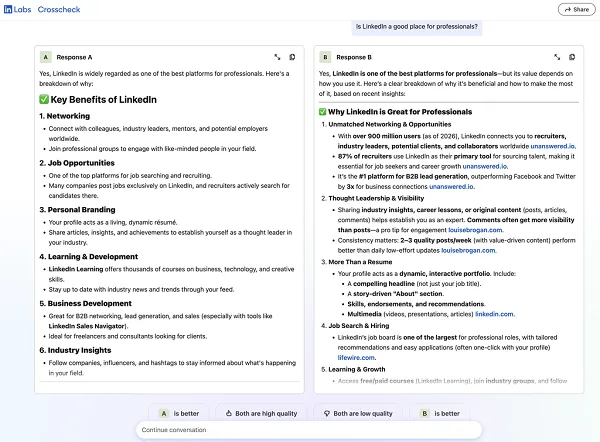
At its heart, Crosscheck is designed to eliminate the guesswork inherent in selecting an AI partner for business tasks. The platform allows users to input specific prompts—ranging from drafting complex legal emails to generating technical documentation—and receive two distinct, side-by-side responses generated by different AI models.
To maintain objective evaluation, these models are anonymized. The user does not know which provider—whether OpenAI, Anthropic, Google, or Microsoft—generated which response until after they have provided their quality rating. This "blind testing" approach is designed to eliminate brand bias, ensuring that users select the model that provides the most relevant, accurate, and high-quality output for their specific professional niche.
The Ecosystem of Models
Crosscheck integrates the industry’s leading Large Language Models (LLMs). By acting as a neutral intermediary, LinkedIn creates a sandbox where these models can be tested against the "real-world" requirements of professionals. This includes:
- Sector-Specific Benchmarking: Evaluating how well a model understands the nuances of fields like finance, software engineering, marketing, or healthcare.
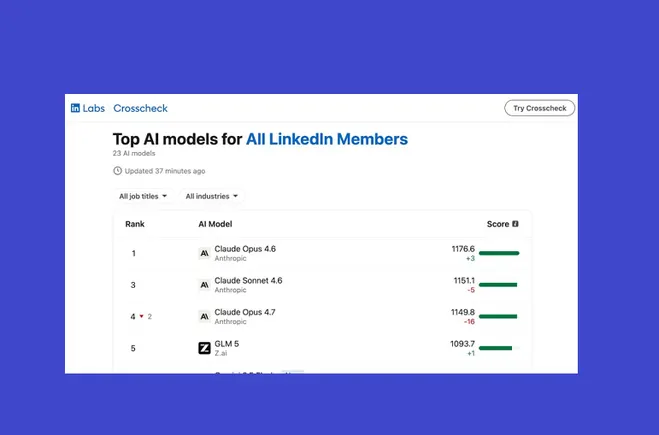
- Job-Type Metrics: Providing insights into which models perform best for specific tasks, such as cold-outreach emails, project management summaries, or data analysis.
- Performance Aggregation: Collecting user ratings to build a repository of performance data that helps the broader LinkedIn community make data-driven decisions.
A Brief History: From Pilot to Public Utility
The journey of Crosscheck reflects the rapid pace of AI adoption within the professional sphere.
March 2024: The Premium Prototype
LinkedIn initially introduced Crosscheck to its Premium tier members. This controlled rollout allowed the platform to gather initial feedback from power users, refine the UI/UX, and ensure that the infrastructure could handle the computational demands of real-time multi-model comparisons.
May 2024: The U.S. Expansion
Starting this week, LinkedIn has opened the doors to U.S.-based users. This move marks the transition of the tool from a "premium perk" to a core utility of the LinkedIn experience, signaling that the company views AI literacy as a foundational skill for the modern workforce.
Future Outlook
Following the U.S. rollout, the company has indicated that availability will expand internationally throughout the remainder of 2024. This trajectory mirrors LinkedIn’s previous successful product launches, prioritizing stability in its largest market before scaling to a global audience.
Supporting Data and Strategic Value
Why is LinkedIn, a platform primarily known for networking and recruitment, investing so heavily in AI benchmarking? The answer lies in the intersection of "professional identity" and "utility."
The Data Advantage
LinkedIn possesses a unique asset: the world’s most comprehensive dataset of career trajectories, job functions, and professional skills. By layering AI performance data on top of this "career metadata," LinkedIn is building a feedback loop that is highly valuable to both the user and the AI developer.
Value for Developers
For the major players like OpenAI and Google, the battle for enterprise dominance is intense. Crosscheck offers these developers a "gold standard" testing ground. By seeing how their models perform in specific job categories compared to competitors, developers can refine their training data to better cater to professional needs. This transforms LinkedIn into a vital barometer for AI efficacy.

Value for the Professional
For the individual user, the "choice paralysis" caused by the current explosion of AI tools is real. Crosscheck provides a tangible, trust-based infrastructure. Instead of relying on anecdotal marketing claims from AI companies, professionals can see how a model handles their specific daily tasks.
Official Stance: Bridging the Trust Gap
In a blog post detailing the launch, LinkedIn’s engineering team emphasized that the tool is more than just a novelty; it is a response to the "daily tool" status that AI has achieved for hundreds of millions of professionals.
"AI is becoming a daily tool for hundreds of millions of professionals, and the models they choose shape the quality of their work," a LinkedIn spokesperson stated. "Crosscheck brings together LinkedIn’s unique assets—professional identity at global scale, rich career metadata, and enterprise-grade trust infrastructure—with statistical innovations purpose-built for professional evaluation."
The company frames this as a "trust infrastructure." In an age of hallucinations and inconsistent AI performance, LinkedIn is aiming to provide a layer of accountability. By facilitating a transparent comparison, they are effectively raising the bar for AI quality across the entire professional ecosystem.
Implications for the Future of Work
The launch of Crosscheck carries profound implications for how AI will be integrated into the workplace over the coming years.
1. The Death of One-Size-Fits-All
The era of assuming one AI model is "the best" is effectively over. Crosscheck highlights that for a data scientist, one model might be superior, while for a creative copywriter, another might reign supreme. The move toward specialized model selection will likely force developers to market their tools not as "general intelligence" engines, but as highly optimized solutions for specific professional roles.
2. The Rise of "AI Literacy" as a Career Skill
As LinkedIn integrates these tools, the ability to effectively prompt, compare, and select the right AI tool will become a competency in itself. Professionals who can leverage Crosscheck to optimize their workflow will likely see higher productivity rates, potentially becoming a new metric for "top talent" on the platform.
3. Strengthening the LinkedIn Moat
By providing this service, LinkedIn increases the "stickiness" of its platform. Users are no longer just visiting LinkedIn to look for jobs or network; they are visiting to complete their daily professional tasks. This transition from a passive networking site to an active productivity suite is a significant shift in LinkedIn’s business model.
4. A New Standard for AI Transparency
Perhaps most importantly, Crosscheck pushes the industry toward greater transparency. By forcing AI models to perform in the open, LinkedIn is challenging the "black box" nature of current LLMs. If a major model consistently underperforms in a specific sector, that data will now be visible to the community, forcing developers to iterate faster and prioritize quality over sheer speed of release.
Conclusion: Navigating the AI Frontier
As Crosscheck continues its rollout, the professional landscape is set to undergo a subtle but significant transformation. The tool serves as a bridge between the rapid, often chaotic evolution of AI and the pragmatic, efficiency-driven needs of the modern workforce.
While the tool is currently in its early stages of public availability, its long-term potential to standardize AI quality and empower professionals is clear. LinkedIn has effectively leveraged its position as the custodian of the world’s professional data to create a product that not only aids the individual worker but also forces the broader AI industry to prove its value in the real world.
For the professional, the message is simple: The best AI for your job is the one that proves itself in practice. With Crosscheck, LinkedIn is ensuring that users no longer have to take that proof for granted. As we look toward the remainder of the year, all eyes will be on how this benchmarking data influences the development cycle of the world’s most powerful AI models, and ultimately, how it changes the way we define "professional excellence" in the age of machines.











No comments yet. Be the first to join the conversation!