Suro Senen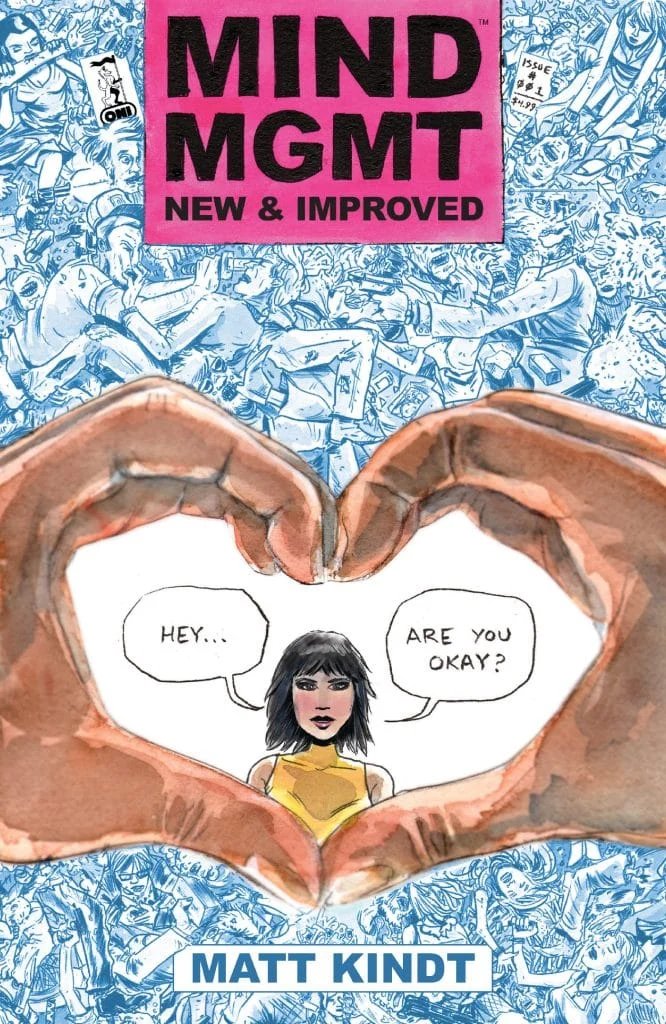
Ten years after the cataclysmic collapse of the extra-governmental agency known as Mind Management—a shadow organization built on psychic warfare and global manipulation—the dust has finally settled. Or so we thought. With the release of Mind MGMT: New & Improved #1, creator Matt Kindt invites readers back into a world where reality is merely a suggestion, and the most dangerous weapon is a thought you didn’t know you were having.
Published by Oni Press under the Flux House imprint, this new series arrives with the weight of its predecessor’s legacy while simultaneously stripping away the certainty of everything we previously understood about this universe.
Main Facts: A Paradigm Shift in Psychic Espionage
The premise of Mind MGMT: New & Improved #1 is deceptively simple: a series of impossible, arcane crimes are being committed across the globe. Detectives Delphi and Swan, two investigators tasked with navigating the debris of the old world, find themselves trailing a faceless killer who seemingly defies the laws of physics and digital surveillance.
The crimes themselves are chillingly surreal. In one instance, a target is neutralized by a sophisticated neurotoxin in a crowded coffee shop; in another, a suicide victim is discovered under a train, yet his limbs are found miles away in a trash receptacle. These are not the marks of common criminals. They are the signatures of an entity that understands the mechanics of reality manipulation—the very specialty of the long-defunct Mind Management.
The central conflict forces a harrowing question upon the reader: Has Mind Management returned from the grave, or did it never truly leave? As the narrative unfolds, the series challenges the reader’s perception of continuity. Is this a sequel? A reboot? A meta-fictional commentary on the nature of storytelling itself? Kindt ensures that the reader remains as paranoid as his protagonists, masterfully blurring the line between fact, fiction, and psychological projection.
Chronology: The Decade of Silence and the New Threat
To understand the urgency of the current narrative, one must revisit the timeline of the "Mind MGMT" universe:
- The Era of Control (Pre-Collapse): Mind Management operated as a covert, global agency, utilizing psychic assets to steer geopolitics, spark revolutions, and bury secrets. Their influence was absolute, and their presence was invisible.
- The Collapse (Ten Years Ago): The agency disintegrated in a violent, bloody climax involving high-stakes betrayal and the literal shattering of psychic defenses.
- The Interregnum (The Last Decade): Surviving agents went deep underground. They adopted unremarkable identities, abandoned their psychic callings, and constructed elaborate, falsified pasts to evade detection. The world moved on, convinced that the psychic threat had been neutralized.
- The Present Day: The emergence of a "faceless killer" targeting these sleeper agents acts as the catalyst for the new series. The security protocols that were supposed to protect these survivors are failing, and the digital age’s surveillance state is proving useless against an enemy that operates in the gaps between thoughts.
Supporting Data: The Anatomy of a Kindt Comic
What sets Mind MGMT apart from standard genre fare is its refusal to be contained by the traditional boundaries of the comic book medium. Matt Kindt’s work is famously immersive; the story is not merely contained within the panels. It exists in the margins, the gutter space, the introductory essays, and even the credit pages.
The "Meta" Narrative
Kindt’s signature style involves "narrative leakage." Readers of New & Improved #1 will notice that the credit page is not a standard list of names but a dense, cryptic introduction to the world’s history. This creates an immediate friction: the reader is tasked with deciphering what is an objective truth of the series and what is a "lie" planted by an unreliable narrator.
The Visual Language
Kindt’s art remains consistent with his established aesthetic: a watercolor-adjacent style that feels fluid, organic, and slightly dreamlike. This visual approach is critical to the story’s success. The art acts as a vessel for clues; subtle details hidden in the background, erratic line work, and the deliberate use of negative space serve as visual puzzles. For the astute reader, the art is a map of the conspiracy itself.

Official Responses and Editorial Context
Oni Press has positioned Mind MGMT: New & Improved #1 as a cornerstone of their Flux House imprint. The editorial decision to label the series "New & Improved" is clearly a double entendre—a nod to the evolving nature of the franchise and a tongue-in-cheek reference to consumer culture’s obsession with "new" versions of the same old products.
In providing a review copy to critics, the publisher emphasized that the series is designed to be accessible to new readers, functioning as a "rabbit hole" entry point. However, for the die-hard fanbase, the series offers a meta-textual puzzle: Do the previous volumes matter? The editorial team has leaned into this ambiguity, encouraging the discourse surrounding whether this series is a canonical continuation or a deliberate fracturing of the established lore.
Implications: The Nature of Reality and Paranoid Consumption
The arrival of this series holds significant implications for the landscape of modern graphic literature. By challenging the reader to question the reality of the story, Kindt is engaging in a form of psychological conditioning that mirrors the very themes of his work.
The Death of the Reliable Narrator
In most mystery comics, the reader expects a resolution where the facts are revealed. In Mind MGMT, the "truth" is often less important than the "manipulation." As the detectives delve deeper into the killings, the reader is forced to confront their own bias. Are we reading the story as it happened, or are we being fed a curated version of events by an entity within the story?
The Digital Surveillance Critique
The series also serves as a sharp critique of contemporary surveillance. In a world where every movement is tracked by cameras and data, the "faceless killer" who leaves no digital footprint represents the ultimate fear of the modern era: the return of the unquantifiable. If Mind Management can operate in the shadow of our high-tech panopticon, it suggests that our modern security is a fragile illusion.
A Call for Reader Engagement
Ultimately, Mind MGMT: New & Improved #1 is a masterclass in interactive storytelling. It demands that the reader pay attention to every stroke of the brush and every line of text. It is a comic that invites you to be paranoid, suggesting that your paranoia is not a disorder, but a survival mechanism.
Conclusion: A Must-Read for the Discerning Reader
Mind MGMT: New & Improved #1 is a rare achievement. It succeeds as a gripping procedural mystery while simultaneously serving as a high-concept exploration of the medium itself. Whether you are a long-time follower of Matt Kindt’s work or a newcomer looking for a story that will challenge your intellect, this issue is a mandatory addition to your collection.
With its 8.5/10 rating for both story and art, the consensus is clear: the psychic war is back, and it is more dangerous than ever. If you find yourself questioning the validity of the text as you read it, know that you are exactly where the author wants you to be. As the series continues to unfold, one thing is certain: in the world of Mind MGMT, the only thing more dangerous than being targeted is believing you are safe.
Recommendation: Buy. Dive into the mystery, but be prepared to lose your footing. The truth, as they say, is not just out there—it’s hiding in the margins.

 Sagoh
Sagoh
 Ammar Sabilarrohman