

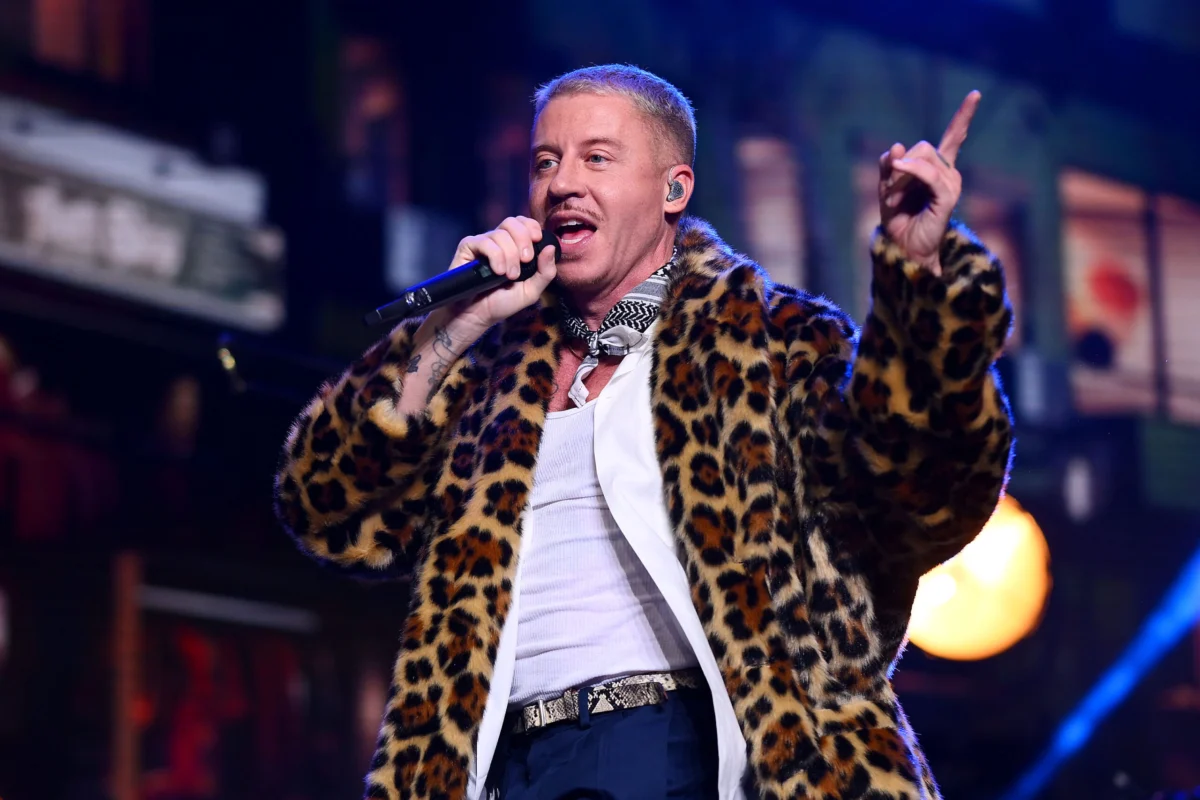
The intersection of global politics and live entertainment has once again become a flashpoint for cultural discourse. Following a high-profile performance at New Jersey’s MetLife Stadium, rapper Macklemore finds himself at the center of a firestorm regarding his vocal support for Palestinian rights and his broader political commentary. The incident, which occurred while Macklemore was serving as the opening act for Ed Sheeran’s global "Mathematics" tour, has prompted both intense public debate and a formal campaign from advocacy groups demanding his removal from the tour.
The Chronology of the Controversy
The tension began on Friday night at MetLife Stadium, one of the most prominent venues on Sheeran’s current tour. During his set, Macklemore addressed the crowd directly, centering his message on the ongoing humanitarian crises in Gaza and the West Bank. He spoke of his desire for the international community to remain focused on the plight of civilians, stating, "I believe that every human being walking on this earth deserves exactly the same freedom."
The comments were intended as an expression of solidarity with the suffering of people in the region. However, the reaction was swift and polarizing. By the following day, as the clip of his remarks circulated on social media, the discourse escalated from online debate to organizational action.
On Saturday, responding to the growing backlash and seeking to clarify his stance, Macklemore delivered a more expansive statement. Addressing the audience—and the public at large—he stated: "To all of my Jewish brothers and sisters: criticism of Israel, criticism of apartheid, being against genocide in no way is a criticism of you. My message is for peace; love for all human beings to be treated with dignity, respect, and equality."
He expanded his scope further, linking the Palestinian cause to a global framework of anti-oppression. "So I say free Palestine, I say free Lebanon, I say free Cuba, I say free Congo, free Sudan, I say free all people in America living in fear of this terrorist organization, ICE," the rapper declared. "None of us will be free until we are all free."
The Israeli American Council’s Response
The immediate fallout materialized in the form of a formal petition launched by the Israeli American Council (IAC). The organization, which advocates for the Israeli-American community, moved quickly to capitalize on the public discomfort expressed by some attendees.
The petition explicitly demands that the four-time Grammy winner be removed from the remainder of the "Mathematics" tour. The central argument put forth by the IAC is not merely one of political disagreement, but one of venue appropriateness.
"This was an Ed Sheeran concert—not a political rally, not a protest, and not an activist event," the petition reads. "The issue is not whether Macklemore has the right to hold political views. The question is where the line should be drawn when an opening act uses a global concert platform to advance a one-sided political agenda."
The petition highlights a growing tension within the music industry regarding the role of artists as public intellectuals versus entertainers. The IAC’s stance reflects a perspective shared by many concertgoers who feel that the "captive audience" nature of a stadium show makes the imposition of partisan political rhetoric intrusive and, in some cases, exclusionary.
Supporting Data and Historical Context
Macklemore is no stranger to blending his music with political activism. Throughout his career, he has utilized his platform to address issues ranging from LGBTQ+ rights and racial justice to the critique of systemic capitalism. His 2012 hit "Same Love" became an anthem for marriage equality, and he has consistently positioned himself as an artist who views his public profile as a vehicle for advocacy.
The current situation, however, exists within a heightened atmosphere of global sensitivity regarding the Israeli-Palestinian conflict. Since the escalation of violence on October 7, 2023, the cultural sphere has become a battlefield for competing narratives. Data from various social media analytics firms suggests that mentions of the conflict in the context of celebrity endorsements have seen a 400% increase compared to previous regional escalations.
Furthermore, the music industry has seen a rise in "cancellation" culture applied to artists based on their perceived political alignment. In the past twelve months, several festivals and tours have faced boycotts or sponsor withdrawals due to the political statements of performers. This trend reflects a broader polarization in Western society, where consumers are increasingly demanding that the brands and artists they support mirror their own geopolitical values.
The Role of the "Opening Act" Platform
The controversy also brings to light the nuanced professional dynamics of stadium tours. As an opening act, Macklemore is a guest on Ed Sheeran’s stage. This has led to questions regarding the responsibility of headlining artists to curate the content of their supporting acts.
While Ed Sheeran himself has remained silent on the controversy, the incident highlights the professional risks for headliners. When a supporting act creates a "political environment" that alienates a segment of the ticket-buying public, the primary artist often faces the brunt of the criticism. This creates a difficult dilemma for tour organizers: how to balance an artist’s creative freedom and personal expression with the commercial imperative of maintaining a neutral, inclusive environment for a diverse, multi-million dollar stadium audience.
Implications for the Future of Live Entertainment
The fallout from the MetLife Stadium performance has broader implications for the future of touring. We are likely to see an increase in contractual clauses that limit political speech during performances, or, conversely, a rise in artists choosing to tour only with those who share their specific ideological leanings.
- Contractual Clauses: Promoters and tour management companies may begin to include "neutrality clauses" in contracts for supporting acts to prevent unexpected political disruptions that could lead to negative publicity or loss of sponsorships.
- Artist Autonomy vs. Commercial Interests: The struggle between an artist’s desire for self-expression and the commercial need for broad appeal will likely become a recurring theme in contract negotiations.
- The "Civic" Stage: As artists continue to use the stage as a platform for global advocacy, audiences will become increasingly segmented. Venues may eventually be forced to navigate the logistical challenges of hosting events that effectively function as protests, leading to potential security and public relations overheads.
Conclusion: A Divided Audience
Macklemore’s actions have underscored the deep divisions that persist regarding the Israeli-Palestinian conflict. For his supporters, he is a courageous artist using his reach to highlight humanitarian suffering and challenge the status quo. For his detractors, particularly those represented by the IAC, he is an opportunistic provocateur who has violated the "social contract" of the concert experience.
As the "Mathematics" tour continues, the industry will be watching closely to see if the pressure from advocacy groups results in tangible consequences for Macklemore. Regardless of the outcome, this episode stands as a stark reminder that in the age of viral social media, there is no longer such a thing as a "neutral" space. Every stage is now a potential soapbox, and every performance carries the weight of a world that is increasingly unwilling to separate the artist from the ideology.
Whether this leads to a new era of "safe" entertainment or a more politically engaged concert culture remains to be seen. However, one thing is certain: the conversation surrounding the role of artists in the global political arena is far from over. As Macklemore noted in his defense, the discourse is fundamentally about freedom—a concept that, in the context of global events, remains as complex and contested as ever.










