

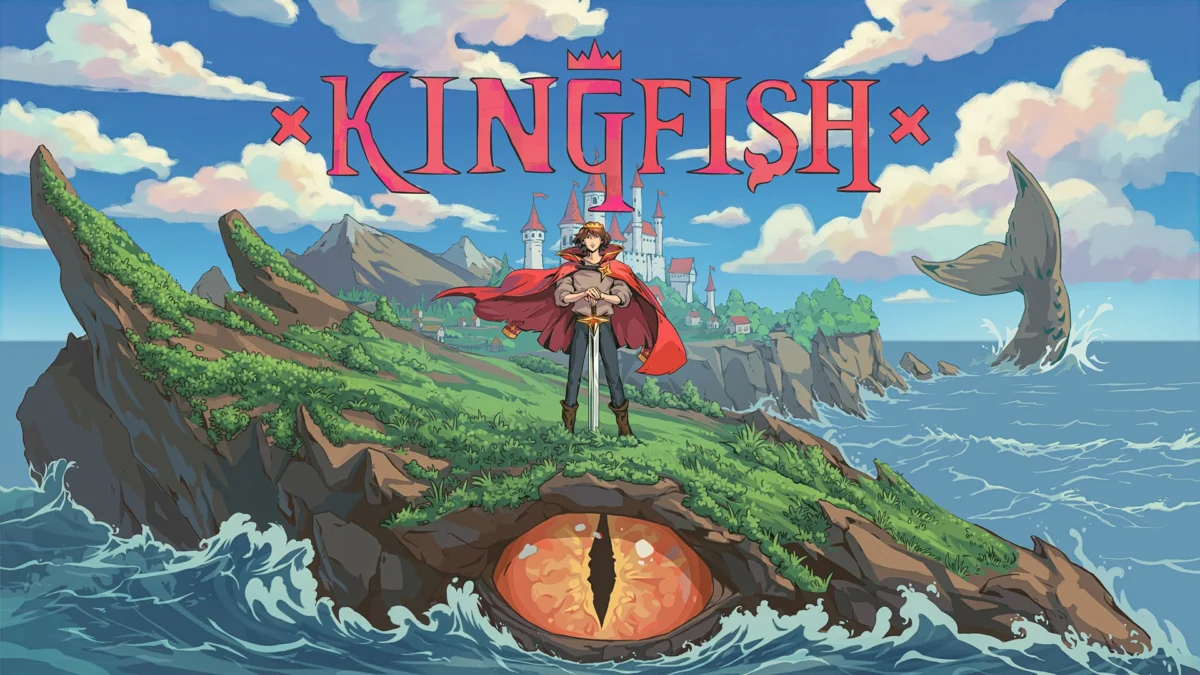
The landscape of the city-building genre has long been dominated by top-down management simulations, where the player acts as an omniscient, detached deity. However, indie developer FireVolt is poised to shatter that paradigm with its ambitious new project, Kingfish. Announced this week, Kingfish is a cooperative, asymmetric roguelite that literalizes the symbiotic relationship between a ruler and their domain—by placing that domain on the back of a colossal, living sea beast.
Scheduled for a 2027 release on Windows PC via Steam and currently slated for unannounced consoles, Kingfish promises to blend the frantic tension of third-person action with the calculated deliberation of real-time strategy. By forcing two players into distinct, interdependent roles, FireVolt aims to create a unique social dynamic where communication is not just a feature, but a survival necessity.
The Core Concept: A Kingdom in Motion
At its heart, Kingfish is a game about perspective. In a world consumed by an endless, monster-ridden ocean, humanity’s only hope for survival lies upon the gargantuan, ancient leviathan that traverses these treacherous waters. The game splits the workload between two players: the King and the Fish.
The King operates on the ground level—the scaly, shifting back of the leviathan. This perspective is intimate and immediate. Players in this role must manage the granular details of their tiny civilization: the needs, morale, and specialization of the villagers, and the construction of buildings necessary for growth. When the leviathan is breached by external threats, the King enters the fray, engaging in real-time combat to defend the populace from encroaching horrors.
Conversely, the player controlling the Fish acts as a strategic overseer. From this aerial, god-like vantage point, the Fish manages the "big picture." They monitor the surrounding seas for incoming dangers, identify resource clusters, and oversee the macro-layout of the city. More importantly, the Fish serves as the kingdom’s primary defense, casting spells and altering the environment to assist the King on the surface.
Chronology and Development Roadmap
While Kingfish is currently in the early stages of its public life cycle, the development roadmap provided by FireVolt suggests a focused, iterative approach to the roguelite format.
- Initial Concept Phase (2025): FireVolt began prototyping the asymmetric camera systems, balancing the high-octane combat of the King with the tactical interface of the Fish.
- Announcement (May 2026): The formal reveal of the project via Steam and promotional trailers, confirming the 2027 release window.
- Beta Testing (Late 2026 – Early 2027): Planned community testing to refine the co-op communication systems.
- Launch (2027): The full release on PC, with subsequent console ports intended to follow shortly thereafter.
The "roguelite" nature of the game is central to its longevity. Every "run" involves navigating a new, procedurally generated ocean map. As the leviathan travels, the kingdom will encounter different threats, unique biomes, and randomized events. While the city itself may rise and fall, the developers have confirmed a persistence element: returning villagers who, if kept alive or satisfied in previous runs, provide special perks and bonuses to future expeditions. This creates a compelling "just one more run" loop that rewards player investment beyond the immediate game session.
Asymmetric Cooperative Design: The "Incomplete Information" Dynamic
The most intriguing aspect of Kingfish is the deliberate decision to withhold information from each player. In a traditional co-op game, players often share a screen or a unified UI. In Kingfish, the King and the Fish inhabit entirely different worlds.
"The King and Fish both have incomplete information, and it creates this great dynamic of working together despite having completely different perspectives on the same situation," FireVolt stated in their official press release.
This design choice serves to force active communication. The King might be overwhelmed by a sudden raid on the back of the beast, unaware that a massive sea monster is approaching from the horizon. Meanwhile, the Fish might see the approaching threat but lack the visibility to coordinate the ground troops effectively. The game transforms from a mere simulation into a test of interpersonal coordination. Players must constantly relay data: "I’m out of wood for the barricades," or "Something is rising from the port side, prepare for impact."
This creates an experience where the gameplay is as much about the social interaction between the two players as it is about the mechanics on screen. It is an evolution of the "couch co-op" spirit, brought into the modern era with complex, strategic depth.
Supporting Data and Technical Ambitions
From a technical standpoint, Kingfish presents a complex challenge. Integrating a third-person combat engine with a grid-based city builder requires a robust synchronization engine. FireVolt has indicated that they are focusing heavily on the "hand-off" moments—the transitions where the Fish’s strategic spells impact the King’s battlefield.
The game’s aesthetic, as revealed in the initial trailer, leans into a stylized, vibrant fantasy look. The contrast between the dark, turbulent ocean and the brightly lit, bustling city on the leviathan’s back creates a strong visual identity. Furthermore, the procedural nature of the environment suggests a high level of replayability. With randomized building types, artifact discoveries, and character interactions, FireVolt is banking on the idea that no two playthroughs will ever feel the same.
The inclusion of "artifacts" adds a layer of depth to the meta-progression. These items, discovered during the course of a run, likely offer permanent or semi-permanent buffs to the leviathan or the kingdom, allowing players to tackle increasingly difficult hazards as they grow more proficient at the game’s core mechanics.
Implications for the Genre
The release of Kingfish arrives at a time when the city-building genre is seeing a resurgence of "niche" mechanics. Titles like Against the Storm proved that players are hungry for roguelite-infused strategy, while games like It Takes Two highlighted the massive appeal of dedicated, mandatory co-op experiences. Kingfish sits squarely at the intersection of these two trends.
If successful, Kingfish could pave the way for a new sub-genre of "Asymmetric Management Games." The implications for future titles are significant: if players prove willing to adopt such specialized roles, developers could push even further into experimental territory, potentially adding third or fourth players with even more specific, restricted viewpoints (e.g., a "Navigator" or a "Diplomat" role).
However, the risk is equally high. By making the game strictly cooperative, FireVolt is narrowing its potential audience to those who have a reliable partner. The developers will need to ensure that the AI—or the alternative matchmaking systems—can fill the gap for players who do not have a dedicated co-op partner, or risk alienating the solo-player demographic entirely.
Conclusion: A Leviathan-Sized Challenge
FireVolt’s Kingfish is an ambitious experiment in cooperative design. It challenges the player not just to manage resources, but to manage relationships. The promise of an evolving, living, breathing kingdom—one that literally swims through the dark waters of a mysterious world—is a hook that is as narratively strong as it is mechanically sound.
As we look toward 2027, the success of Kingfish will likely depend on the balance of its two halves. If the combat feels punchy and the strategy feels rewarding, FireVolt may well have a sleeper hit on their hands. For now, the gaming community remains in a state of watchful anticipation, waiting to see if they are ready to step into the role of King, or take the helm as the Fish, in a journey that promises to be as perilous as it is rewarding.












No comments yet. Be the first to join the conversation!