Nostalgia, much like the illicit substances that fuel the plot of Kieron J. Walsh’s vibrant new film Skintown, is a potent and intoxicating narcotic. It blurs the edges of memory, turning the jagged, dangerous reality of 1990s Northern Ireland into a hazy, pulse-pounding rave. Walsh’s warm-hearted, hot-headed feature serves as a spiritual sibling to the anarchic energy of Kneecap and a more cautious, contemplative cousin to the beloved Derry Girls.
Set against the backdrop of Enniskillen in 1994, Skintown is a coming-of-age odyssey that manages to capture the fizzy, chemically altered spirit of a generation caught between the terror of the Troubles and the escapism of the dance floor. While the narrative framework—a familiar story of young men yearning for horizons beyond their provincial borders—may feel like a well-worn path, the film delivers its bittersweet lessons with such infectious affection that even the most cynical viewer is likely to be disarmed.
The Geography of Discontent: Enniskillen in 1994
To the locals who populate the story, Enniskillen is "Skintown"—a place defined by a lake, an aging castle, and the somber, lingering shadow of the 1987 IRA bombing that claimed 11 civilian lives. It is a landscape where the political is personal, and the personal is often fraught with the suffocating weight of history.
At the center of the story is Vinny (Jack Rowan), a 23-year-old whose physical age seems at odds with his restless, adolescent desire for transcendence. Vinny is a young man in the throes of an independence struggle, not just from his country, but from the jaundiced familiarity of his own hometown. As he watches his childhood attachments begin to curdle into a mixture of contempt and resignation, his singular goal becomes an urgent, desperate need to escape.
However, the film finds its emotional anchor in an unexpected alliance. Vinny forms a bond with Wilson (Hope Ipoku Jr.), a Black soldier from Manchester deployed as part of the British military presence in Northern Ireland. The friendship serves as a poignant reminder that the desire for escape is universal; for Wilson, the British Army was merely a vehicle to flee the stifling confines of his own upbringing. It is an intersection of two disparate lives, both seeking to outrun the geographies that shaped them.
A Chronology of a Capered Life
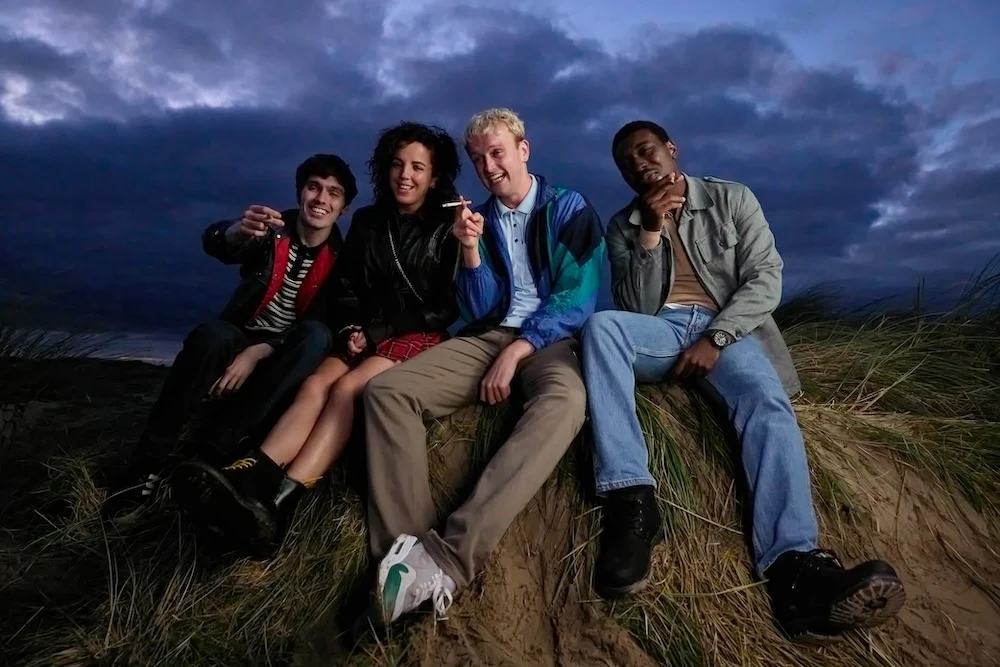
The narrative rhythm of Skintown is dictated by the push-pull of Vinny’s ambition and his loyalty to those he intends to leave behind. His support system is eclectic: his hardworking, pragmatic mother (Roisin Gallagher); his unrequited love, the vivacious Eileen (Jamie Lee O’Donnell); and his inseparable best friend, Jonty (Chris Walley).
Jonty is the quintessential raver—a shell-suited firecracker whose primary objective is the pursuit of hedonistic joy. When Vinny and Jonty find themselves accidentally pressganged into a high-stakes criminal enterprise involving a massive cache of ecstasy stolen from the UVF, the film shifts gears from a domestic drama to a frantic caper.
The stakes are simple: if they can successfully move the contraband, they stand to make a small fortune—far more than they could ever scrape together working at the local pizzeria. This setting provides some of the film’s most biting humor, particularly through the character of Tony Pepperoni (Michael Smiley). Tony, an entrepreneur of questionable culinary standards, insists on pairing his pizzas with Peking ribs, claiming that the Irish population requires a "gateway" meat to transition away from their traditional Chinese takeout preferences.
Cultural Texture and Authenticity
Adapted by Enniskillen native Ciarán McMenamin from his 2018 novel, the screenplay is rich with the granular details of life in 1990s Northern Ireland. These are not merely background flourishes; they are the connective tissue of the community.
- The Ritual of the News: The local pub serves as a communal living room, where the arrival of the nightly news—anchored by the iconic Moira Stuart—is met with a specific, ritualized reverence.
- The Liturgy of the Rave: Jonty’s casual blasphemy—distributing ecstasy pills as if they were communion wafers—highlights the sacrilegious blending of religious tradition and club culture.
- The Marching Season: The omnipresence of the Orangemen, parading through the streets with a cadence that disrupts the daily flow of life, is captured with a weary, resigned humor. As barmaid Chalky (Tara Lynn O’Neill) observes, the paraders seem to have an insatiable need to pause outside every Catholic establishment, a detail that underscores the performative nature of the sectarian divide.
The Politics of the Ordinary
Skintown makes a conscious effort to navigate the minefield of Northern Irish politics without resorting to easy didacticism. Vinny’s voiceover is littered with the acronyms of conflict—IRA, UVF, UDA, INLA, RUC—yet the film resists the urge to assign moral superiority to any single faction.
Instead, the film directs its ire toward the political establishment, painting them as the architects of a long, agonizing stalemate. A scene involving the announcement of the IRA ceasefire is particularly telling. While the public experiences a flicker of genuine, breathless hope, the sentiment is quickly checked by a weary local who notes that if there is a way to sabotage the peace, the politicians will inevitably find it.
This avoidance of "sides" is both a strength and a limitation. By focusing on the "ordinary people" who managed to endure the humdrum business of living amidst a climate of violence, Skintown offers a humanistic portrait that feels honest. It does not aim to provide a comprehensive political analysis of the Troubles; rather, it documents the indomitable sense of humor that served as a survival mechanism for an entire generation.
Implications: A Nostalgic Reflection on Home
While Skintown occasionally dips into sentimentality—a choice that makes it a "safer" or more timid film compared to the raw, unfiltered intensity of Kneecap—it succeeds as a precise evocation of a specific time and place.
The film’s cinematography, led by Ruairi O’Brien, manages to imbue even the sparse street scenes with a bright, dreamlike quality. Even when the budget constraints are visible, the stylistic choices reinforce the idea that the characters are seeing their world through the filtered lens of youth, music, and chemical euphoria.
The ultimate implication of the film is that home is a complicated, often painful entity. For many in Northern Ireland, the relationship with their birthplace is defined by a paradoxical love/hate dynamic—a bond that is forged in the fire of shared history and maintained through the begrudging acceptance of the past.
Skintown does not ask its audience to solve the complex riddles of Northern Irish history. Instead, it invites them to sit in the pub, listen to the slang, watch the news, and recognize the humanity of those who lived through it. It is a testament to the fact that even in the darkest of times, there is room for laughter, for friendship, and for the kind of "wise up" attitude that keeps the human spirit afloat when the world feels like it is burning.
In the final assessment, Skintown is a love letter to the resilience of the Irish youth. It is a reminder that while history may define the borders of our lives, it is our friendships and our humor that define the quality of our existence within them. If you come to Skintown expecting a lecture on the complexities of the peace process, you will likely be disappointed. But if you come for the ’90s kitsch, the sharp dialogue, and the universal ache of growing up, you will find a film that is as warm as a pub fireplace and as buzzing as a Friday night.