

In this week’s roundup, we explore the intersection of fandom history, the evolution of narrative art, the resilience of analog film culture, and the rapid expansion of our astronomical horizons. From the technical nuances of the Hugo Awards to the explosive challenges facing private space exploration, this report synthesizes the latest developments in culture, science, and industry.
I. The Hugo Awards: Navigating the Boundaries of Genre Eligibility
The Hugo Awards remain the gold standard for science fiction and fantasy achievement, yet the criteria for eligibility—specifically in the "Best Related Work" category—continue to spark nuanced debate. Nicholas White, writing for From the Heart of Europe, has provided a vital retrospective on the history of disqualifications within this category.
The Aleister Crowley Precedent
A pivotal case study in White’s analysis is the 2020 disqualification of Aleister Crowley’s The Book of Thoth from the 1945 Retro Hugo ballot. The work was removed on the grounds that it lacked sufficient intersection with the fields of science fiction, fantasy, or fandom.
The structural impact of such decisions is not merely administrative; it shifts the competitive landscape. In the case of the 1945 Retro Hugos, the removal of the Crowley entry allowed Leigh Brackett’s The Science Fiction Field to ascend to the ballot, ultimately winning the award. Such instances underscore the responsibility of administrators to maintain the thematic integrity of the genre while ensuring that the ballot remains a representative reflection of the community’s interests.
II. The Lucas Museum: A Monument to Narrative Art
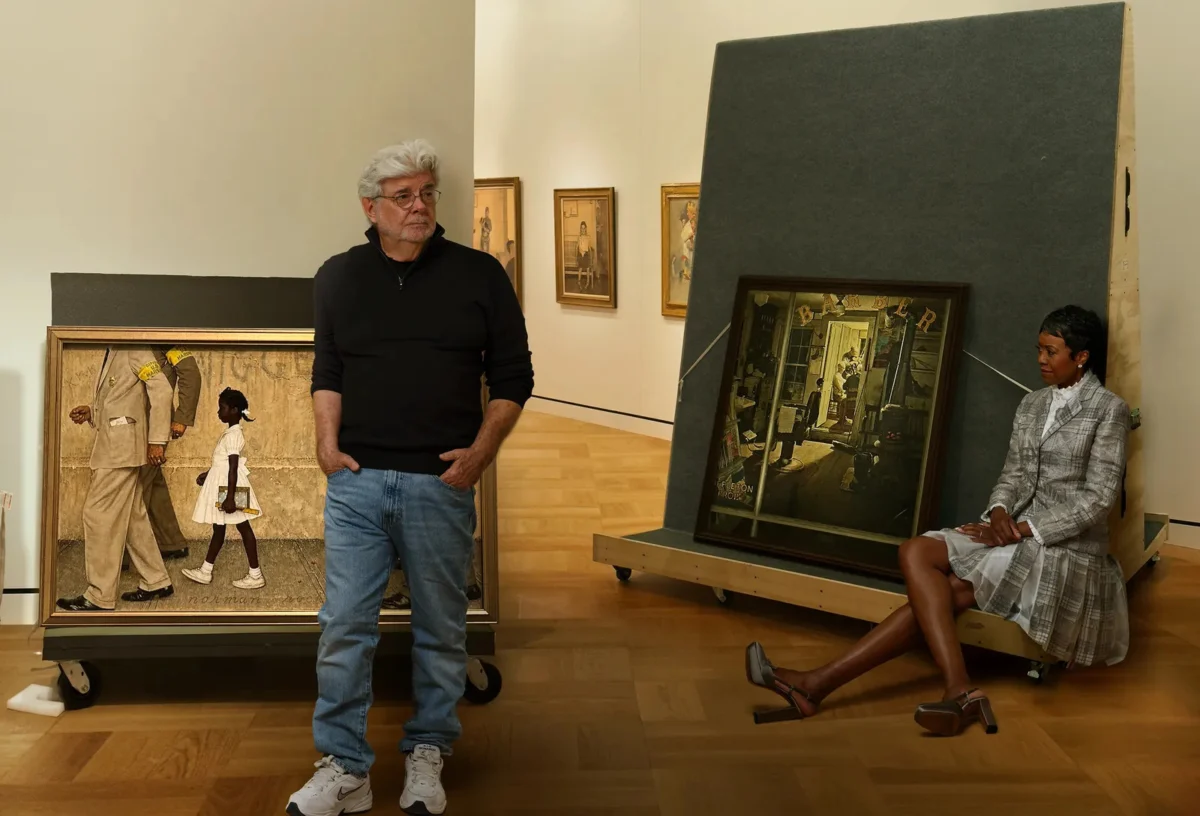
In Los Angeles, a project of unprecedented scale and ambition is nearing fruition: the Lucas Museum of Narrative Art. Photographed by Annie Leibovitz for Vogue, the structure is described as a "towering, otherworldly" edifice, designed with a complete absence of right angles.
Architectural Innovation and Vision
The museum’s facade, constructed from 1,500 fiberglass panels molded via parametric modeling, represents a significant leap in modern architecture. Michael Siegel of Stantec architecture notes that the building is a product of its time, utilizing technology that would have been inaccessible just 15 years ago.
George Lucas, the mastermind behind the project alongside Mellody Hobson, views the creation of the museum as an extension of his work in film. "It’s like making a movie—exactly the same thing," Lucas noted. The collection itself—curated from 40,000 items to 1,200—focuses on the power of visual storytelling, bridging the gap between high-art oil paintings by masters like Norman Rockwell and the populist appeal of comic strips and fantasy illustrations.
Cultural and Economic Impact
Beyond the aesthetics, the museum serves as a billion-dollar commitment to the city. Its mission, however, is grounded in accessibility. Hobson and Lucas have prioritized a gift shop experience that elevates merchandise to the level of the art itself, ensuring that visitors from all backgrounds find a connection to the material. By blending the high-brow with the beloved—including a dedicated section for Star Wars models—the institution aims to demystify art history and inspire the next generation of storytellers.

III. The Analog Renaissance: Resurrecting Film Culture
The British Film Collectors Convention (BFCC) is celebrating its 50th anniversary this year, marking a remarkable comeback for a hobby that, only a few decades ago, was often practiced in the shadows.
From Illicit Hobby to Cultural Preservation
Mark Stuckey of the charitable trust Film is Fabulous notes that, until recently, private ownership of 35mm prints was legally precarious, often categorized as theft. This legal ambiguity forced many collectors to remain underground, resulting in the tragic loss of significant portions of social and cinematic history.
Today, the narrative has shifted. With the success of the 2023 convention, organizers like John Clancy are observing a renewed appreciation for physical film media. Film is Fabulous has emerged as a crucial entity in this landscape, actively recovering lost films from the collections of deceased enthusiasts that might otherwise have been discarded. This shift marks a transition from viewing film collection as an act of defiance to viewing it as a vital act of cultural stewardship.
IV. Legacy and Hard Science: Remembering Hal Clement
On the anniversary of his birth (May 30, 1922), we reflect on the contributions of Hal Clement, a master of hard science fiction. Paul Weimer highlights Clement’s unique ability to treat physics and complex astrophysics as "characters" in his narratives.
The Mechanics of Worldbuilding
Works such as Mission of Gravity and The Nitrogen Fix demonstrate Clement’s commitment to scientific rigor. While his human protagonists are often functional, the worlds he constructs—governed by strict logic and environmental puzzles—are deeply immersive.
Clement’s participation in collaborative projects, such as the Medea shared world, showcased his dedication to the mechanics of worldbuilding. For Clement, the "character" of the story was the planet itself, and the narrative tension was derived from the characters’ struggle to comprehend and survive within those scientific parameters.
V. The Zombies, Run! Phenomenon: Fitness Through Narrative
The intersection of gaming and health has seen a unique success story in the form of the app Zombies, Run!. As reported by The Guardian, the app has served as a critical training tool for those attempting to overcome the physical and mental barriers of aging.
Dominik Diamond, who recently began training for a marathon at 56, credits the app’s narrative immersion for his success. By providing a "story-driven" incentive to move, the game transforms the monotony of long-distance running into a survival scenario. The success of this approach points to a broader trend: the gamification of health, where narrative engagement can provide the psychological impetus that traditional exercise regimes often lack.

VI. Space Exploration: Setbacks and Milestones
Blue Origin’s Rocket Test
The aerospace industry faced a setback this week as a Blue Origin New Glenn rocket exploded during an engine-firing test at Cape Canaveral. Jeff Bezos confirmed the incident via social media, stating, "Very rough day, but we’ll rebuild whatever needs rebuilding." This incident is particularly significant as the New Glenn is central to NASA’s Artemis program, intended to facilitate future lunar landings. The grounding of the vehicle highlights the inherent risks of rapid iteration in private space flight.
The Exoplanet Census
Conversely, the field of exoplanetary research is hitting unprecedented milestones. NASA’s Exoplanet Archive has officially confirmed more than 6,000 planets outside our solar system. Jessie Christiansen, the archive’s chief scientist, projects that this number could swell to 100,000 within the next seven years.
To accommodate this data explosion, the team has been "madly redesigning" their software infrastructure. This transition from a world where we knew of zero exoplanets in 1992 to a future of six-figure counts represents perhaps the most rapid expansion of human knowledge in the history of astronomy.
VII. Implications for the Future
The themes explored this week—from the rigid standards of the Hugo Awards to the fluid, generative nature of modern architecture and the exponential growth of astronomical discovery—all point to a common thread: the necessity of adaptation.
Whether it is re-coding archives to handle 100,000 planets, rescuing forgotten film reels from skips, or navigating the technical failures of a new rocket, the common denominator is a commitment to the preservation and expansion of human knowledge. As we move forward, these sectors will continue to rely on the tension between the established traditions of the past and the volatile, innovative technologies of the future.
This report was compiled with contributions from Cat Eldridge, Jonathan Cowie, Chris Barkley, Mark Roth-Whitworth, Kathy Sullivan, Steven French, Mike Kennedy, Andrew Porter, and John King Tarpinian.










No comments yet. Be the first to join the conversation!