Developer/Publisher: Take IT Studio!
Genre: Simulation / VR
Platforms: PlayStation VR2 (Reviewed), PC VR, Meta Quest
Author: Marcus Orchard
Executive Summary: The Rise of the "Blue-Collar" Simulator
The simulation genre has undergone a significant renaissance in the age of virtual reality. Where once we were limited to managing theme parks or flying jet fighters, the modern VR landscape has pivoted toward the grounded, tactile reality of blue-collar labor. From cleaning crime scenes to fixing power grids, these titles aim to gamify the mundane. Electrician Simulator VR, developed and published by Take IT Studio!, enters this crowded field with a clear mission: to make the intricacies of electrical repair both accessible and meditative.
On the surface, Electrician Simulator VR is a straightforward proposition. Players assume the role of a technician tasked with resolving a variety of household electrical issues. While the premise is modest, the execution—leveraging the depth and precision of VR—transforms repetitive manual labor into a satisfying, gamified loop. Despite some technical friction and a lack of true-to-life electrical complexity, the title succeeds as a digital "comfort food" experience, proving that there is a genuine market for the simulated satisfaction of a job well done.
Chronology of Development and Mechanics
Take IT Studio! initially gained traction with the flat-screen version of Electrician Simulator, which established the core gameplay loop: accept contracts, travel to a client’s home, diagnose the failure, and repair the system. However, the transition to VR was not merely a port; it was a fundamental shift in user interface and interaction design.
The Early Phase: Learning the Ropes
The game opens with a gentle onboarding process. Players are introduced to their virtual toolbox—a collection of screwdrivers, wire strippers, and voltage testers. The chronology of the gameplay loop is intentionally linear:
- The Brief: A notification arrives detailing a specific electrical fault, such as a dead socket or a flickering fixture.
- The Assessment: Upon arriving at the site, the player must use tools to identify where the circuit is broken.
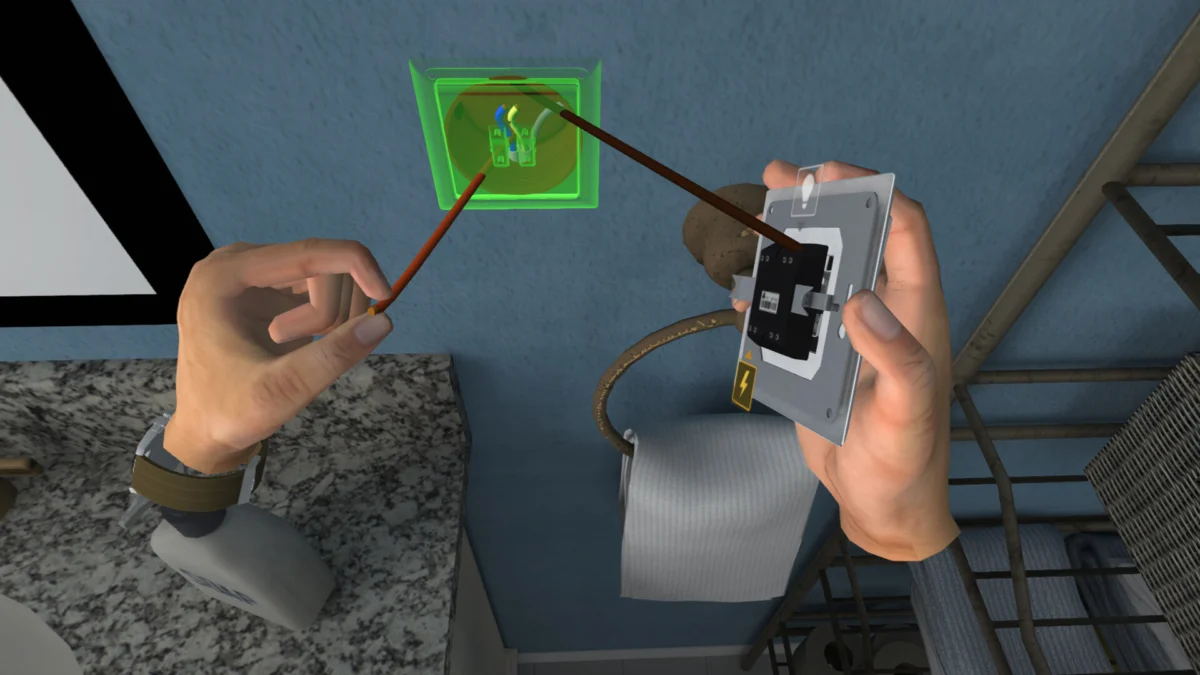
- The Execution: Through manual motion, the player physically unscrews plates, strips wires, and connects components.
- The Verification: The final step involves testing the circuit. Seeing the lights flicker to life provides a distinct psychological reward that flat-screen gaming struggles to replicate.
As the player progresses, the tasks evolve from simple light bulb replacements to complex, multi-room wiring puzzles. By the mid-game, the player is expected to troubleshoot entire fuse boxes and navigate complex schematic layouts, though the game carefully avoids the lethality associated with real-world high-voltage work.
Supporting Data: Why VR Elevates the Simulation
The efficacy of Electrician Simulator VR relies heavily on "presence," the psychological phenomenon where a user feels physically located within a virtual environment.
The Tactile Advantage
In traditional gaming, "fixing" an outlet involves pressing a single button. In Electrician Simulator VR, the process is broken down into constituent parts: reaching for the screwdriver, rotating the wrist, removing the plate, and selecting the correct wire gauge. This granular interaction serves two purposes:

- Immersion: It mimics the motor skills required for the trade.
- Pacing: It forces a slower, more methodical rhythm, which inherently reduces the "twitchy" nature of most VR action games, making it an ideal "chill" experience.
Market Context
Compared to its peers—such as House Flipper VR or Car Mechanic Simulator—Electrician Simulator occupies a niche that focuses on technical troubleshooting rather than cosmetic renovation. Data from the VR simulation sector suggests that players gravitate toward these titles not for realistic training, but for the "Completionist Satisfaction Loop." The ability to start a level with a chaotic, non-functional room and end with a clean, fully powered space satisfies a fundamental human urge for order.
Official Responses and Developer Intent
Take IT Studio! has been transparent regarding their goals for the title. In various developer diaries and community updates, the studio has emphasized that Electrician Simulator VR was designed as an "accessible entry point" rather than an educational tool.
The studio’s decision to simplify electrical engineering was a calculated move to prevent frustration. By removing the genuine dangers of shock, fire, and complex local building codes, they have created a "playground" version of the trade. While some enthusiasts have noted the lack of NEC (National Electrical Code) standards or realistic wire-gauge logic, the developers maintain that their primary goal is user experience and accessibility. They have also committed to ongoing post-launch support, specifically addressing some of the UI bugs and collision detection issues that players encountered during the launch window.
Technical Analysis: The Rough Edges
No review would be complete without addressing the barriers to entry. Electrician Simulator VR is not a AAA production, and it shows.
Interface and Control Friction
During the first few hours of gameplay, the controls can feel cumbersome. Virtual toolbelts are notoriously finicky in VR, and players will likely find themselves dropping tools or struggling to grab items from their back or hip slots. While these issues become less frequent with muscle memory, they are significant hurdles for new users.
Visual Fidelity
The graphics are best described as "functional." The environments are clean and well-lit, which is essential for a game about visibility, but they lack the texture density of high-end VR experiences like Half-Life: Alyx. For the target audience, however, this is a non-issue; the game prioritizes frame rate and stability, which is vital to avoiding motion sickness in a game that requires long periods of standing and precision movement.
The "Reality" Gap
It is crucial to state for the record: This game will not make you an electrician. The simplification of the wiring process—while necessary for gameplay—strips away the nuance of the profession. For instance, the game does not simulate the frustration of routing wire through tight, inaccessible studs or the sheer physical exhaustion of a day on the job. Those seeking a true-to-life trade simulator may find the experience too "arcade-like" for their tastes.
Implications: The Future of Vocational Gaming
Electrician Simulator VR is an important case study for the future of interactive media. It demonstrates that as VR hardware becomes more refined, the line between "entertainment" and "vocational interest" will continue to blur.

The Pedagogical Potential
While this title is clearly a game, the industry is seeing a rise in "Serious Gaming." The success of Electrician Simulator VR suggests that there is a path toward more robust, accurate simulations that could serve as training aids for apprentices. By gamifying the fundamental concepts—safety, tool handling, and systematic troubleshooting—developers are creating a generation of players who understand the logic of the trade, even if they lack the practical certifications.
The Mental Health Aspect
Furthermore, the therapeutic potential of these simulators should not be ignored. In a world where digital interactions are increasingly fast-paced and overwhelming, the "methodical repair" mechanic offers a rare opportunity for cognitive decompression. The act of focusing entirely on a single, solvable problem—and watching that problem disappear—is a powerful tool for stress management.
Final Verdict
Electrician Simulator VR is a testament to the idea that the most satisfying gameplay often lies in the most mundane tasks. While it suffers from early-game control frustrations and a lack of deep-dive realism, it succeeds in its primary objective: providing a rewarding, tactile, and surprisingly peaceful experience.
For the VR enthusiast who has tired of shooting zombies or flying starships, this title offers a refreshing change of pace. It turns the home repair aisle of a hardware store into a series of engaging puzzles. It may not replace a trade school, and it certainly won’t help you fix your real-world kitchen light without risking a circuit breaker trip, but it will provide hours of "productive" fun.
Rating: 7.5/10 – A solid, relaxing simulation that makes the daily grind feel like a victory.
About the Author
Marcus Orchard is a veteran gaming journalist and long-time observer of the simulation genre. When he isn’t trying to fix virtual wiring, he is likely replaying a Final Fantasy title for the tenth time or debating the merits of the latest comic book arcs with his peers. He is a firm believer that the best games are the ones that let you solve problems at your own pace.