

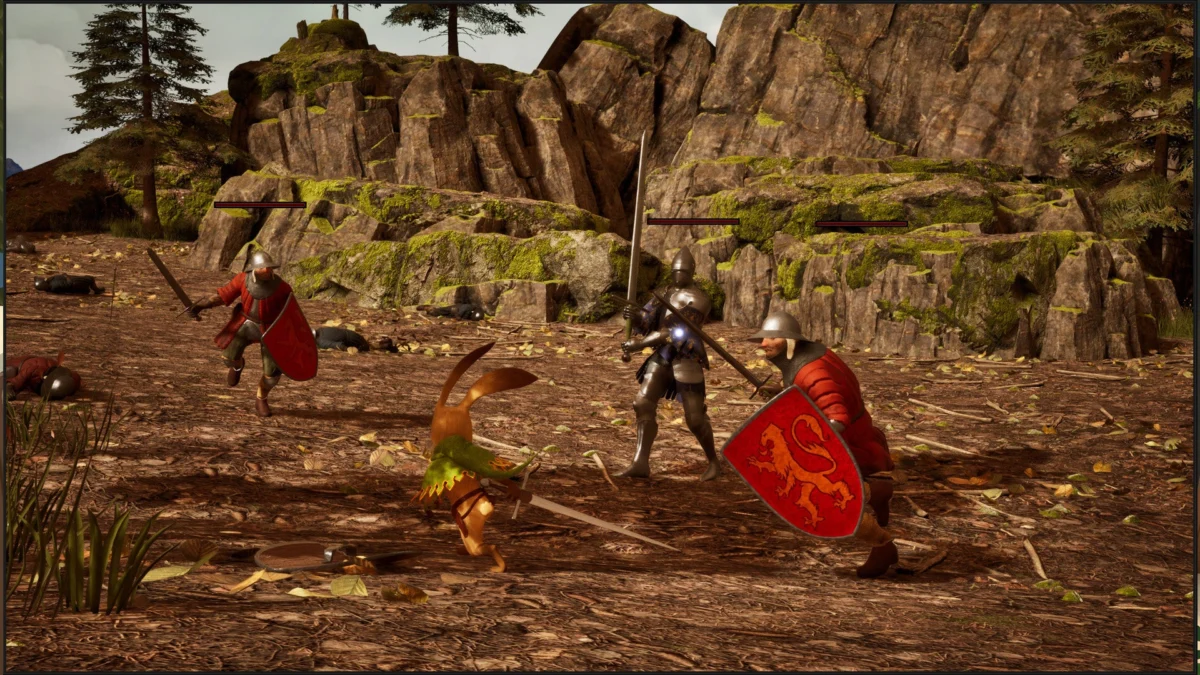
In the sprawling, often self-serious landscape of modern action gaming, it is rare to find a title that embraces both the absurdity of historical art and the technical precision of the "Soulslike" genre. Enter Johan, the debut project from Vercors Studio. A game that visually manifests the bizarre, violent, and often surreal illustrations found in the margins of medieval manuscripts, Johan places players in the paws of an unlikely protagonist: a sword-wielding rabbit seeking vengeance against the armored crusaders ravaging its homeland.
While the premise may sound like a whimsical fable, the gameplay mechanics suggest a project with significant mechanical teeth. By fusing the rhythmic, parry-focused combat popularized by Sekiro: Shadows Die Twice with a unique summoning system rooted in bestiary folklore, Vercors Studio is carving out a niche that is as intellectually curious as it is mechanically demanding.
Main Facts: The Anatomy of a Rabbit’s Crusade
At its core, Johan is a third-person action game defined by high-intensity melee combat. The protagonist, Johan, is a rabbit who has effectively "leapt" from the parchment of a medieval codex into a tangible, dangerous world.
The game’s primary draw is its combat system, which emphasizes precise timing, parrying, and environmental awareness. Players must contend with heavily armored knights, whose size and reach dwarf the rabbit, requiring the player to utilize agility and a burgeoning arsenal of medieval weaponry.
Key features currently identified include:
- Manuscript-Inspired Combat: A focus on parry-based gameplay that rewards patience and precise inputs.
- Traversal Mechanics: The inclusion of a grappling hook, allowing for verticality in combat and exploration.
- The Bestiary Summoning System: A core mechanic where players can call upon creatures from medieval lore—ranging from giant, spectral snails to headless humanoids—to shift the tide of battle.
- Folklore Integration: The game’s aesthetic and narrative are heavily informed by the "drolleries" and grotesque illustrations found in 13th and 14th-century illuminated manuscripts.
A Chronology of Development: From Sketch to Steam
The development of Johan has been a journey of translating static, two-dimensional art into a dynamic 3D experience. While Vercors Studio has kept the project largely under wraps during its incubation period, the recent unveiling of the first proper gameplay trailer has provided a clearer timeline of the project’s ambition.
The Conceptual Phase
Vercors Studio began by analyzing the "marginalia" of the Gothic period—the strange, often violent drawings found at the edges of religious texts. These drawings, which depicted rabbits wielding swords, fighting dogs, or building castles, were the initial spark for the game’s narrative. The team sought to answer a singular question: What if these creatures were sentient, and what would they do if their world were threatened by human expansion?
The Reveal
In May 2026, the studio released a trailer that served as the game’s formal introduction to the public. The footage highlighted the stark contrast between the rabbit’s cartoonish, manuscript-influenced silhouette and the gritty, high-fidelity rendering of the knightly antagonists. The trailer confirmed that the project had reached a level of mechanical maturity, showcasing fluid parry animations and the integration of the summoning system.
Current Status
As of mid-2026, the game is in active development. While the studio has not yet committed to a release window, the presence of a live Steam store page indicates that the game has moved out of the prototype phase and into a formalized production cycle.
Supporting Data: Why ‘Sekiro’ is the Benchmark
The frequent comparisons to FromSoftware’s Sekiro: Shadows Die Twice are not merely aesthetic; they are functional. In Johan, the combat is built around the concept of "clash" mechanics. Just as in Sekiro, the player is encouraged to stand their ground, absorbing strikes through perfectly timed blocks that build up an enemy’s stagger gauge.
The Summoning Mechanics
The "Summoning" feature adds a layer of strategic depth that differentiates Johan from traditional action games. By discovering lost manuscript pages scattered throughout the world, players unlock new entities from medieval mythology. Each entity functions as an "ability," providing temporary buffs, crowd control, or raw damage.
The potential for this system is immense. If the developers include figures like the Myrmecoleon (a creature half-ant, half-lion), the game could provide a deep dive into the cryptid history of the Middle Ages. This serves as a "metagame" layer—players are not just hunting for gear upgrades; they are hunting for lore and historical curiosities.
Official Perspectives and Studio Vision
Vercors Studio has characterized Johan as a "love letter to the absurdity of medieval art." In official communications, the developers emphasize that while the tone is lighthearted, the challenge will be anything but.
"We wanted to capture the duality of the Middle Ages," a spokesperson for the studio noted in recent discussions. "On one hand, there is the divine, the heavy, the iron-clad reality of the knight. On the other, there is the wild, chaotic, and often hilarious imagination of the monk who drew a rabbit holding a sword in the corner of a prayer book. Johan is the meeting point of those two worlds."
The studio acknowledges that they are building an experience that walks a tightrope. By taking a "silly" premise seriously, they risk alienating players who want a purely comedic experience or, conversely, those who want a purely grounded "Soulslike." However, the early community reception suggests that players are hungry for a game that doesn’t feel the need to be "grimdark" to be taken seriously as an action title.
The Implications: What ‘Johan’ Means for the Genre
The arrival of Johan represents a broader trend in the indie development space: the "Genre Mashup" as a vehicle for artistic expression.
1. The Death of the "Generic" Action Game
For years, the action genre was dominated by clones of Dark Souls that focused on gothic architecture and bleak narratives. Johan challenges this by proving that you can apply complex, high-skill mechanics to an aesthetic that is vibrant, historical, and distinctly surreal.
2. Educational Potential through Play
While Johan is not an educational game, its reliance on authentic medieval bestiaries introduces a vast, untapped library of folklore to a new generation of gamers. If the game succeeds, it could spark a resurgence of interest in medieval manuscript studies—an unlikely but welcome byproduct of a game about a sword-wielding rabbit.
3. Mechanical Innovation
The integration of the grappling hook and the summoning system suggests that Vercors Studio is interested in "mobility-focused combat." If the studio manages to balance these systems so that they feel cohesive rather than disparate, Johan could set a new standard for how indie studios approach the "Soulslike" formula. It moves the conversation away from "how many i-frames does this dodge have" to "how do I use my environment and my supernatural companions to overcome overwhelming odds."
Looking Ahead: The Road to Release
As Vercors Studio continues to polish the combat and expand the bestiary, the community is watching closely. The current lack of a release date is a strategic choice, allowing the small team the flexibility to iterate on the combat loops without the pressure of a looming deadline.
For those interested in following the progress of this medieval crusade, the game is currently available for wishlisting on Steam. Whether Johan manages to fulfill the promise of being both a rigorous action game and a whimsical exploration of history remains to be seen. However, one thing is certain: the medieval knights of this world are in for a very rude, and very furry, awakening.
The rabbit is out of the book, and he has a point to prove. For the players who appreciate the intersection of high-octane gaming and deep-cut historical references, Johan is undoubtedly a title to keep on the radar. It is a reminder that in the world of game development, the most compelling ideas often lie not in the center of the page, but in the margins.











No comments yet. Be the first to join the conversation!