

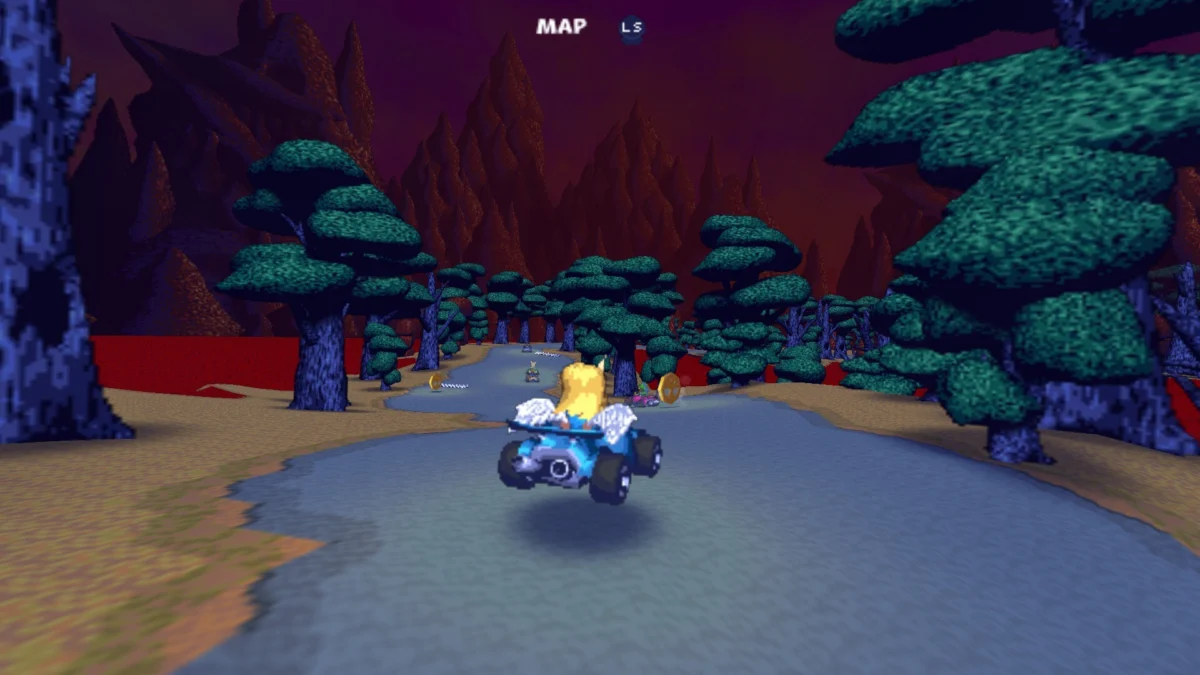
In an era where AAA racing titles are often defined by photorealistic graphics, live-service monetization, and rigid, pre-determined track layouts, a quiet revolution is brewing in the indie sector. Enter Mythic Kart Maker, a title that serves as both a love letter to the N64-era kart racers of the late 90s and a bold experiment in player-driven game design. Developed by the solo talent at Dream Mix Games, the title recently made its debut on Steam Early Access, capturing the attention of a community hungry for the chaotic, unscripted fun of games like Mario Kart 64 or Diddy Kong Racing, but with the modern convenience of infinite creative potential.
The Core Concept: Nostalgia Meets Modern Utility
At first glance, Mythic Kart Maker is a masterclass in aesthetic cohesion. It utilizes chunky, pre-rendered visuals, vibrant character designs, and exaggerated, gravity-defying track architectures that feel ripped straight from a 1997 cathode-ray tube television. However, to label the game as a mere "retro-clone" would be a disservice to its most innovative feature: the real-time, integrated track editor.
Unlike traditional track-building games where players must navigate labyrinthine menus and exit the "action" to save, compile, and load their creations, Mythic Kart Maker allows for seamless integration. Players can drop terrain, boost pads, and obstacle-laden objects directly into the world while their kart is mid-race. This "make-it-as-you-go" philosophy transforms the gameplay loop from a simple test of reflexes into a dynamic, shifting puzzle that tests both driving skill and structural creativity.
Chronology of Development
The journey of Mythic Kart Maker is indicative of the "indie-first" approach to modern game development.
- Early Conceptualization: Dream Mix Games began the project with a focus on capturing the "vibe" of 90s gaming. The developer identified a gap in the market for a kart racer that prioritized community-driven content over the restrictive, closed-loop systems typical of established franchises.
- Prototype Phase: During the initial prototyping, the focus was on the physics engine. To maintain the "feel" of the N64 era, the team tuned the drift and acceleration mechanics to be snappy and forgiving, yet demanding enough for competitive time-trial play.
- The Editor Implementation: The breakthrough came with the decision to make the editor functional during active gameplay. This technical feat required a robust object-streaming system that could handle environmental modifications without triggering a frame-rate drop.
- Steam Early Access Launch: On May 16, 2026, the game entered the public sphere via Steam Early Access. This milestone marked the transition from a solo hobbyist project to a community-supported ecosystem, with the developer utilizing player feedback to refine the UI and expand the library of placeable track components.
Supporting Data: Why the "Sandbox" Approach Matters
The success of Mythic Kart Maker in its early days highlights a broader trend in the gaming industry: the shift toward user-generated content (UGC) as a primary engagement driver. According to industry analysts, games that offer integrated modding tools—such as Roblox, Trackmania, and LittleBigPlanet—consistently boast higher player retention rates than those that rely solely on developer-provided content.
Mythic Kart Maker leverages the Steam Workshop to amplify its reach. By allowing players to share not just tracks, but also custom racers and mods, the game creates a self-sustaining content cycle. Even at this early stage, the community has begun to populate the Workshop with highly intricate designs that push the engine’s collision detection to its limits. For a solo developer, this is the ultimate safeguard; the game does not need to release constant DLC updates because the players are, effectively, the developers.
The Technical Framework: Beyond the Surface
The technical prowess of Mythic Kart Maker lies in its duality. While the aesthetic is intentionally "low-poly," the underlying architecture is thoroughly modern.
The Real-Time Editor vs. The Top-Down Precision Suite
The game provides two distinct ways to build. The real-time, on-track editor is designed for spontaneity—perfect for split-screen sessions where friends want to troll one another by placing a banana peel or a loop-de-loop right in front of the leader.
Conversely, the top-down precision editor caters to the "architects" of the community. This mode offers a grid-based interface, allowing for granular control over elevation, texture mapping, and checkpoint placement. By providing these two distinct avenues, Dream Mix Games ensures that the barrier to entry is low for casual players, while the ceiling for power users remains remarkably high.

The Challenge of Local Multiplayer
Currently, the game is optimized for four-player local split-screen. This design choice is a conscious nod to the couch-co-op era of the 90s. The developer has stated that they chose to perfect the local experience first, citing the complexity of netcode implementation as a primary hurdle for a solo developer. However, the roadmap for the game explicitly mentions the possibility of online multiplayer should the Early Access period prove successful enough to justify the server infrastructure and networking development time.
Official Stance and Development Roadmap
In various developer logs and forum updates, Dream Mix Games has maintained a transparent, community-first communication style. When asked about the lack of online play, the developer emphasized that "community stability and local performance are the pillars of the Mythic Kart experience."
The official stance from Dream Mix Games is that the Early Access period will last for approximately 12 to 18 months. During this time, they aim to:
- Expand the Asset Library: Introduce new themes (e.g., underwater, sky-castles, cyberpunk) for track building.
- Refine the Physics Engine: Address minor collision bugs reported by the community in high-speed segments.
- Evaluate Networking: Begin closed-beta testing for peer-to-peer (P2P) online functionality to minimize latency, which is critical for a high-speed kart racer.
Implications for the Kart Racing Genre
The emergence of Mythic Kart Maker poses an interesting question for the industry: Is the future of the kart racer a platform rather than a product?
For years, the kart racing genre has been dominated by static titles where the player is a consumer of pre-designed tracks. Mythic Kart Maker flips this dynamic. It suggests that players are not just looking for a race—they are looking for a playground. If the game continues its current trajectory, it could set a new standard for independent racers. We may soon see a landscape where "kart racing" is treated less like a linear progression and more like a creative canvas, much like how Minecraft fundamentally changed the expectations for sandbox survival games.
Furthermore, the success of a solo-developed project like this serves as a powerful testament to the democratization of game development tools. Using engines like Unity or Godot, developers are now able to create experiences that previously required a staff of hundreds.
Conclusion: A Bright Future on the Horizon
Mythic Kart Maker is more than a nostalgic trip to the 90s; it is a sophisticated, highly playable, and deeply rewarding creative tool. By blending the frantic, colorful, and accessible gameplay of classic kart racers with a robust, real-time construction engine, Dream Mix Games has hit upon a formula that resonates with both the child in us who misses the couch-co-op days and the adult who wants to build, experiment, and share.
While the absence of online multiplayer is a notable hurdle, the strength of the core gameplay loop and the promise of future updates keep the community optimistic. Whether you are looking to spend hours crafting the perfect, physics-defying speedway or simply want to zip around a chaotic track with friends on a Friday night, Mythic Kart Maker delivers an experience that is as imaginative as it is exhilarating. As it continues to evolve through Early Access, it is undoubtedly a title that deserves a spot in the library of any fan of racing games or creative sandboxes. Keep an eye on this one; it’s off to a blistering start.











No comments yet. Be the first to join the conversation!