

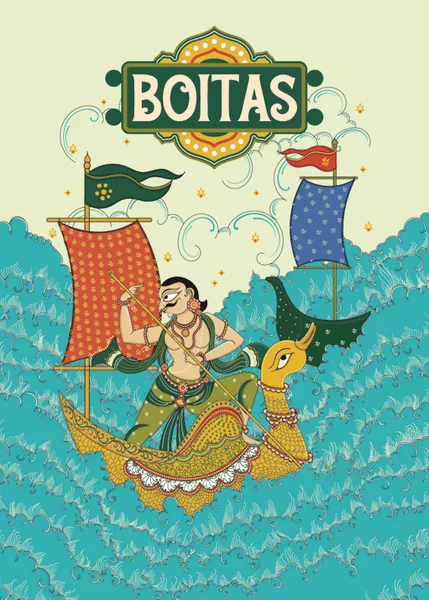
In the crowded landscape of modern tabletop gaming, the trick-taking genre is often defined by its adherence to European traditions—think of the regal hierarchies of Hearts, Spades, or the complex, abstract logic of The Crew. However, a new title from publisher Kheo Games is setting sail to disrupt this status quo. Boitas, designed by Sidhant Chand with evocative, culturally rooted artwork by Janki Bavle, transports players from the familiar drawing rooms of the West to the vibrant, salt-sprayed shores of ancient Odisha.
By blending the mechanical satisfaction of trick-taking with the strategic depth of market planning and set collection, Boitas offers a refreshing departure from standard fare. It is a game that honors its historical source material while providing a sharp, competitive experience that fits comfortably into a 30-minute window.
The Core Facts: A New Current in Trick-Taking
At its heart, Boitas is a competitive card game for 2–4 players. It eschews the typical "king and queen" aesthetic in favor of the Sadhaba sea traders—the historical mariners of Odisha who navigated the Indian Ocean to trade precious goods.
- Designer: Sidhant Chand
- Artist: Janki Bavle
- Publisher: Kheo Games
- Player Count: 2–4
- Playtime: 15–30 minutes
- Genre: Trick-Taking / Set Collection
The game’s primary appeal lies in its duality. It functions as a classic trick-taking engine where the goal is to secure the best trade goods, but it adds a layer of economic management that forces players to look beyond the immediate trick. The use of currency—cowries—and a rotating market phase ensures that even a player who loses a trick can find strategic value in the fallout.
Chronology and Flow: How the Game Unfolds
To understand Boitas, one must understand its rhythm. The game is played over four distinct rounds, each structured into a predictable yet tense sequence of events.
Phase 1: The Trick-Taking Exchange
Each round begins with three trick-taking hands. Players utilize a deck consisting of four suits. Unlike traditional games where the hierarchy is static, Boitas introduces a rotating trump suit for every round, keeping players on their toes.
The goal here is not merely to win the trick, but to win the right trick. The winner of a hand gains the first pick of available goods tokens, while the runner-up secures the remaining token. Those who fail to place in the top two are not left empty-handed; they receive cowries, the game’s essential currency, which serves as a vital resource for the subsequent phase.
Phase 2: The Market Phase
Once the three tricks are concluded, the game shifts from maritime navigation to market strategy. Players spend their accumulated cowries to purchase cards from the market. This creates a "hand-building" element that is rarely seen in pure trick-taking games. By spending wisely, players can augment their hands with stronger, more versatile cards for the next round, effectively allowing them to mitigate bad luck and plan for future success.
The Twist: Dynamic Hierarchy
The game features several mechanical wrinkles that prevent it from becoming predictable. Certain numbered trump cards can override higher-value cards if they align with the "current port value" of the round. Furthermore, the inclusion of "Elephant" cards—powerful, high-value assets—adds a layer of tension. While they sit at the top of the hierarchy, they are not invincible, as clever players can bait them out or counter them under specific, rule-defined conditions.
Supporting Data: Why the Mechanics Work
The success of Boitas as a modern design lies in its pacing and interaction. Despite the multiple phases, the game avoids the "analysis paralysis" that plagues more complex titles.
Pacing and Accessibility
The game’s 30-minute runtime is a testament to its streamlined design. Because players are restricted to revealing one card at a time, the tempo is brisk. The market phase is equally efficient; since purchase options are limited, players are forced to make high-impact decisions quickly. This makes Boitas an ideal "gateway" game, suitable for families looking to transition from traditional trick-takers into the more modern, thematic world of contemporary board games.
Interaction Without Aggression
One of the most notable aspects of Boitas is its approach to player interaction. Many trick-taking games rely on "take-that" mechanics—cards designed specifically to punish an opponent. Boitas is more subtle. It encourages "table reading." You are constantly watching who needs which goods and who is hoarding cowries for the market. By tracking these variables, players can intentionally lose a trick to conserve resources or force an opponent into a suboptimal move. It is a game of social deduction and tactical positioning rather than brute-force aggression.
Official Perspective: Cultural Identity in Gaming
The most striking feature of Boitas is its dedication to the history of Odisha. While many games adopt a theme merely as a "skin" for abstract mechanics, Boitas attempts to weave the Sadhaba culture into its core identity.
In an era where board gaming is becoming increasingly global, Boitas stands out by bringing a slice of Indian maritime history to a global audience. The artwork by Janki Bavle is instrumental in this, providing a visual language that feels authentic and distinct from the standard Western fantasy or sci-fi tropes.
From a production standpoint, Kheo Games has delivered a high-quality product. The import goods tokens are tactile and substantial, and the iconography is intuitive, ensuring that the game remains playable even for those unfamiliar with its historical context. While the cards are slightly thinner than industry-standard premium linen, they maintain a glossy finish that holds up well to repeated shuffling and handling.
Implications: The Future of the Genre
For fans of modern hits like Cat in the Box or The Crew, Boitas is a mandatory addition to the shelf. It effectively proves that the trick-taking genre is far from exhausted; it simply requires the right infusion of creativity and thematic depth.
Scoring Flexibility
The game’s longevity is largely attributed to its flexible scoring system. Players have two primary paths: they can either chase the highest-value token in every category or specialize in two, effectively "cornering the market." This choice forces players to pivot their strategy based on the cards they are dealt and the actions of their opponents. This level of depth ensures that no two sessions feel identical, providing high replayability.
Is It For Everyone?
Despite its strengths, Boitas remains a trick-taking game at its core. Those who fundamentally dislike the mechanics of hand management, following suit, and reading the table will not find a revolution here. The game does not hide its nature; it merely polishes it. For those who enjoy the intellectual challenge of calculating odds and managing a hand, however, Boitas is a triumph.
Conclusion: A New Standard
Boitas is a remarkable achievement. It balances the abstract, logical nature of cards with the thematic weight of a historical setting. It is fast, thoughtful, and culturally enriching—a rare combination in a market often saturated with derivative designs.
By successfully integrating a market-based economy into a trick-taking framework, Kheo Games has provided a blueprint for how to evolve classic genres. Whether you are a seasoned veteran of the trick-taking scene or a family looking for a new, engaging Friday night staple, Boitas offers a voyage well worth taking. It is a reminder that the best gaming experiences are those that manage to be both easy to learn and impossible to master.











No comments yet. Be the first to join the conversation!