The semiconductor industry, currently the bedrock of the global economy, is bracing for a potential shift in capital expenditure dynamics. ASML, the Dutch titan and the world’s sole supplier of Extreme Ultraviolet (EUV) lithography systems, is reportedly moving to increase the pricing of its existing Low-NA (Numerical Aperture) EUV machines. This strategic shift, first brought to light by The Information, has met with immediate and vocal resistance from Taiwan Semiconductor Manufacturing Company (TSMC), the world’s largest contract chipmaker and arguably ASML’s most vital partner.
As the industry grapples with the escalating costs of advanced process nodes—moving toward 2nm and beyond—the friction between the equipment supplier and its primary customer highlights the precarious nature of the semiconductor supply chain. While ASML maintains that its price hikes are justified by iterative performance gains, the move threatens to disrupt the delicate financial balance of chip fabrication, potentially forcing downstream costs onto the tech giants that rely on these foundries.
The Core Conflict: Value vs. Volatility
At the heart of this standoff is a fundamental disagreement over value. ASML argues that its machines are not static products but evolving ecosystems. Through constant engineering refinements, software updates, and hardware improvements, ASML claims it is delivering "more productivity" per square inch of silicon processed. Consequently, they believe they are entitled to capture a larger share of the value their machines create.
TSMC, however, faces immense pressure to maintain margins while navigating the gargantuan costs of building new fabrication plants (fabs). For TSMC, a sudden increase in the price of the equipment that defines their production capability is not merely a line-item expense; it is a structural challenge to their long-term capital efficiency.
A Chronology of Lithography Dominance
To understand the gravity of this dispute, one must look at the timeline of lithography’s evolution.
The Rise of EUV (2010–2018)
Before the widespread adoption of EUV, the industry relied on multi-patterning techniques with Deep Ultraviolet (DUV) light. As Moore’s Law began to hit physical limits, the industry turned to ASML to commercialize EUV, a technology that uses light with a wavelength of 13.5 nanometers. This development was a decadal project, requiring billions in R&D and a consortium of global investors, including Intel, Samsung, and TSMC.
The Commercialization Phase (2019–2023)
By 2019, EUV tools began to reach high-volume manufacturing (HVM). These Low-NA systems became the "gold standard" for producing 7nm, 5nm, and 3nm chips. During this period, the relationship between ASML and TSMC was symbiotic; ASML provided the tools, and TSMC provided the testing ground and volume necessary to refine the technology.
The Current Friction Point (2024–Present)
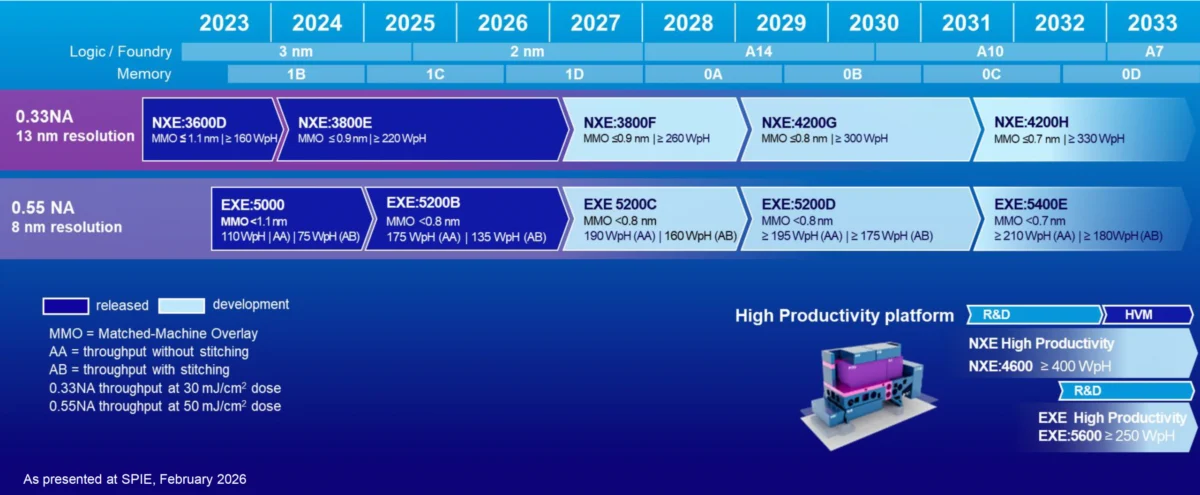
The current tension arises as ASML prepares to transition the industry toward High-NA EUV tools, which are significantly more expensive and complex. In an effort to maximize revenue across its entire product portfolio, ASML has begun signaling that its legacy Low-NA tools—despite being "older" technology—should command higher prices due to their proven reliability and continuous performance enhancements.
Supporting Data: The Economics of the Machine
ASML’s business model is unique. With a near-monopoly on the most advanced lithography machines, the company holds significant pricing power. However, the costs associated with these machines are staggering.
- Cost per Unit: A single Low-NA EUV system can cost upward of $150–$200 million.
- Performance Metrics: ASML measures value in "wafers per hour" (WPH). By increasing the throughput of existing machines, ASML argues that a machine bought today is more productive than the same model sold three years ago.
- Lead Times: The semiconductor equipment sector operates on multi-year lead times. Orders placed today may not be delivered or installed for 18 to 24 months, creating a "lag" between price adjustments and actual financial impact.
- Market Concentration: Only three companies in the world—TSMC, Samsung, and Intel—are capable of utilizing these tools at the cutting edge. This creates a high-stakes "triopoly" where ASML is the sole gatekeeper.
Official Responses: Navigating the Narrative
During ASML’s recent quarterly earnings call, Chief Financial Officer Roger Dassen addressed the rumors of price hikes with a measured, corporate tone. He emphasized that price adjustments are not impulsive or immediate but rather a reflection of the "value-based" pricing model the company employs.
"When it comes to Low-NA pricing, of course, you know that we keep on increasing the productivity of the Low-NA tool," Dassen stated. "That gives us a pretty strong runway for potential price improvements going forward."
Dassen was careful to manage expectations regarding the timeline of these changes. "Given the long order lead times that we have, that does not translate into pricing effects tomorrow," he noted. This comment serves as a buffer, suggesting that while the intent to raise prices exists, the implementation will be gradual, likely tied to new contracts or service agreements rather than retroactive hikes on existing purchase orders.
TSMC has remained characteristically tight-lipped regarding the specific details of its negotiations with ASML. However, reports from The Information indicate that the foundry giant is less than pleased. For a company that operates on razor-thin margins at the leading edge, any increase in the cost of goods sold (COGS) is viewed as a threat to their competitive positioning against rivals like Samsung Foundry or Intel Foundry Services.
Implications: The Ripple Effect
The implications of this pricing dispute extend far beyond the balance sheets of two companies.
1. The Cost of Innovation
If ASML succeeds in raising prices, the foundries will be forced to pass those costs on to their customers. Companies like NVIDIA, Apple, AMD, and Qualcomm—which rely on TSMC to manufacture their high-performance AI and mobile chips—will likely see their production costs rise. This could lead to higher prices for consumer electronics, data center hardware, and the underlying infrastructure of the artificial intelligence boom.
2. Supply Chain Sovereignty
This dispute highlights the dangers of extreme supply chain concentration. When a single firm (ASML) holds the keys to the future of computing, it creates a geopolitical and economic bottleneck. Governments in the U.S., EU, and Asia are currently pouring billions in subsidies into chip manufacturing, but those subsidies are largely flowing toward the purchase of equipment from one company. If that equipment becomes significantly more expensive, the effectiveness of these government-funded "chip wars" could be diminished.
3. Incentivizing Competition
High prices are a signal for market entry. While no other company has yet managed to replicate EUV lithography, ASML’s aggressive pricing strategy may provide the necessary economic incentive for alternative technologies—such as Nanoimprint Lithography (NIL) or other non-EUV methods—to gain traction. Canon, for instance, has been working on nanoimprint technologies that could potentially offer a lower-cost alternative to EUV for certain layers of chip production. If ASML pushes too hard, they may inadvertently accelerate the viability of their own competitors.
Looking Ahead: A Future of Managed Tensions
The standoff between ASML and TSMC is not likely to result in a total breakdown of relations. The two companies are too deeply entwined for that to happen; they are effectively co-dependent partners in the advancement of human technology.
However, the dialogue marks a shift in the semiconductor power dynamic. For years, the focus was entirely on "can we make it?"—a technical challenge. Now, the focus is shifting to "how much should it cost?"—a commercial challenge. As the industry moves into an era where every nanometer of progress requires exponential increases in capital, the price of lithography will remain the most contentious variable in the tech world.
Whether ASML’s "productivity-linked" pricing model will be accepted by the industry remains to be seen. If they proceed with caution and justify the hikes through verifiable performance metrics, they may preserve their relationships. If, however, they are perceived as leveraging their monopoly status to extract excessive rent, they risk alienating their largest customers and inviting a wave of disruptive innovation that could eventually challenge their dominance.
For now, the industry watches and waits. The machines continue to arrive, the wafers continue to spin, and the accountants continue to calculate the high cost of the future.