Evan Lee Salim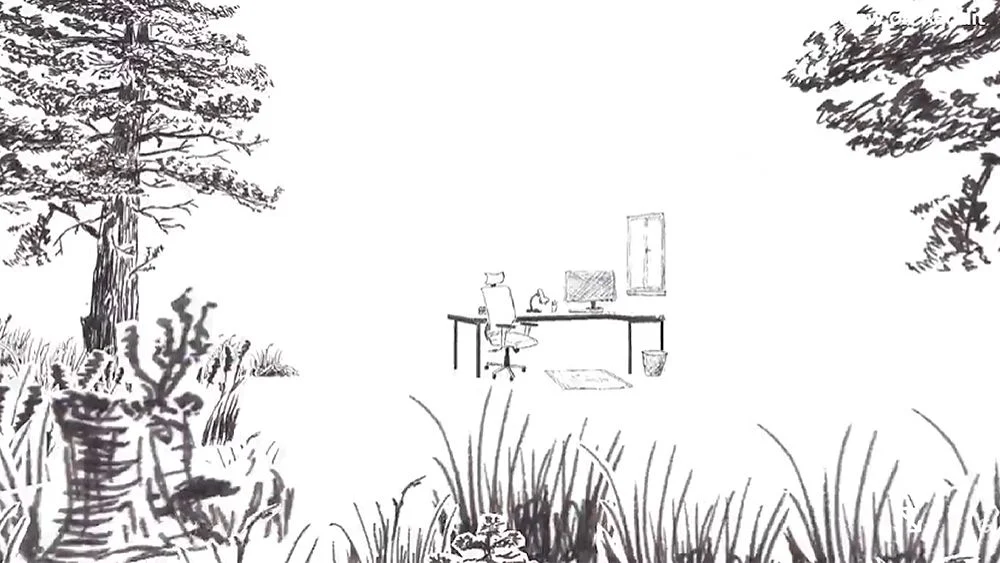
The boundaries between traditional media and digital immersion are becoming increasingly porous. For decades, artists have labored to make digital creations look more "human" or "analog," often chasing the warmth of charcoal, the texture of oil paint, or the erratic charm of pencil on paper. However, a new project by an artist known as Leteramma has flipped the script, creating a surreal, navigable 3D environment that feels less like a computer-generated model and more like walking through a living, breathing charcoal sketchbook.
By leveraging the power of Blender—the industry-standard open-source 3D suite—Leteramma has demonstrated that the future of immersive art may not lie in photorealism, but in the stylized, hand-drawn aesthetic that bridges the gap between static illustration and spatial experience.
The Genesis of a Hand-Drawn World
The project began with a humble, analog foundation: 2D pencil sketches. Leteramma, who describes themselves as relatively new to the world of traditional illustration, began their creative journey by learning the fundamentals of drawing through online tutorials. Rather than viewing their lack of formal training as a limitation, the artist embraced the distinct, raw quality of their initial sketches.
The workflow was deceptively simple in concept but highly effective in execution. Leteramma produced a series of detailed pencil drawings on paper. These were then scanned into a digital format, preserving the gritty, tactile quality of the graphite. From here, the artist transitioned into the digital realm, utilizing Blender to translate these flat, two-dimensional planes into a three-dimensional environment.
Technical Implementation: The "Billboard" Illusion
The magic of the scene lies in a clever use of geometry nodes and shader manipulation. To achieve the effect of a 3D environment, Leteramma employed a technique similar to the "billboarding" used in early 3D video games. The drawings were cut out as individual assets and placed into a geometry node setup designed to ensure that the elements always orient themselves to face the camera, regardless of the viewer’s perspective.
"Essentially, it just rotates the drawings so they always face the camera," Leteramma explained in a Reddit community discussion. "The background also has a white glow, so the cut-out elements blend in seamlessly." By turning the white paper texture into an emissive material—effectively causing the background of the sketches to glow with the same intensity as the surrounding environment—the artist eliminated the harsh borders that usually betray a "cut-out" look, creating a cohesive, dreamlike aesthetic.
Chronology of an Artistic Experiment
The rise of Leteramma’s work serves as a case study in how modern artists are iterating through digital tools.
- Phase 1: Foundations. The artist dedicated time to learning the basics of 2D drawing, specifically focusing on perspective and character design. This period was marked by the study of foundational art principles.
- Phase 2: Digital Integration. Realizing the potential for a deeper, more immersive experience, the artist began scanning their work. The initial experiments involved basic layering within Blender, testing how 2D planes reacted to lighting.
- Phase 3: Shader Optimization. Recognizing that the "white" of the paper was clashing with the digital environment, Leteramma refined their shader settings. This was the turning point where the art shifted from "sketches placed in a 3D space" to "a 3D space constructed from sketches."
- Phase 4: Expansion of Atmosphere. Once the core technique was perfected, the artist began experimenting with atmospheric effects, such as Optix denoising, to create more unsettling, liminal spaces, effectively pivoting from whimsical sketches to moody, psychological environments.
Supporting Data: Why Blender Remains the Tool of Choice
The resurgence of independent 3D art is intrinsically linked to the accessibility and power of Blender. As noted in industry circles, the software has evolved from a niche tool into a powerhouse that rivals high-end, expensive alternatives.
For many artists, the decision to use Blender is rooted in three key factors:
- Open-Source Philosophy: Blender is free to use, which democratizes the barrier to entry for independent creators.
- Extensive Tutorial Ecosystem: As the project highlighted, the abundance of high-quality Blender tutorials allows artists to self-teach complex workflows, such as geometry nodes and shader scripting, without formal education.
- Community-Driven Development: With the release of versions like 5.2 LTS, the software continues to receive stability updates that cater to both hobbyists and professional studios.
The success of Leteramma’s project underscores that the "look" of an artwork is no longer determined by the hardware, but by the artist’s ability to manipulate light, shadow, and geometry to evoke a specific emotional response.
Implications for the Future of Virtual Environments
The implications of this work extend far beyond a single artist’s Reddit post. We are currently witnessing a shift in digital design where "perfect" rendering is being abandoned in favor of "expressive" rendering.
The Rise of "Liminal" Aesthetics
Leteramma’s experimentation with Optix denoising to create "Backrooms-style" liminal spaces suggests a broader trend in digital art. By deliberately playing with noise and light, artists are using 3D software to recreate the uncanny, unsettling feeling of forgotten or empty spaces. This approach to environmental design is gaining traction in indie game development, where the goal is to create an emotional impact rather than a hyper-realistic representation of the world.
The Blurring of 2D and 3D
We are entering an era where the distinction between "an illustrator" and "a 3D artist" is fading. When an artist can bring their physical sketches into a 3D space, they gain the ability to manipulate perspective in ways that were previously impossible. This allows for a unique visual hybrid: the charm and imperfection of the human hand, combined with the infinite possibilities of a virtual camera.
Expert Perspectives and Industry Impact
Industry observers suggest that this style of "hand-drawn 3D" may influence future developments in animation and virtual reality. Traditional 3D animation often struggles to maintain the "soul" of an artist’s original drawing. However, by using the artist’s own sketches as the texture map, the final render retains every stroke, smear, and imperfection of the original pencil work.
"What Leteramma has done is create a bridge," says a digital design consultant familiar with the project. "They haven’t just modeled a room; they’ve invited the viewer into the room as it exists in their mind. By embracing the limitations of the medium—the white paper, the pencil lines—they’ve actually created a more powerful, evocative experience than a standard, high-fidelity render ever could."
Conclusion: The Human Element in the Digital Age
The work of Leteramma serves as a poignant reminder that technology is, and should always be, a tool in the service of artistic intent. By combining the simplicity of a pencil and paper with the computational power of modern 3D software, the artist has managed to create something that feels profoundly human.
As digital tools become more sophisticated, the challenge for the next generation of artists will not be learning how to make the computer do everything for them, but rather how to maintain their unique, analog "fingerprint" within a digital environment. Whether through the use of geometry nodes, custom shaders, or innovative denoising techniques, the future of art lies in this synthesis of the old and the new.
For those inspired by this project, the message is clear: the tools are available, the tutorials are abundant, and the only limit is the willingness to scan a sketch and see where it leads in three dimensions. As Leteramma continues to experiment with new atmospheres and environments, they stand as a testament to the fact that you don’t need a massive studio or an expensive budget to redefine the boundaries of what is possible in digital art. You only need a pencil, a scanner, and a bit of imagination.

 Asro
Asro
 Sagoh
Sagoh