

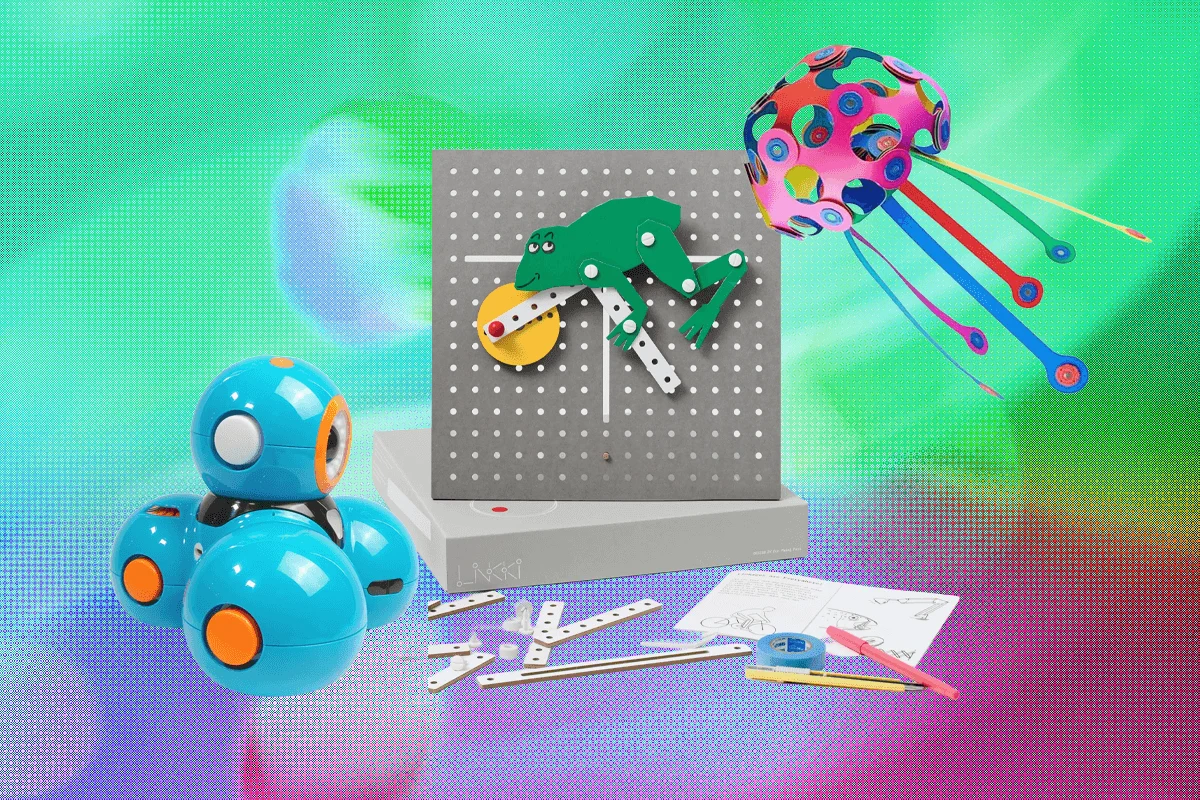
Anyone who has ever watched a toddler methodically dismantle a Tupperware drawer or spend an hour examining the gears of a discarded clock knows that children are, by nature, budding engineers. They possess an innate, unquenchable curiosity about how the world works—what happens if I pull this, or what happens if I combine these two disparate objects?

As parents and educators, our role is not just to provide the materials for play, but to nurture that latent creativity and provide a framework for logical thinking. In the modern era, this is often categorized under the umbrella of STEM (Science, Technology, Engineering, and Mathematics) or STEAM (which incorporates the Arts). Whether your child is a budding coder, an aspiring architect, or a tactile learner who loves to "squish and build," the right toy can act as a catalyst for a lifelong passion for discovery.

After years of rigorous testing—conducted in collaboration with my own children, the broader WIRED Reviews team, and my wife, a career educator who road-tests these products in the classroom—I have compiled a definitive list of the best STEM toys currently on the market.

The Philosophy of "Hard Fun"
When we talk about STEM toys, we are looking for more than just entertainment; we are looking for "hard fun." This concept, popularized by Seymour Papert, the father of educational computing, refers to the type of engagement that is challenging, frustrating at times, and deeply rewarding.

The toys featured in this guide are selected because they avoid the trap of being "passive consumption" devices. They require the user to assemble, program, dismantle, or rethink. They transform the child from a consumer of technology into a creator of it.

Featured Innovations: A Closer Look
1. Plus-Plus Building Blocks: The Ultimate Constructive Canvas
The Plus-Plus system is deceptively simple: a single shape (resembling two connected plus signs) that interlocks with others to create 2D mosaics or 3D sculptures.

- The Appeal: Unlike traditional bricks, these offer a curvature and fluidity that allows for organic shapes.
- Educational Value: It teaches spatial reasoning and geometric design. Kids can start with simple patterns and graduate to complex architectural structures.
2. Qubs Qubitunes: The Screen-Free Music Architect
In an age where children are often glued to tablets, Qubitunes offers a refreshing tactile experience. It allows children to arrange physical blocks on a stage to create melodies and soundscapes.

- The Appeal: It turns music theory into a physical puzzle.
- Educational Value: It introduces the concept of sequencing and algorithmic thinking without the need for a screen. It’s "coding" via composition.
3. Ambessa DIY Kinetic Flashlight
True STEM literacy involves understanding how energy is generated and transferred. The Ambessa DIY flashlight requires the child to build the device from the ground up, including the gear mechanism that creates light through kinetic energy.

- The Appeal: It provides an immediate "Aha!" moment when the user cranks the handle and the light flickers to life.
- Educational Value: This is a masterclass in mechanical engineering and the conversion of energy.
4. Particula GoChess Mini
Chess is the quintessential game of strategy, but the GoChess Mini brings it into the 21st century. It features an electronic board that tracks pieces and allows for remote play, helping children learn tactics through interactive AI guidance.

- The Appeal: It bridges the gap between traditional board games and modern digital connectivity.
- Educational Value: Beyond simple gameplay, it teaches pattern recognition, foresight, and logic—the bedrock of computer science.
Chronology: The Evolution of STEM Toys
To understand why these toys matter, we must look at how the educational toy market has evolved over the last three decades.

- The 1990s: The Era of Logic. Toys were largely static. Building blocks (LEGO) and mechanical kits (K’Nex) dominated. The focus was purely on physical construction.
- The 2000s: The Digital Transition. The introduction of programmable robotics, such as the early Mindstorms kits, shifted the focus toward basic logic and programming sequences.
- The 2010s: The "Maker" Movement. With the rise of the Arduino and Raspberry Pi, hobbyist-level components began appearing in children’s toy aisles. The emphasis moved toward "making" and rapid prototyping.
- The 2020s and Beyond: Integration. Modern STEM toys now prioritize seamless integration between physical hardware and digital interfaces, focusing on computational thinking rather than just "how to code."
Supporting Data: Why STEM Education Matters
According to recent reports from the National Science Foundation, students who engage in structured, hands-on STEM play before the age of 10 are significantly more likely to pursue careers in engineering, software development, and scientific research.

The benefit isn’t just about job prospects, however. Studies show that children who engage with STEM toys develop higher "frustration tolerance." When a structure collapses or a code fails to run, the child learns to iterate—to test, observe, and adjust. This iterative process is the scientific method in its purest, most accessible form.
-Reviewer-Photo-SOURCE-Adrienne-So.png)
Implications for Future Development
As we look toward the future, the integration of Artificial Intelligence into children’s play is the next major frontier. We are seeing a shift from toys that simply "react" to input (like a simple button-press) to toys that "learn" from the user.

Ethical Considerations
While these toys are beneficial, parents should be mindful of the "data footprint" of connected toys. Ensure that any device requiring a cloud connection is compliant with COPPA (Children’s Online Privacy Protection Act) standards. Our recommendations prioritize offline play or secure, local-connection devices wherever possible to protect the privacy of the young user.

The Role of Mentorship
Technology cannot replace the mentor. A toy is merely a tool. The most effective STEM learning occurs when a parent or educator engages with the child, asking, "Why do you think that happened?" or "What would happen if we changed this one variable?" These open-ended questions turn a simple afternoon of play into a rigorous intellectual session.

Conclusion: Investing in Curiosity
Whether you are looking for a complex robotics kit or a simple set of interlocking blocks, the goal remains the same: to foster a mindset that asks questions and seeks answers. The toys mentioned in this article have been vetted for their durability, educational efficacy, and, most importantly, their "fun factor."

If you are just starting your journey, I recommend beginning with a versatile set like the Plus-Plus blocks, which allow for infinite iterations. As your child grows, introduce more specialized tools like the Ambessa flashlight to explore mechanical concepts, or the GoChess Mini to challenge their strategic thinking.

By providing these tools, you are doing more than just buying a gift; you are providing the building blocks for a future filled with innovation, problem-solving, and a deep, enduring love for the mechanics of our universe.

Updated July 2026: This guide has been updated to include the latest iterations of Plus-Plus Building Blocks and the Science Can Solar System. Older models have been retired to ensure this list reflects the most reliable and innovative products currently available.

For more resources on fostering a tech-forward household, browse our comprehensive buying guides on Best Subscription Boxes for Kids, Best Speakers for Kids, and our deep dive on How to Build the Lego Collection of Your Dreams.











