Evan Lee Salim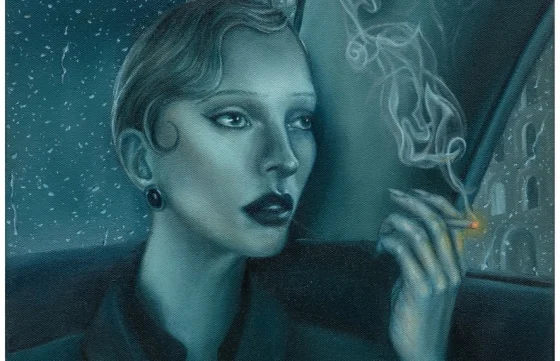
In the hallowed, muted quiet of Harper’s gallery, a new narrative is unfolding—one rendered in the cold, clinical, yet deeply romantic hues of the 18th-century pigment that gives the exhibition its name. Prussian Blue, the inaugural solo presentation of New York-based artist Sophia Huitema, marks a significant milestone in her burgeoning career. Featuring seven large-scale oil paintings, the exhibition transforms the gallery space into a site of psychological theater, where the boundaries between the canvas and the viewer are not merely blurred, but actively challenged. On view through April 25, 2026, the collection offers an immersive, if somewhat chilling, exploration of the feminine psyche, filtered through a lens of high-society artifice and cinematic tension.
The Anatomy of a Pigment: A Conceptual Anchor
At the heart of Huitema’s latest body of work is the titular pigment, Prussian Blue (ferric ferrocyanide). Beyond its deep, oceanic saturation, the color serves as the exhibition’s metaphysical core. Historically, the pigment is a study in contradictions: it is a chemical derivative of cyanide, yet it has also been used medically as an antidote for heavy metal poisoning.
This inherent duality—the capacity to both kill and cure—mirrors the emotional landscape of Huitema’s subjects. The women who populate these canvases are not mere passive muses; they are guardians of their own secrets. They occupy "Prussian Blue" spaces—hazy, dimly lit, and emotionally dense interiors—where the cool harmonies of blue and green create a mood that is at once protective and predatory. For Huitema, the pigment acts as a visual metaphor for the guardedness of the modern woman, a shroud of elegance that simultaneously serves as a defensive perimeter.
A Chronology of a Stylistic Evolution
Huitema’s ascent in the contemporary art world has been marked by a singular, self-directed trajectory. Unlike many of her peers who emerged through the standard channels of MFA programs and academic institutionalization, Huitema’s aesthetic vocabulary was forged through sustained, solitary studio practice and an obsessive commitment to visual research.
- Formative Years: Early in her career, Huitema began experimenting with the attenuated, elongated proportions that have since become her signature. Drawing heavily from the archives of early 20th-century fashion illustration, she honed her ability to translate the "streamlined finesse" of the Art Deco era onto canvas.
- The Transition to Oil: Moving away from the lighter, more fluid mediums of her early illustration work, Huitema pivoted to oils to achieve the depth and "hazy, dreamlike" textures required for the Prussian Blue series.
- The Harper’s Debut: The current exhibition at Harper’s is the culmination of two years of intensive study regarding the interplay between light, architectural space, and psychological projection. This body of work represents her most cohesive thematic statement to date, moving beyond mere aestheticism into the realm of narrative storytelling.
Supporting Data: The Language of the Femme Fatale
To understand the weight of Huitema’s work, one must examine the visual lexicon she employs. Her figures are characterized by slender necks, exaggerated limbs, and an air of aristocratic nonchalance. They are draped in the trappings of a bygone era—Gatsby-esque gowns, intricate pearl necklaces, and jewel-encrusted headdresses—yet they exist in a state of perpetual alertness.
The Cinematic Influence
Huitema’s paintings operate with the mechanics of a film noir. In the piece titled Sleeper Car, the viewer is invited into a claustrophobic, rain-streaked carriage. The subject, a woman in a backless evening gown, offers a sly, over-the-shoulder glance that is simultaneously seductive and threatening. Her posture is relaxed, yet her hand is braced—a physical manifestation of a "cunning" nature ready to strike.
The painting functions as a freeze-frame of a psychological thriller. By utilizing shallow, compressed spaces, Huitema forces the viewer to confront the "uncertain depth" of the background, where the architecture of the room feels less like a physical structure and more like a manifestation of the subject’s subconscious.
Art-Historical Affinities
Critics have noted the strong influence of Symbolist and Surrealist traditions in Huitema’s work. Much like the Symbolists, who sought to represent absolute truths through metaphorical imagery, Huitema’s interiors are not realistic; they are "psychological realms." Her reliance on the theatrical poise of interwar couture, reminiscent of artists like Erté, provides a grounding element that prevents the work from slipping entirely into the abstract. By synthesizing the fashion-forward sensibility of the 1920s with the surrealist desire to probe the subconscious, Huitema has carved out a unique space within contemporary figurative painting.
Official Responses and Curatorial Perspectives
The reception of Prussian Blue has been met with significant enthusiasm from both critics and gallery patrons. Representatives from Harper’s have noted that the exhibition represents a shift toward a more "theatrical" mode of painting, one that demands a slower, more deliberate viewing experience.
"Sophia Huitema is not merely painting portraits; she is staging interventions," said a gallery spokesperson during the opening weekend. "When you stand before these works, you are not just looking at a woman in a dress. You are being evaluated by her. The way Huitema uses Prussian Blue to unify these scenes creates a sensory atmosphere that is difficult to shake."
While the artist herself remains relatively elusive, preferring to let the work speak through its own internal logic, her recent press statements emphasize the importance of "sustained observation." Huitema has stated that her goal is to build a "contemporary visual language that moves fluidly between illustration, painting, and cinematic staging," effectively dissolving the hierarchies that often separate these disciplines.
The Implications: Where Beauty Meets Menace
The broader implications of Huitema’s work touch upon the changing role of the female figure in contemporary art. For decades, the "femme fatale" was a trope defined by the male gaze—a cautionary tale of seduction and ruin. In Huitema’s hands, however, the trope is reclaimed.
Her figures are not waiting to be looked at; they are actively observing the observer. They possess a "quietly calculating air" that suggests they are always two steps ahead of the danger—or the temptation—presented in the scene. By placing these women in environments that are opulent yet fraught with tension, Huitema suggests that high society is a stage, and survival requires a mastery of performance.
A New Chapter in Figurative Painting
The success of Prussian Blue suggests that there is a growing appetite for painting that leans into the literary and the atmospheric. As digital media continues to dominate the visual landscape with rapid-fire, low-context imagery, Huitema’s commitment to the slow, physical process of oil painting feels like an act of rebellion. Her work demands that the viewer stop, linger, and engage with the "threat and protection" embedded in every brushstroke.
Future Trajectory
With the exhibition scheduled to run through April 2026, the impact of Prussian Blue is expected to ripple outward, influencing a younger generation of painters who are looking to synthesize historical illustration with contemporary narrative. Whether Huitema will continue to explore the darker, noir-inspired elements of her current style or pivot toward a new chromatic palette remains to be seen. However, one thing is certain: her ability to marry the decorative with the dangerous has established her as a formidable voice in the current art scene.
In conclusion, Prussian Blue is a masterful display of technical control and thematic depth. By utilizing a single, chemically complex pigment to anchor her exploration of feminine agency, Sophia Huitema has created an exhibition that is as intellectually stimulating as it is visually arresting. It is a work of high-stakes theater, one that invites the viewer to step into the haze—and perhaps, to realize that they are the ones being watched.

 Sagoh
Sagoh
 Lina Irawan