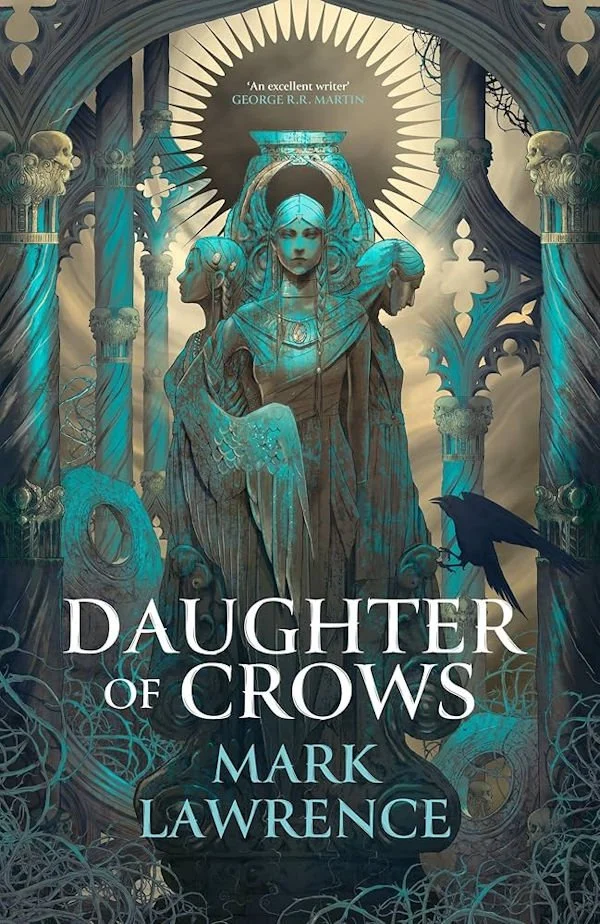
In the landscape of modern grimdark fantasy, few authors possess the surgical precision of Mark Lawrence. With his latest release, Daughter of Crows, the first installment in a new trilogy, Lawrence strips away the genre’s common tropes—the youthful hero’s journey, the clear-cut morality, and the linear progression of power—to present something far more unsettling. This is a visceral exploration of memory, aging, and the high cost of becoming an avatar of retribution.
The Academy of Kindness: Where Innocence Goes to Die
The narrative revolves around the titular "Academy of Kindness," a nightmarish institution that recruits a hundred young girls annually, only to graduate a mere three. Inspired by the mythological Furies—the "Kindly Ones"—the Academy exists to forge weapons in human form. These girls are not trained; they are indoctrinated, broken, and rebuilt upon the "Wound Garden," a site of constant physical and psychological attrition.
The central figure is Rue, a woman whose life is defined by a paradox: she sold herself to the Academy, surviving a decade-long crucible that claimed all but the most hardened. Years later, having sought a quiet, peaceful existence, Rue finds her hard-won tranquility shattered by the massacre of her village. What follows is not merely a tale of revenge, but an explosive, raw, and intimate study of a woman who is, quite literally, a force of nature.
A Chronology of Trauma: The Triple-Layered Narrative
What distinguishes Daughter of Crows from Lawrence’s previous works is its structural complexity. The novel employs three distinct narrative timelines, weaving together the disparate stages of Rue’s life to paint a portrait of a woman whose identity is both fractured and absolute.
The Elder Years: The Burden of History
We meet Rue in her twilight years. She is bitter, twisted, and physically failing. Unlike the typical fantasy protagonist whose physical prowess increases with the plot, Rue faces the harsh reality of an aging body. Her mind remains a razor-sharp weapon, but her joints ache and her stamina is a finite resource. This portrayal challenges the reader’s perception of "heroism," grounding the violence in the relatable, quiet brutality of physical decline.
The Academy: The Crucible of Mollandra
The second timeline chronicles her formative years as "Mollandra" within the Academy. Here, Lawrence delves into the mechanics of survival. In an environment where violence is the only currency, the reader is forced to witness the shaping of an avatar of vengeance. Through prose that is as blunt as it is eloquent, Lawrence depicts the physical and emotional trauma of the students, highlighting the fleeting, unbreakable bonds of companionship that bloom in the darkest of soil.
The Eldest: The Shadow of the Past
The third and most disturbing narrative thread involves Rue’s childhood before the Academy. Living in a depraved home under the thumb of "parents" who possess supernatural, monstrous qualities, Rue acts as the "Eldest," the protector of other captive children. This segment is arguably the book’s emotional core, revealing the origin of Rue’s resilience and the tragedy of her eventual betrayal, which led her to the gates of the Academy.
Supporting Data: The Philosophy of Grimdark
Daughter of Crows functions as a microcosm of the human condition. Lawrence utilizes the fantasy setting to probe the mechanics of identity:
- Memory as a Foundation: Lawrence explores how we curate our own history. Rue is defined not just by what she remembers, but by what she suppresses. The trilogy poses a fundamental question: are we the sum of our experiences, or are we the choices we make to move past them?
- The Randomness of Connection: The bonds formed between the girls in the Academy are depicted as both a strength and a liability. Lawrence suggests that these early, chance encounters are the architects of our adult foundations—foundations that fray as we age.
- The Morality of the Compromised: Critics and fans alike often note Lawrence’s ability to make the morally bankrupt sympathetic. In this work, he argues that "likability" is secondary to "interest." By placing Rue in situations of extreme duress, he forces the reader to confront the reality that survival often requires the abandonment of traditional virtue.
Official Perspectives: An Interview with Mark Lawrence
Following the publication of the novel, we sat down with Mark Lawrence to discuss the genesis of his most complex protagonist to date.
On the Inspiration Behind Rue
"The idea to show her old came from forums and social media, where the desire to see older female main characters is frequently voiced," Lawrence explains. "I was either meeting that desire or calling their bluff." He notes that the shift from the traditional "youthful discovery" arc to an "aging experience" arc allowed him to explore the nuanced complexities of physical and mental decay, and how that contrasts with the wisdom gained over a lifetime.
On Narrative Structure
When asked if the three-timeline structure was planned, Lawrence is characteristically candid: "I don’t plan my books. They just happen as I write them. I tend to write single point-of-view books, but here I span many decades to provide the illusion of multiple perspectives." This organic approach to storytelling results in a pacing that, while varied, never feels disjointed.
On the Academy’s Chilling Nomenclature
The name "Academy of Kindness" was a deliberate irony. Lawrence notes, "I had the Morrigan in the prologue and talked about different aspects of a triple-goddess. It wasn’t much of a jump to decide to use the Furies, and since they were referred to as The Kindly Ones in antiquity, the name suggested itself."
On the Future of the Trilogy
When pushed on whether the remaining books will focus on uncovering the past or forging the future, Lawrence offers a simple, enigmatic: "Yes." It is clear that the horizon for Rue is expanding, and the reader should expect a continuation of the psychological and physical intensity established in the first volume.
Implications: The Pulse of Modern Fantasy
Daughter of Crows stands as a significant contribution to the genre. By refusing to conform to sub-genre boundaries—veering effortlessly between epic fantasy, psychological horror, and character-driven drama—Lawrence has created a work that is as intellectually stimulating as it is visceral.
The implications for the reader are twofold: first, there is the immediate, visceral reaction to the book’s violence and cruelty. It is a work that demands the reader grit their teeth. Second, there is the reflective, lingering impact of its themes. By the time the reader reaches the final page, they are left not with answers, but with a deeper curiosity about their own life.
As Lawrence himself hopes, the book acts as a mirror, asking us to consider how our own experiences—our suffering, our successes, and our relationships—have shaped us into the people we are today.
Final Assessment
The novel is an unrelenting, naked depiction of humanity at its nadir, yet it remains anchored by a fierce, stubborn hope. It is a story of stolen innocence and the terrible cost of survival. While its only true flaw is that it leaves the reader desperate for the next installment, Daughter of Crows is, without question, a masterclass in modern storytelling. It is grimdark fantasy with a pulse—bloody, intimate, and emotionally ruthless.
As Rue navigates the treacherous waters of her own history and the impending war on her doorstep, one thing becomes clear: to underestimate an old woman who has survived the Academy of Kindness is a mistake no one lives to make twice.