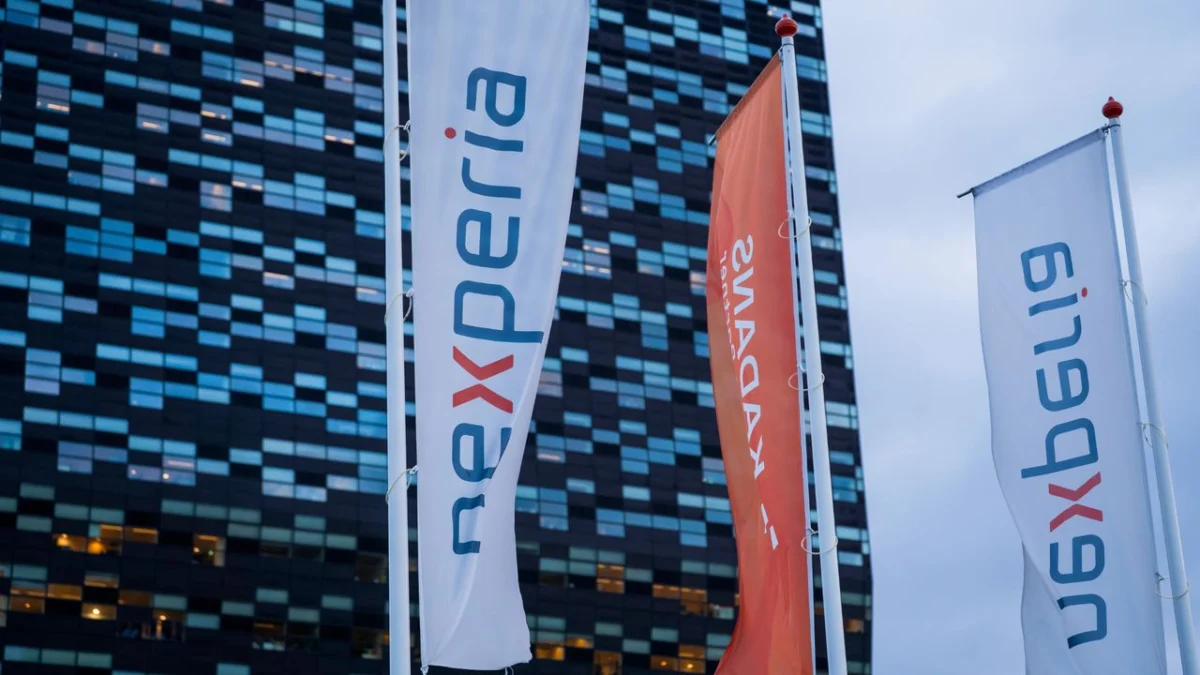
In a significant escalation of the ongoing corporate and geopolitical tug-of-war over semiconductor sovereignty, a court in Dongguan, China, has issued a sweeping asset freeze against Dutch chipmaker Nexperia. According to a regulatory filing submitted to the Shanghai Stock Exchange by Nexperia’s Chinese parent company, Wingtech Technology, the court has locked 2.14 billion yuan (approximately $318 million) in assets.
The ruling, which remains in effect until August 2029, represents a major tactical victory for Wingtech, providing the company with newfound leverage in its year-long battle to reclaim control over its subsidiary—a struggle that has been complicated by the intervention of the Dutch government and a deepening divide between Nexperia’s Nijmegen headquarters and its Chinese operations.
The Anatomy of the Asset Freeze
The Dongguan Intermediate People’s Court’s decision, formally communicated to Wingtech on August 28, is comprehensive in its scope. The order freezes 100% of Nexperia B.V.’s equity stakes in its primary Chinese subsidiaries: Nexperia Semiconductor (China), Nexperia Semiconductor (Wuxi), and Nexperia Semiconductor (Shanghai). Furthermore, it captures a 99% stake in Nexperia Semiconductor Technology (Shanghai) and the entirety of ITEC B.V.’s stake in ITEC Technology (Wuxi).
This move is part of a larger, aggressive legal offensive. In May, Wingtech initiated a massive 8 billion yuan ($1.19 billion) damages claim against Nexperia, its holding company, ITEC, and three high-ranking executives. While the trial has yet to commence, the interim asset freeze ensures that Nexperia is effectively barred from selling, transferring, or restructuring any of these Chinese equity interests for the next three years. This effectively places these key assets in a state of legal purgatory, preventing any potential settlement or corporate restructuring that might resolve the ownership dispute before August 2029.
Chronology of a Corporate Divorce
The origins of this standoff trace back to October 2025, when Nexperia’s Chinese subsidiaries ceased following directives from the company’s Dutch headquarters. The breach of protocol was profound: Nexperia’s leadership in Nijmegen accused the Chinese entities of withholding payment for delivered wafers and, more alarmingly, opening unauthorized bank accounts to bypass central corporate oversight.
The divide was further exacerbated by the shifting geopolitical landscape. In a series of maneuvers aimed at safeguarding “crucial technological knowledge,” the Dutch government temporarily seized control of Nexperia in 2025. This move was intended to prevent the potential leakage of sensitive semiconductor technology to foreign interests. However, following pressure and a shift in export control policies, the Dutch government suspended its intervention in November of that same year.
Despite the suspension of the government’s direct intervention, the damage to the corporate structure was already done. The Chinese subsidiaries had already begun operating as an independent, or at least autonomous, entity. Today, Nexperia admits that it has no functional control over these businesses, creating a fractured organizational reality where a Dutch parent company is legally linked to—but operationally divorced from—its most critical manufacturing hubs.
The Legal Offensive: Targeting the Executive Suite
Wingtech’s May complaint is particularly targeted. It names three specific executives as defendants:
- Ruben Lichtenberg: Chief Legal Officer
- Achim Kempe: Chief Operating Officer
- Stefan Tilger: Chief Financial Officer (currently serving as interim CEO following the suspension of founder Zhang Xuezheng)
The lawsuit alleges that these individuals were responsible for enforcing "discriminatory restrictive measures" against the Chinese entities under the guise of compliance with Dutch government mandates. By framing the actions of these executives as discriminatory rather than purely regulatory, Wingtech is attempting to position the conflict as a breach of fiduciary duty and contract law, rather than a geopolitical fallout. The lawsuit seeks to hold these leaders personally and collectively liable for the financial losses incurred by the Chinese subsidiaries during the period of administrative separation.
Supporting Data: A Company in Freefall
The financial implications of this conflict are staggering. Wingtech, once a powerhouse in the semiconductor assembly and packaging space, reported a dismal first half for 2026. Sales plummeted to 1.51 billion yuan, a staggering decline of more than 90% compared to the previous year. The company posted a net loss of 406 million yuan.
The situation has reached a critical juncture on the Shanghai Stock Exchange, where Wingtech’s shares are now trading under the *ST (Special Treatment) designation, indicating a high risk of delisting. The financial instability is exacerbated by a crisis of transparency: auditor RSM has publicly stated it cannot verify 57% of Wingtech’s assets. This is not due to accounting fraud in the traditional sense, but because those assets are locked within the Nexperia Chinese entities, which are currently operating in defiance of the parent company’s global leadership.
While the parent company struggles, the Chinese subsidiaries have been busy. Nexperia China has been aggressively qualifying domestic wafer suppliers to replace their lost access to global supply chains and has claimed to be successfully producing chips using 12-inch wafers—a capability the Dutch headquarters has been unable to mirror under the current climate of restrictive licensing and supply chain disruptions.
Official Responses and Strategic Positioning
In an official statement released to Bloomberg, Nexperia maintained a stance of distance and business continuity. The company characterized the Dongguan court’s measures as relating "solely to entities in China that have been operating outside Nexperia BV’s governance structures."
The company underscored that these legal proceedings do not impact its broader global day-to-day operations, management, or its commitment to its international client base. However, this assertion masks the reality that a significant portion of its production infrastructure remains effectively "hostage" within the Chinese legal system.
Industry analysts suggest that Nexperia’s public calm is a necessary strategy to maintain investor confidence in Europe, even as the company faces a protracted war of attrition. For Wingtech, the objective is equally clear: by freezing these assets, they are creating a defensive perimeter around their Chinese manufacturing capability, ensuring that even if the legal battle for ownership is lost, they retain control over the physical production facilities and the technology localized within those borders.
Implications: A New Era of Semiconductor Nationalism
The Nexperia case serves as a microcosm of the "de-risking" and "de-coupling" trends currently defining the global semiconductor industry. It highlights the inherent risks of cross-border corporate structures when national interests diverge.
The Technological Impact
The shift toward domestic wafer sourcing in China, accelerated by this dispute, suggests that Nexperia’s Chinese entities are rapidly becoming self-sufficient. If this trend continues, the global chip market could see a further bifurcation, where Western and Chinese companies move toward non-interoperable standards and separate supply chains.
The Regulatory Precedent
The use of local court systems to freeze assets in a cross-border dispute creates a dangerous precedent. It signals to multinational corporations that operating in high-growth markets like China carries the risk of "regulatory capture," where local courts can effectively nullify the rights of a foreign parent company. This could lead to a chilling effect on foreign direct investment (FDI) in the semiconductor sector, as companies rethink the risks of having their manufacturing and R&D separated by geopolitical fault lines.
The Future of Nexperia
As the 2029 deadline for the asset freeze approaches, the window for a negotiated settlement is narrowing. Unless there is a significant thaw in the diplomatic relations between the Netherlands and China, or a massive restructuring of Nexperia’s corporate governance, the company faces a long-term future as a bifurcated entity.
For the tech industry at large, the lesson is clear: in an era of semiconductor nationalism, corporate ownership is no longer the final word. Control is defined by who holds the keys to the factories, who controls the supply chain, and which local courts are willing to enforce the rights of the stakeholders on the ground. As this drama unfolds, the global semiconductor market will be watching closely, aware that the fate of a single chipmaker may well determine the future of international industrial collaboration.