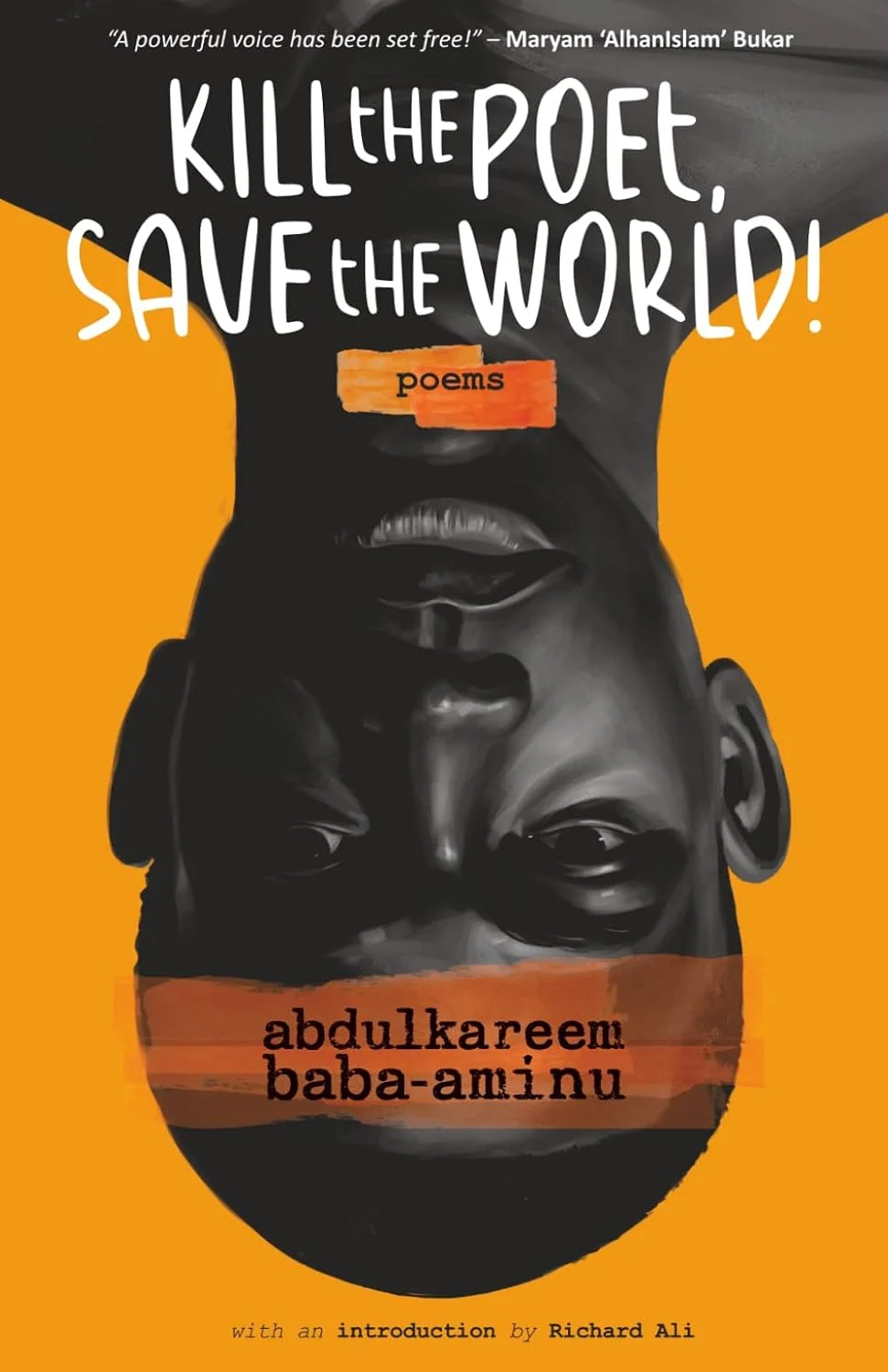
In the landscape of contemporary African literature, few debut collections have arrived with the intellectual volatility of Abdulkareem Baba-Aminu’s Kill the Poet, Save the World! With a title that serves as both a provocation and a manifesto, the Nigerian author has crafted a suite of thirty-five poems that traverse the intersections of speculative fiction, political critique, and raw, visceral memoir. By blending the cold precision of computer code with the warm, often painful frequency of the human heartbeat, Baba-Aminu challenges the reader to reconsider the role of the poet in a world rapidly accelerating toward an uncertain future.
The Speculative Impulse: Time, Fate, and the Paradox of Intervention
It is nearly impossible to encounter the book’s title without immediately summoning the cultural memory of "Save the cheerleader, save the world"—the iconic, high-stakes catchphrase from NBC’s cult-classic series Heroes (2006–2010). In the series, the survival of a single individual becomes the fulcrum upon which the fate of humanity balances. Baba-Aminu leans into this trope, not as a mere pop-culture reference, but as a gateway to exploring our deep-seated human obsession with fate and the desire to "fix" the past.
Much like the "time heists" of the Marvel Cinematic Universe or the transtemporal longing found in Diana Gabaldon’s Outlander, Baba-Aminu’s work utilizes the speculative lens to ask a fundamental, unsettling question: If we possessed the power to reach back into the currents of time and alter a single tragedy, would the resulting future be any brighter?
This thematic inquiry reaches its apex in the poem "The Past is Not a Place." Here, the speaker contemplates a hypothetical encounter with a young, innocent Abubakar Shekau—long before he would become the notorious face of the Boko Haram insurgency. Baba-Aminu’s prose captures a haunting ambiguity: he describes the future terrorist as "a softness, a potential." The speaker muses, "If I end this heartbeat now, will Chibok still sing? / Will the girls return home / in a different timeline, / braiding their hair / without ghosts in their fingers?" It is a chilling exploration of the temporal paradox, suggesting that our desire to prevent horror often forces us to confront our own capacity for violence.
The Chronology of Consciousness: From Civil War to Modern Tech
Baba-Aminu’s work acts as a bridge between Nigeria’s historical scars and its technological aspirations. His positionality is firmly rooted in the Africanfuturist school of thought, championed by visionaries like Nnedi Okorafor. Yet, he is not merely an observer of the future; he is an "engineer of consciousness."
- The Historical Foundation: In "An Elegy in Split Frequencies," the author confronts the lingering specters of the Nigerian Civil War. The poem serves as an exorcism of sorts, addressing the national trauma that remains etched into the country’s collective memory.
- The Technological Critique: In "The Genegineer," Baba-Aminu turns his gaze toward the ethics of genetic manipulation. While the poem acknowledges the seductive promise of fixing nature’s "flaws," it ultimately sounds a warning: in our pursuit of a perfect, engineered future, we risk eroding the very humanity that makes life worth preserving.
- The Ecological Toll: In "The Last Butterfly I Ever Saw," the author shifts toward ecocriticism, documenting the environmental decline of his homeland with a sharp, observant eye.
The Professional Critique: Why the Poet Must "Die"
One of the most provocative aspects of the collection is the author’s disdain for the insular nature of modern poetry. Throughout the titular poems—differentiated as "I," "II," and "Finale"—Baba-Aminu rails against the tendency of poets to engage in navel-gazing. He views contemporary poetry as an "endogamous activity," a closed loop that offers little to the society at large.
By likening the act of writing poetry to the act of writing code, Baba-Aminu suggests that the poet’s true function is not to be a passive observer, but to act as a prophet and an architect of social change. He calls for a restoration of the poet as a forward-facing figure, someone who helps "fashion society" rather than merely reflecting its vanity. It is a bold, uncompromising stance that challenges his peers to abandon the comfort of the ivory tower and enter the messy, unpredictable arena of public discourse.
Personal Vulnerability: A Memoir in Verse
While the collection is filled with grand, speculative, and political themes, its most devastatingly effective moments are deeply intimate. In 2024, Baba-Aminu survived a major car accident, an event that led to a protracted and harrowing experience with a failing medical system. While he previously explored these events in his journalism for the Daily Trust, he suggests that poetry serves as a more accurate vessel for such trauma.
Poems like "The Body Forgets" and "Clinical Findings After Two Harmattans" document his struggle with chronic pain and the feeling of betrayal by his own biology. In the meditation on mortality titled "Farewell," he writes:
"Call: What is a body when spared or betrayed?
Response: A rumour of light that the dark has mislaid."
This shift from the macro-political to the micro-personal provides the collection with its emotional gravity. It grounds the "engineer of consciousness" in the fragile reality of a physical body, reminding the reader that the "world" he seeks to save is made up of individuals who are often left behind by the very systems they inhabit.
Supporting Data and Literary Influences
The depth of Kill the Poet, Save the World! is further enriched by its linguistic texture. Baba-Aminu seamlessly weaves Hausa—the primary language of Northern Nigeria—into his English stanzas, creating a hybrid lexicon that reflects the linguistic reality of his home. This, combined with the vocabulary of military rule (a byproduct of Nigeria’s historical landscape) and scientific terminology, creates a dense, multi-layered reading experience.
Literary scholars will find clear echoes of the 13th-century mystic Rumi in his spiritual similes, as well as the profound influence of Rainer Maria Rilke. Specifically, Baba-Aminu seems to have adopted Rilke’s injunction from Letters to a Young Poet—that love is the ultimate trial and the "work for which all other work is just preparation."
Whether he is likening a failed romance to "computer malware" in "/pulse.exe" or expressing deep filial devotion in "For Yaya, For Everything," the author treats love not as a soft emotion, but as a rigorous, difficult, and essential discipline.
Implications for the Future of African Letters
The arrival of this collection signals a shift in the African literary canon. As the continent continues to grapple with the dual pressures of post-colonial legacy and rapid modernization, Baba-Aminu provides a blueprint for how to write about these challenges without descending into despair or didacticism.
By refusing to categorize himself strictly as a poet, a journalist, or a speculative fiction writer, Baba-Aminu invites a broader audience to engage with his work. Kill the Poet, Save the World! is a testament to the resilience of the human spirit in an age of algorithms. It is a book for the geeks, the mystics, the revolutionaries, and the romantics. It challenges us to look at our own "code"—our history, our medical traumas, and our failed loves—and realize that while we cannot change the past, we have the agency to determine what kind of "rumour of light" we leave behind in the dark.
In the final analysis, Baba-Aminu’s collection is an essential read for anyone interested in the future of the written word. It is a work that demands much from its reader, but in return, it offers a vision of the world that is as complex, flawed, and beautiful as the human beings who inhabit it.