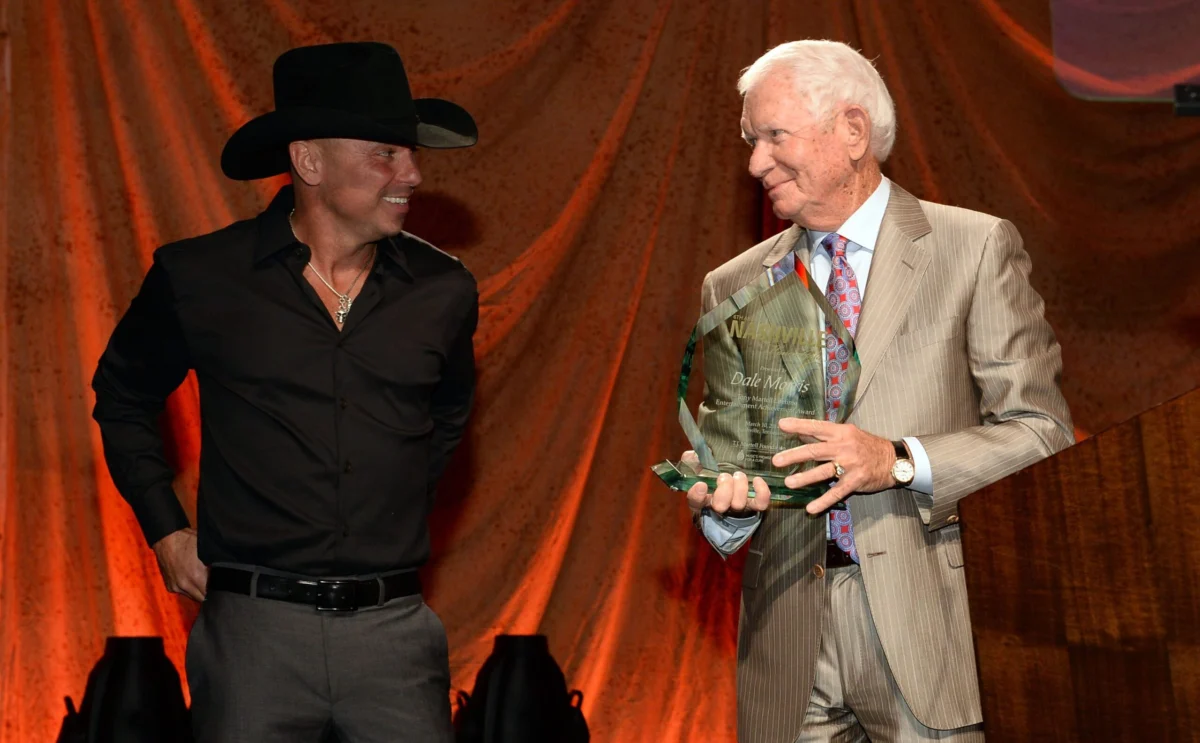
The landscape of country music as it exists today—defined by massive stadium tours, arena-sized production values, and crossover commercial dominance—owes an immeasurable debt to the vision of Dale Morris. A titan of the Nashville industry who transitioned from a songwriter into one of the most influential managers in the genre’s history, Morris passed away on Friday at the age of 89. His death, which a representative confirmed occurred peacefully in his sleep, marks the end of a transformative era in music management.
Morris was the architect behind the meteoric rise of the group Alabama and the man who steered Kenny Chesney from a promising newcomer to one of the most reliable stadium-filling superstars in music history. Beyond his client list, Morris was a pioneer of the "hands-off" management philosophy, a man who famously operated on handshake deals for decades, and an entrepreneur who understood that if the industry wouldn’t provide the tools for his artists to succeed, he would build them himself.
A Legacy Built on Instinct and Innovation
Dale Morris’s career was defined by a rare ability to spot latent potential and nurture it into global superstardom. He was not merely a manager who handled bookings or contract negotiations; he was a holistic strategist who reshaped how country artists interacted with their audience.
His partnership with Alabama, which began in 1979, remains a case study in effective artist development. Under Morris’s guidance, Alabama broke the mold of what a country band could be. By adopting the high-octane production values and technical standards typically reserved for rock-and-roll acts, Morris helped Alabama bring a stadium-rock energy to country music. The results were unprecedented: 33 No. 1 hits across the 1980s and 90s, three consecutive Entertainer of the Year awards from the Country Music Association, and five from the Academy of Country Music.
"He lived a big, bold, beautiful, blessed life, and I’m holding onto that right now," said Clint Higham, president of Morris Higham Management and Morris’s longtime protege and partner. "It’s the end of an era."
Chronology: From Songwriter to Industry Titan
To understand the scope of Morris’s impact, one must look at the arc of his professional life, which began far from the corner offices of Nashville’s elite management firms.
Early Days and Songwriting
A South Carolina native, Morris entered the music business through the creative side. In 1967, he tasted early success as a songwriter when Johnny Paycheck hit the Top 5 with the quirkily titled, "Don’t Monkey With Another Monkey’s Monkey." The experience provided him with a crucial insight: he preferred the mechanics of the business to the isolation of the writing room.
The Rise of the Entrepreneur
Morris pivoted to radio promotion for Little Darlin’ Records, a move that eventually led him to co-found Cartwheel Records alongside producer Ron Chancey. Their success with singer Billy “Crash” Craddock—who would remain Morris’s first management client for years—caught the attention of ABC, which eventually acquired the label. This acquisition provided the capital and the mandate for Morris to move full-time into the management and booking space, founding the International House of Talent.
The Alabama and Chesney Phenomena
It was in the late 1970s that Morris began managing Alabama, recognizing that their sound required a level of production support that Nashville lacked at the time. When he realized that external sound and lighting providers were hindering the band’s growth, he took a gamble: he purchased the sound system previously used by Bob Seger. This was the birth of Morris Leasing, which evolved into the industry powerhouse Morris Lighting + Sound.
In the 2000s, Morris repeated his success with Kenny Chesney. While many in the industry viewed Chesney as a standard country act, Morris saw the potential for a stadium phenomenon. Chesney’s transformation into the genre’s most consistent arena-filler was the result of Morris’s meticulous touring strategy and unwavering belief in the artist’s vision. Chesney would go on to earn four Entertainer of the Year awards, mirroring the success Morris had cultivated with Alabama decades prior.

Supporting Data: A Record of Excellence
Morris’s career was marked by consistent, high-level achievement that extended far beyond his two most famous clients. His roster included legends like Jerry Lee Lewis and Ricky Van Shelton, and in more recent years, the group Old Dominion.
His industry stature was solidified through numerous accolades:
- 2010: Induction into the International Talent Buyers Association (ITBA) Hall of Fame.
- 2014: Recipient of the T.J. Martell Foundation’s Tony Martell Lifetime Entertainment Achievement Award.
- Management Philosophy: Perhaps his greatest statistic was his retention rate. Despite a 45-year career, Morris famously never used formal, long-term contracts. His policy was simple: "You come with us, and if you want to leave us tomorrow, pay us what you owe us and out the door you go."
Official Responses and Personal Reflections
The outpouring of grief from the Nashville community highlights the profound personal influence Morris exerted on those around him. Clint Higham, who started as an intern under Morris and eventually became his business partner, credited his entire career to Morris’s mentorship.
"He was larger than life, and never met a dream he couldn’t build," Higham remarked. "He saw things in people—in me, in Kenny—and inspired everyone to reach beyond what we thought possible. Maybe it’s how much he loved life, loved his family, loved us."
The Morris family also released a statement, with his grandson, Zack Morris, reflecting on the patriarch’s long and full life. "We’re so blessed to have had 90 years with him as the patriarch of our family," he said. "Thank you to our music industry family and to his vast community of friends in Nashville, Boca, and beyond for loving him all these many years."
Morris was married to his wife, Earline, for 68 years. He is survived by Earline, his daughter-in-law Jennifer, four grandchildren—Zack, Colton, Nick, and Kendall—and two great-grandchildren, Mary Dee and Gus. He was preceded in death by his son, Tim.
Implications for the Industry
The passing of Dale Morris represents more than just the loss of a successful manager; it signals the closing of a chapter in music business history defined by personal relationships, handshake agreements, and the "boutique" management model.
In 2018, when Morris and Higham sold their booking agency to Paradigm Talent Agency (now The-Team), Morris maintained a cautious optimism about the industry’s shift toward corporate consolidation. In a 2018 interview with Pollstar, he explained his preference for staying small: "We’ve elected to stay small rather than to try to sign every act in the world. That way we were able to do what we were able to do and book and manage. Everybody seemed to be happy."
As Nashville continues to evolve into a global music hub, the "Morris way"—prioritizing deep, long-term artist development over rapid expansion—remains a gold standard for managers entering the industry. He proved that an artist’s career could be managed not just through numbers and spreadsheets, but through the courage to build the very infrastructure needed for the music to reach the masses.
A celebration of life for Dale Morris is being planned for this fall, with further details expected to be released in the coming weeks. For now, the Nashville music industry pauses to honor the man who, perhaps more than any other, helped turn country music into the stadium-filling, global force it is today.