

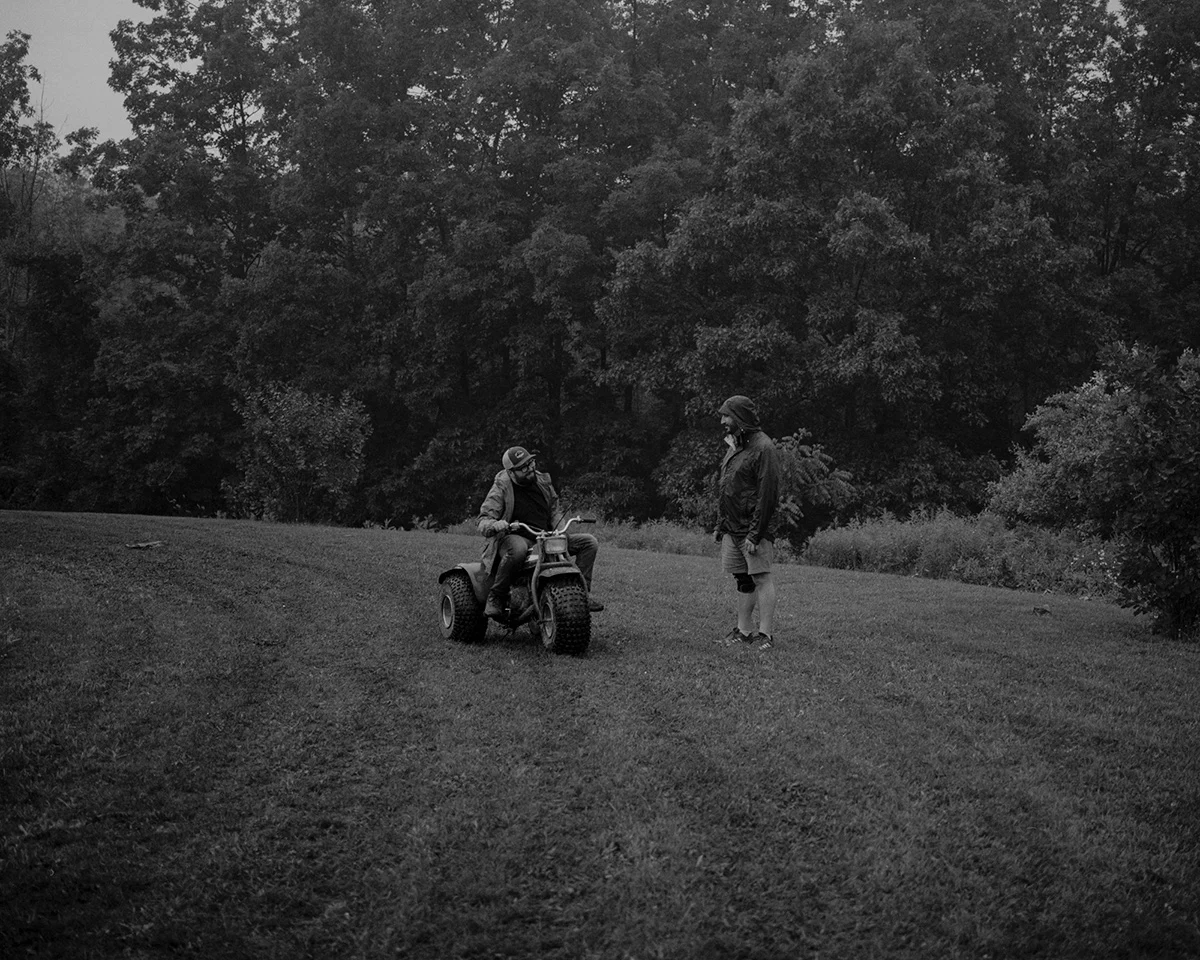
In the contemporary landscape of American fine art photography, few practitioners manage to bridge the chasm between the deeply personal and the universally resonant as effectively as New York-based artist Orpheus Acosta. Through a body of work that serves as both an autobiography and a sociological inquiry, Acosta has carved out a unique space that examines the "dysphoria of connection"—the haunting realization that in an age of hyper-connectivity, the human experience remains profoundly isolated.
Acosta’s latest project, Long Time Caller, First Time Listener, is not merely a collection of photographs; it is a meditation on the fragility of human signaling. By framing the act of expression as a radio broadcast sent into a void, Acosta explores the dissonance between our desire to be known and the reality of our inherent, quiet displacement.
I. Main Facts: The Anatomy of a Project
At its core, Long Time Caller, First Time Listener is a multi-media exploration rooted in the artist’s own history. Acosta, who was adopted at two months old into a Puerto Rican family, spent his formative years navigating the complexities of identity, belonging, and the search for origins. These themes are not peripheral to his work; they are the bedrock upon which his visual language is built.
The project employs a distinct aesthetic—muted tones, candid but alienated subjects, and urban spaces that feel simultaneously intimate and cavernous. Acosta, a graduate of SUNY Purchase with a BFA in Photography, uses his technical mastery to document environments that reflect internal states of being. The work posits that "dysphoria" is not a fleeting emotion or a dramatic spectacle, but an atmospheric condition of modern American life. It is the texture of the air between two people who are trying, but failing, to find a frequency on which they can truly meet.
II. Chronology: A Path Toward the Lens
To understand the emotional weight of Acosta’s work, one must trace the timeline of his personal and professional development.
The Early Search
Born in New York, Acosta’s initial interaction with the concept of "self" was disrupted by the circumstances of his adoption. For most of his childhood, his heritage was a question mark—a silent space in his biography. At age 16, this curiosity reached a tipping point. The pursuit of his biological history became the primary catalyst for his creative output. As he began to peel back the layers of his own narrative, he turned to the camera as a tool for stabilization.
Formal Education and Refinement
Acosta’s enrollment at SUNY Purchase marked a transition from intuitive documentation to critical inquiry. Within the rigorous environment of the BFA program, he began to contextualize his personal feelings of displacement within broader societal frameworks. He stopped viewing his camera as a simple recording device and began treating it as an investigative instrument—a way to map the "gaps" between people.
The Evolution of Long Time Caller
Following his graduation, Acosta spent years refining his visual style. He moved away from traditional portraiture, favoring a documentary approach that captures the "repetition of reaching out." Long Time Caller, First Time Listener emerged as the culmination of these years of observation. The project evolved from a series of disparate images into a cohesive narrative structure, mirroring the format of radio call-in shows—a medium defined by the hopeful, often lonely, attempt to be heard by an anonymous audience.
III. Supporting Data: The Sociology of the "Unreceived Signal"
While Acosta’s work is primarily artistic, it aligns with emerging sociological data regarding the "loneliness epidemic" in the United States. Recent studies by health organizations have noted that despite the proliferation of digital communication tools, feelings of social isolation have reached record highs.
Acosta’s work provides a visual corollary to this data. By documenting the "unstable" nature of understanding, he captures what sociologists often describe as the "mediated self." In his images, we see individuals who are physically present but emotionally distant—subjects caught in the act of waiting for a response that may never come.
The project’s title, Long Time Caller, First Time Listener, is a direct nod to the paradox of modern interaction. In radio culture, the "long time caller" implies a history of attempts, while the "first time listener" suggests a sudden, perhaps fragile, state of receptivity. Acosta applies this to the broader American experience: we are all constantly broadcasting our identities, yet we are rarely prepared to truly hear the broadcasts of others.
IV. Official Perspectives and Critical Analysis
Acosta has been clear about his intent: he is not interested in providing answers, but in documenting the friction of the process. In his own reflections, he notes, "Each image exists as both a call and an echo."
Critics have lauded the work for its restraint. Where other photographers might lean into the melodrama of isolation, Acosta maintains a clinical, almost hushed perspective. His images do not demand attention; they wait for the viewer to notice them, much like the radio signals they represent.
"The work is about the failure of systems," says one independent curator familiar with the series. "Acosta highlights how our institutions, our technology, and even our language promise us visibility. They tell us that if we speak, we will be seen. But Acosta shows us that the distance between intention and reception is often insurmountable. He makes that distance visible."
V. Implications: What It Means to Exist in the Gaps
The implications of Long Time Caller, First Time Listener extend far beyond the gallery wall. In a climate of intense political and social polarization, Acosta’s work serves as a reminder of the quiet, individual tragedy of disconnection.
The Erasure of Spectacle
Perhaps the most significant contribution of this body of work is the refusal to turn dysphoria into a spectacle. By framing it as an "atmosphere," Acosta suggests that this sense of displacement is not an anomaly to be fixed, but a foundational element of the human condition in the 21st century. It is the background noise of our lives.
Re-evaluating Connection
Acosta’s work forces the viewer to confront the "quiet recognition that connection is never guaranteed." This is a difficult pill to swallow in a culture that prides itself on networking, global connectivity, and the myth of the "always-on" individual. By stripping away the digital veneer, Acosta returns us to the physical reality of the space between two people. He asks: If we stop shouting to be heard, what remains?
A Legacy of Inquiry
As the project continues to evolve, it stands as a testament to the power of personal experience in shaping universal art. Acosta has successfully transformed his search for his own history into a mirror for a nation struggling to listen to itself. His photographs document not just the people he encounters, but the very act of existing within a culture where the promise of understanding is increasingly out of sync with the reality of our lives.
Conclusion: The Echo in the Void
Orpheus Acosta has created more than a series of photographs; he has created a space for reflection. Through his lens, we are invited to look at the gaps in our own lives—the moments where we reached out and felt the silence return.
In the final analysis, Long Time Caller, First Time Listener is a vital work of contemporary art because it acknowledges the pain of isolation without succumbing to cynicism. It offers a kind of grace in the struggle. It tells us that while the signal may be unstable, the act of reaching out remains necessary. We are all, in our own way, calling into the dark, hoping that someone, somewhere, is listening. And in the quiet, atmospheric tension of Acosta’s images, we find the comfort of knowing that we are not the only ones waiting for the echo.
About the Artist:
Orpheus Acosta is a photographer and videographer based in New York. His work has been featured in various exhibitions and publications, focusing on the intersections of identity, memory, and the American landscape. For more information on his current projects and to view his full portfolio, visit his website at orpheusacosta.com.









No comments yet. Be the first to join the conversation!