Nana Muazin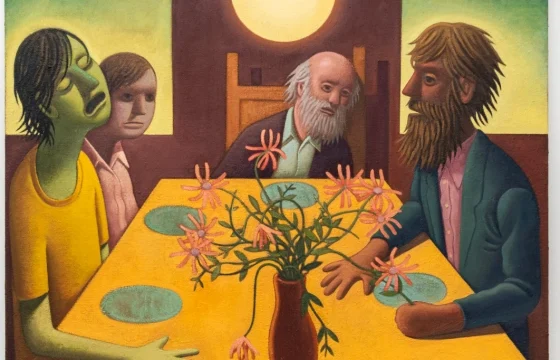
Introduction: A New Chapter at Hesse Flatow
HESSE FLATOW has officially unveiled Franklin, a profound and introspective exhibition featuring the latest paintings and works on paper by artist Nat Meade. Marking his third solo presentation with the gallery, the exhibition serves as a watershed moment in Meade’s career, inviting viewers into a meditative space where the mundane realities of fatherhood, sonship, and the academic life collide with the sublime weight of existential inquiry. The exhibition, which remains on view through April 18, 2026, acts as a visual diary of human endurance, bridging the gap between personal grief and the universal hope for renewal.
Thematic Foundation: Life’s Emotional Arc
At the heart of Meade’s practice is a rejection of the traditional portrait. His protagonists are not specific individuals captured in a static moment, but rather timeless archetypes—figures who embody the universal struggles of the human condition. Through his brushwork, Meade navigates the complex roles he occupies: the father nurturing a child, the son mourning a loss, the partner seeking connection, and the academic reflecting on history.
This allegorical distance is essential to Meade’s process. By stepping away from literal representation, he gains the freedom to explore personal challenges through a lens of the absurd, the somber, and the darkly humorous. His canvases serve as a theater of human nature, where the specificities of his life are sublimated into scenes that resonate with anyone who has grappled with the inevitability of change.
Chronology: The Genesis of ‘Franklin’
The genesis of this exhibition can be traced to a period of intense personal transformation for the artist. Following the recent passing of his father, Meade found himself in a state of deep reflection, forced to reevaluate the legacy he inherited and the role he now plays as a parent.
- The Period of Mourning: Early in the development of this body of work, the paintings were characterized by a preoccupation with vulnerability, pain, and the stark reality of mortality.
- The Shift in Perspective: As the creative process unfolded, the focus began to shift. The introduction of younger, more hopeful figures into the compositions marked a transition from grief toward reconciliation.
- The Final Curation: The current collection at HESSE FLATOW represents this complete arc—from the heaviness of the past to the light of the future—curated to guide the viewer through a narrative of healing.
Supporting Data: Symbolism and Art Historical Dialogue
Meade’s work is densely layered with art-historical and pop-cultural references, creating a rich tapestry for the viewer to decode. His symbolism is rarely accidental; it is a deliberate attempt to frame the personal within the legendary.
The Subconscious and the Supernatural
In the work Poise, a pair of legs dangles from a cloud. This image forces an immediate interrogation of the viewer’s perception: are we witnessing an ascension or a descent? This ambiguity serves as a metaphor for the thin, often blurred line between birth and death, physical life and spiritual transcendence. Ghostly specters, often depicted hovering over his subjects, represent the weight of inherited trauma—a visual manifestation of the past that refuses to stay buried.
Literary and Cinematic Influences
The exhibition’s title, Franklin, is a cryptic reference to the 1974 horror classic The Texas Chain Saw Massacre. While the connection may seem jarring, it serves as a crucial key to the show’s exploration of patriarchal dysfunction. By invoking a film known for its portrayal of a deranged, claustrophobic family, Meade acknowledges the "inner turmoil" inherent in lineage. He examines the violent and antagonistic impulses that can be passed down through generations, and the necessity of confronting those impulses to ensure they are not perpetuated.
Further classical and historical allusions ground the work in a broader tradition of struggle:
- Promethean Suffering: A vulture picking at a corpse serves as a visceral reminder of the eternal punishment of Prometheus, illustrating the cost of ambition and the pain of being bound to one’s own fate.
- The Blakean Mirror: A bearded figure crawling on hands and knees explicitly echoes William Blake’s Nebuchadnezzar, a figure consumed by the lust for power and subsequently reduced to a base, animalistic state.
The Contrast: Age, Innocence, and the Future
The most striking element of the Franklin exhibition is the distinct visual language Meade employs when contrasting adults with children.
The Burden of Adulthood
Meade’s adult figures are often depicted in states of tension, wrestling with the forces of their environment. In previous exhibitions, these figures were often victims of the elements—buffeted by turbulent winds or swallowed by crashing waves. They represent the "rocky history" that adults must carry.
The Radiance of Youth
Conversely, the younger figures in this exhibition occupy a space of harmony. One painting depicts a young boy steering a boat with a radiant torch; he is unburdened by the societal pressures that seem to weigh so heavily on the older figures. Another work captures an adolescent in a secluded cove, touching the sea floor. This moment of discovery—the tactile engagement with starfish and anemones—is a testament to childlike wonder.
Perhaps most poignant is the image of a father and son with their legs submerged in a shallow pool. The father is seen guiding the child, a tender act of mentorship that suggests the possibility of breaking the cycle of trauma.
Implications: A Turning Point for the Artist
The shift from the "turbulent waves" of his previous work to the "calmer seas" observed in Franklin is not merely a stylistic evolution; it is a philosophical one. Meade is signaling a maturation of his outlook. He recognizes that while the "insurmountable heaviness" of the past is real, it is not an end state.
The exhibition implies that the process of healing requires an active acknowledgment of one’s history. By documenting his own internal reconciliation, Meade offers a blueprint for the viewer. He suggests that by understanding the "rocky histories" we inherit, we can release future generations from those same burdens. This is the core of the exhibition’s "stubborn resilience"—the belief that even when faced with the darker impulses of the human heart, progress remains an attainable, if difficult, goal.
Conclusion: Resonance and Legacy
Nat Meade’s Franklin is more than a series of paintings; it is a profound testament to the power of art to process the complexities of human life. Through the careful balance of his personal narrative and universal archetypes, Meade invites the audience to confront their own histories. As the exhibition stands at HESSE FLATOW through April 2026, it serves as a vital reminder that mortality and trauma are not the final words. Instead, through the act of painting, Meade finds a way to look back at the past with clarity, and look toward the future with a quiet, tempered hope.
The work resonates because it is honest about the "ghostly specters" we all carry, yet it remains brave enough to depict the torch-bearing child, illuminating the path forward. In Franklin, Meade has crafted a mirror that, while reflecting the struggles of the past, ultimately reveals the strength of the human spirit to move beyond them.


 Asro
Asro
 Sagoh
Sagoh