

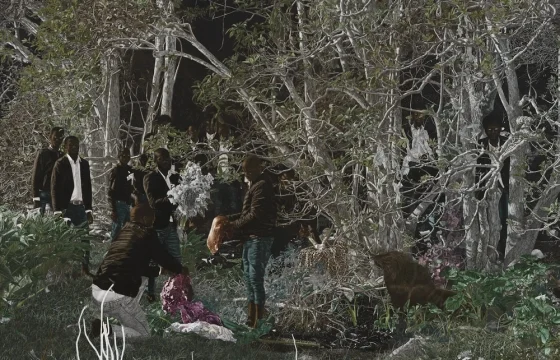
In the contemporary art landscape, few painters command the atmospheric gravity of South African artist Cinga Samson. His latest exhibition, Ukuphuthelwa, serves as a profound meditation on the limitations of sight and the boundless nature of the spiritual. The exhibition, which will remain on public view through April 18, 2026, presents a suite of new oil paintings that challenge the viewer to move beyond the act of "looking" and into the realm of "perceiving."
For Samson, the title of the exhibition is foundational. Derived from his native isiXhosa, Ukuphuthelwa translates to "unable to sleep." Yet, unlike the clinical, pathologized Western notion of "insomnia"—often viewed as a deficit of rest—the isiXhosa term carries no such negative weight. For the artist, this state is one of heightened spiritual alertness, a sensory sharpening that occurs specifically in the shroud of darkness. Through his signature palette of carbon, deep Prussian blues, and near-black tones, Samson invites us into a vast, nocturnal reality that is perpetually in motion.
Main Facts: The Aesthetics of the Shadow
The collection consists of a series of oil paintings that oscillate between the quotidian and the metaphysical. Subjects include elusive, figure-like silhouettes, dogs standing sentinel in overgrown fields, and detailed studies of indigenous South African flora.
Technically, Samson’s work is a masterclass in light manipulation—what he describes as a "magic trick." By applying thin glazes and strategically wiping back layers of pigment, he creates a flickering, unsteady visual rhythm across the canvas. He often leaves sections of his initial under-drawing exposed, granting the works a ghostly transparency that lends them a "brooding chromatic density." Perhaps most strikingly, Samson renders his human subjects without pupils. By leaving the eyes empty, he allows light to circulate through the canvas, effectively dissolving the boundary between the figure and the landscape. These are not portraits of individuals, but manifestations of "human" forms entirely enmeshed with the environment.
Chronology of the Creative Inquiry
The development of Ukuphuthelwa represents a multi-year intellectual journey for Samson, one that began with a fundamental existential quandary: how does an artist create a "true and honest" painting?
- Conceptual Foundation (2024): Samson begins exploring the gulf between the painted sign and the fluid, lived experience it attempts to capture. He arrives at the realization that a painting can never be an equivalent to reality; it can only ever be a relative symbol.
- The Execution Phase (2025): The artist produces the core works of the series, including Umlindo (Watcher), Imfihlo (Secret), and Intsingiselo (Meaning). During this period, he refines his technical process of utilizing unpainted pupils and exposed under-drawings to create his unique atmospheric effect.
- Public Exhibition (Early 2026): The collection is unveiled, showcasing works such as Tshee and Sithini ngelilitye, which distill the sensation of "mute enormity"—a quality of the sublime found in nature.
- The Ongoing Vigil (Through April 2026): The exhibition remains open to the public, facilitating a slow, contemplative engagement with the works, encouraging viewers to sit with the "existential gravity" inherent in the series.
Supporting Data: The Language of Interpretation
The power of Ukuphuthelwa lies in its insistence on the instability of language and visual symbols. Samson argues that there is an inevitable distance between a signifier and its referent—a "gulf that no image can close."
Consider, for example, the recurring motif of the dog in the painting Intsingiselo II (2026). A viewer might interpret the dog through a universal lens of loyalty and domesticity. However, an observer grounded in amaXhosa cosmology might perceive the animal as a spiritual guide or a protector representing ancestral presence. Samson does not aim to resolve this ambiguity; instead, he uses it to highlight how meaning slips through the interstices of different cultural and linguistic frameworks.
The titles of his works—enigmatic isiXhosa words—further emphasize this theme. When an isiXhosa word is translated into English, something is inevitably lost in the transition. This loss mirrors the gap between the painted image and the vast, unnameable reality it attempts to point toward. By titling his work in his mother tongue, Samson forces the viewer to acknowledge that the "knowable" is only a fraction of a much larger, darker, and more mysterious whole.
Official Responses and Artistic Philosophy
In interviews regarding the exhibition, Samson has been remarkably candid about his desire to move beyond the artifice of representation. He does not wish for his work to be a mirror of the world, but a bridge to the "unnameable."
"The ritual itself is not the important thing," Samson remarked regarding the ceremony depicted in his work Umlindo. "It’s an opening to what exists beyond."
By adopting the visual grammar of ritual—figures gathered with wildflowers and lengths of fabric—Samson speaks to a collective human need for orientation in the face of the unknown. He rejects the notion that the divine is an external entity, preferring to find the sublime in the vernacular of everyday objects and landscapes. Whether it is the brilliant, moon-washed cloud in Tshee or the foreboding rocky crag in Sithini ngelilitye, Samson’s subjects possess an "energy" that oscillates between the approachable and the overwhelming. As he notes, "The sky can be so friendly, but sometimes so heavy, dark, so scary. It’s the same energy, but it exists in different forms."
Implications: The Sublime in the Ordinary
The implications of Ukuphuthelwa for the contemporary art world are significant. In an era where digital saturation often demands instant consumption and clear-cut narratives, Samson’s work demands a radical slowing down. He asks the viewer to adopt a state of "hypersensitivity," where even the most mundane elements of existence—a bird in flight, a field of grass, a dark sky—possess the potential to elicit wonder.
By stripping away the pupils of his figures, Samson ensures that his subjects are not "looking" at us in the traditional sense; they are "knowing" from within. They are part of a shared, subterranean knowledge that connects the viewer, the artist, and the landscape. The exhibition posits that true "honesty" in painting is not achieved through perfect replication, but through the courage to admit that the image is insufficient.
In this sense, Ukuphuthelwa is an act of liberation. It frees the artist from the burden of representing the "whole truth" and frees the viewer from the expectation of finding a static answer. Instead, the exhibition provides a space for the sublime to manifest. By acknowledging the limits of his medium, Samson achieves something far more profound: a connection to what he calls "everything"—the vast, interconnected mystery that links the material world to the divine.
As the exhibition continues its run through April 18, 2026, it remains a testament to the idea that the dark, the unnameable, and the "unable to sleep" are not states to be feared or cured, but portals through which we might catch a glimpse of the infinite. In the quiet, flickering light of these paintings, the viewer is invited to join the vigil, finding in the shadows a sense of orientation that is as unsettling as it is deeply, fundamentally true.










No comments yet. Be the first to join the conversation!